
Chemotion ELN
Chemotion ELN is a web-based electronic laboratory notebook for research data, with a focus on chemistry.
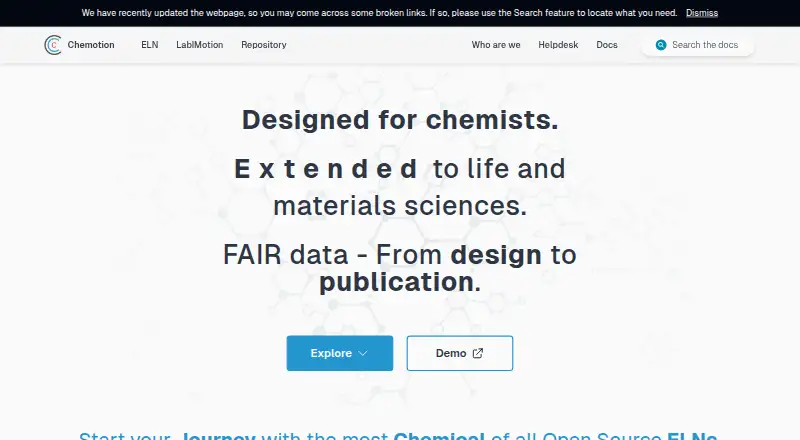
What Chemotion ELN is
Chemotion ELN is a web-based electronic laboratory notebook for research data, with a focus on chemistry. It organizes projects in collections and supports sample, reaction, wellplate, research-plan, QR code, barcode, and analytical-data records through ChemSpectra. Sample records can capture molecular structure, amount, and properties such as purity; reaction records can include conditions and products. Instrument data, including examples from NMR, GC, and LC, can be brought in by email, networked storage, or manual transfer. Institutions, universities, and research groups can install the ELN on their own IT facilities, with Docker-based installation documented. Academic researchers can use the project freely. The system connects to Chemotion Repository for transfer of selected information and supports OpenStats and a TLC Image Annotation Tool. It requires a network connection and has no standalone version. Chrome is recommended; some functionality is limited in Firefox and Edge. A free demonstration instance is available for time-limited evaluation, but data may be lost and some functions are unavailable.
Good
- Free use by academic researchers is a project principle.
- Supports detailed sample and reaction records.
- Can be installed on institutional IT facilities.
- Instrument data can be added through several methods.
- Offers repository connection and third-party tools.
Watch out
- Requires a network connection; no standalone version.
- Chrome is recommended; some Firefox and Edge functions are limited.
- Demo data may be lost.
- Versioning and auditing systems are still being worked on.
Who it suits
It is aimed initially at chemists and has also drawn interest from fields such as biochemistry. It may suit research groups or institutions that can host a web-based notebook and maintain its installation.
Verdict
Chemotion ELN supports chemistry-focused research records and institution-hosted deployment, with options for sharing selected data and handling instrument information. Consider the network, browser, installation, and audit limitations when evaluating it.
The facts
Each one read from Chemotion ELN's own pages, with the date it was checked.
What it does
- Academic access
- The project describes free access and use by academic researchers as one of its principles.checked 5 Oct 2026
- Audit limitations
- The FAQ says versioning and auditing systems are currently being worked on.checked 5 Oct 2026
- Authentication
- Authentication options include database login and configurable third-party providers such as Shibboleth, OpenID Connect, ORCID, GitHub, and NFDI AAI; the page says database passwords are hashed.checked 5 Oct 2026
- Demo
- A freely available test version is offered for demonstration and time-limited evaluation; the page cautions that data may be lost and some functions are unavailable.checked 4 Oct 2026
- Deployment
- For routine use, groups, institutions, or universities can install Chemotion ELN on their own IT facilities using ChemCLI or a manual installation.checked 5 Oct 2026
- External tools
- The documentation lists OpenStats and a TLC Image Annotation Tool as supported third-party applications, which administrators can configure to receive compatible datasets.checked 5 Oct 2026
- Instrument data
- Device data can be collected through email, networked storage, or manual transfer, with documented examples covering analytical instruments including NMR, GC, and LC.checked 5 Oct 2026
- Integrations
- The ELN supports OpenStats and a TLC Image Annotation Tool as third-party applications.checked 4 Oct 2026
- Intended users
- The project says the ELN was initially targeted at chemists and has attracted interest from other fields, particularly biochemistry.checked 4 Oct 2026
- Network requirement
- Chemotion ELN is web based and requires a network connection; the FAQ says there is currently no standalone version.checked 4 Oct 2026
- Operating requirements
- Suggested minimum installation resources are 4 x64 CPUs, 8 GB memory, and 300 GB disk for the operating system, Docker, and ELN, plus at least 100 GB for each attached device.checked 5 Oct 2026
- Purpose
- Chemotion ELN is an open-source electronic laboratory notebook for research data management, initially aimed at chemists and also used by researchers in fields including biochemistry.checked 5 Oct 2026
- Reactions
- Users can document reactions involving samples and record reaction conditions and products.checked 4 Oct 2026
- Repository connection
- The ELN can connect to the Chemotion Repository to transfer selected research information for sharing and archiving.checked 4 Oct 2026
- Research records
- The ELN organizes projects in collections and supports samples, reactions, wellplates, research plans, QR codes, barcodes, and analytical data through ChemSpectra.checked 5 Oct 2026
- Sample records
- Sample records can include molecular structure, amount, and compound properties such as purity.checked 4 Oct 2026
- Security
- The documentation says Chemotion passwords are encrypted and describes password hashing for database authentication.checked 4 Oct 2026
- Sharing
- Accounts belong to individual users, while sharing elements and assigning roles is possible through shared and synchronized collections.checked 5 Oct 2026
- Support
- Users can contact the team through the Helpdesk, and the project offers a live demo and Q&A session every three months plus introductions or group workshops on request.checked 5 Oct 2026
- Support and maintenance
- The team recommends upgrading an instance at least once every three months to receive new features, bug fixes, and security patches.checked 4 Oct 2026
- Supported host systems
- ChemCLI builds are listed for Linux amd64, Windows amd64, macOS Apple silicon, and macOS amd64; Docker Engine and Docker Compose are required.checked 5 Oct 2026
Where it runs
- Browser limitation
- Chrome is recommended; Firefox and Edge have limited functionality in some areas, including collection management and ChemSpectra.checked 4 Oct 2026
- Network and browser
- Chemotion ELN is web-based, requires a network connection, and recommends Chrome; the documentation says some functionality is limited in Firefox and Edge.checked 5 Oct 2026
Money
- Free access
- The project states that free access and free use by academic researchers is one of its principles.checked 4 Oct 2026
Alternatives to Chemotion ELN
- 1

SciNote
Free planOpen sourceAndroidiOSWebAPI8.5From $0.01 a year - 2

eLabFTW
Free planOpen sourceWebAPILinuxmacOS8.2From €3,000 a year - 3

LabArchives
Free planAndroidiOSWebAPI8.2From $99 a year - 4
RSpace
Free planOpen sourceWebAPILinuxmacOS8.2From $6,000 a year - 5
LabCollector ELN
Free planAndroidiOSWebAPI8.0Free plan - 6
Sapio ELN
Free planWebAPISelf-hosted6.7Free plan