
LabArchives
LabArchives is a suite of online tools for recording research data and managing laboratory work.
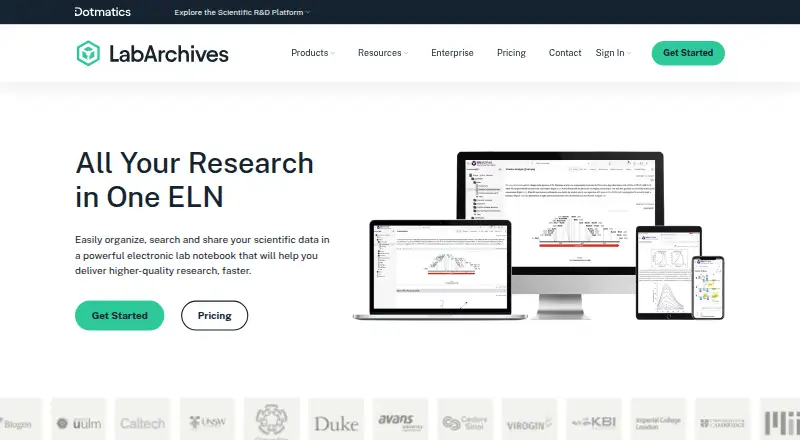
What LabArchives is
LabArchives is a suite of online tools for recording research data and managing laboratory work. Its ELN for Research helps scientists record, organize, search, and share scientific data. Separate tools handle laboratory inventory and samples, or scheduling equipment and other resources. The ELN includes more than 20 built-in widgets and allows custom widgets; listed integrations include GraphPad Prism, SnapGene, REDCap, Jupyter, and Protocols.io. LabArchives offers a free plan with two owned notebooks, 1GB of storage per user, and a 25MB file limit. Professional Academic costs $330 a year per user and includes unlimited owned notebooks, 100GB per user, and a 250MB file limit. The service runs in browsers on Windows, macOS, and Linux, and the ELN supports mobile-browser capture of images, video, and audio. Android users can also access a browser-based session through the app. LabArchives lists audit trails, electronic signatures, approval workflows, offline access, and PDF or read-only offline HTML in ZIP exports.
Good
- Free plan includes two owned notebooks and 1GB per user.
- ELN supports more than 20 built-in and custom widgets.
- Listed integrations include REDCap, Jupyter, and SnapGene.
- Supports audit trails, electronic signatures, and approval workflows.
- Exports to PDF or read-only offline HTML in ZIP.
Watch out
- Free plan limits storage to 1GB per user.
- Free plan limits files to 25MB each.
- Professional Academic costs $330 a year per user.
Who it suits
LabArchives suits research groups that need a shared electronic notebook alongside tools for inventory or equipment scheduling. Its browser and mobile options may also suit teams working across desktop and mobile devices.
Verdict
LabArchives combines research documentation with inventory and resource scheduling tools. The free plan has specific notebook, storage, and file-size limits, while paid plans increase storage and notebook capacity.
Plans and prices
From LabArchives's own pricing page, checked 1 Oct 2026.
| Plan | Price | What it gives you |
|---|---|---|
| Free | Free | 2 owned notebooks · 1GB per user · 25MB file limit · SnapGene & GraphPad Prism integrations · Free |
| Inventory Free Trial | Free | 90-day trial · ELN integration · Custom inventory categories and storage locations |
| Inventory Free | Free | ELN for Research integration · Custom inventory categories · Custom storage locations · Free for 90 days |
| Free ELN | Free | 2 owned notebooks · 1GB storage per user · 25MB file limit · SnapGene and GraphPad Prism integrations |
| ELN for Education | Priced on request | Course management tools · per student / term |
| Inventory Paid Academic | $99 a year | ELN integration · Custom categories and locations · Parent/child item relationships · per user per year |
| Inventory Academic | $99 a year | ELN for Research integration · Custom inventory categories · Custom storage locations · Parent/Child item relationships · per user per year |
| Inventory Paid Corporate | $199 a year | ELN integration · Custom categories and locations · Parent/child item relationships · per user per year |
| Inventory Corporate | $199 a year | ELN for Research integration · Custom inventory categories · Custom storage locations · Parent/Child item relationships · per user per year |
| Professional ELN Academic | $330 a year | Unlimited owned notebooks · 100GB storage per user · 250MB file limit · NIH data-management support · per user per year |
| Professional Academic | $330 a year | Unlimited owned notebooks · 100GB per user · 250MB file limit · NIH Data Management Mandates & Sharing support · per user per year |
| ELN + Inventory Academic | $360 a year | Professional features · Inventory application · Unlimited inventory items · Reagent links and automatic debit · per user per year |
| Professional ELN Corporate | $575 a year | Unlimited owned notebooks · 100GB storage per user · 250MB file limit · NIH data-management support · per user per year |
| Professional Corporate | $575 a year | Unlimited owned notebooks · 100GB per user · 250MB file limit · NIH Data Management Mandates & Sharing support · per user per year |
| ELN + Inventory Corporate | $675 a year | Professional features · Inventory application · Unlimited inventory items · Reagent links and automatic debit · per user per year |
| Enterprise ELN | Priced on request | Unlimited storage · 16GB per-file limit · SAML SSO · Developer API · SLA option · Dedicated success manager |
The facts
Each one read from LabArchives's own pages, with the date it was checked.
Where it runs
- Android app
- Android users can install a LabArchives app from Google Play that wraps the browser-based session.checked 1 Oct 2026
- Browser platforms
- LabArchives can be accessed through a browser on Windows, macOS and Linux devices.checked 1 Oct 2026
What it does
- API access
- The LabArchives API is restricted to Enterprise and Enterprise Plus licensees; Inventory API keys require an account and granted API access.checked 14 Oct 2026
- API release
- A Scheduler API for pulling data was introduced in the December 7, 2022 feature release and is enterprise-only.checked 14 Oct 2026
- Audit trail
- ELN revision history records who changed an entry, when it changed, and what changed, with immutable timestamps and file backups.checked 14 Oct 2026
- Collaboration
- Users can work simultaneously on notebook pages, comment and tag colleagues, share selected notebook content, and publish through links or DOIs.checked 14 Oct 2026
- Documentation depth
- The Help Center contains onboarding guides, videos, browser and mobile guidance, administration articles, integration instructions, accessibility guidance, and feature-release archives.checked 14 Oct 2026
- ELN notebooks
- The research ELN records notes, tables, hyperlinks, HTML, media, Office documents, arbitrary file types, equations, chemical sketches, image annotations, and PubMed references.checked 14 Oct 2026
- ELN purpose
- The ELN for Research records, organizes, searches and shares scientific data.checked 1 Oct 2026
- Encryption and availability
- The service states that data uses TLS 1.3 in transit and AES-256 at rest, with bi-hourly backups or real-time replicas and geographically separate AWS facilities.checked 14 Oct 2026
- GraphPad integration
- GraphPad Prism 8 or newer can save files into LabArchives notebooks and preserve version history when files are rearchived.checked 14 Oct 2026
- Independent backup claim
- UTSA states that LabArchives performs daily backups and data-integrity checks, including corruption checks on uploaded files.checked 14 Oct 2026
- Integrations
- Official integrations include SnapGene, GraphPad Prism, Geneious, Proofig AI, iChemLabs, Jupyter, REDCap, Protocols.io, Microsoft tools, Google tools, Box, OneDrive, Dropbox, Figshare, PubMed, and learning-management systems.checked 14 Oct 2026
- Inventory
- The Inventory product tracks supplies and samples, supports custom locations and categories, and links reagent usage to ELN experiments.checked 14 Oct 2026
- Limit: computational fit
- The University of Texas at San Antonio advises that LabArchives may not suit research centered mainly on code, simulation, or modeling.checked 14 Oct 2026
- Limit: file size on G2
- A G2 reviewer reports that a 100MB file-size cap can make file management difficult.checked 14 Oct 2026
- Limit: usability on Capterra
- Another Capterra reviewer calls the interface unintuitive and confusing and says it has fewer functions than a preferred alternative.checked 14 Oct 2026
- Mobile access
- The ELN is optimized for mobile browsers and supports direct image, video and audio capture.checked 1 Oct 2026
The company
- Company facts
- LinkedIn lists LabArchives as a privately held software-development company headquartered in San Marcos, California, with 11–50 employees.checked 14 Oct 2026
- Company scale
- LabArchives says its platform serves about 750,000 scientists in academic, nonprofit, and commercial organizations.checked 14 Oct 2026
- Founded
- G2 lists LabArchives as serving customers since 2009, the company’s stated founding year.checked 14 Oct 2026
- Headquarters
- Boston, Massachusetts, United Stateschecked 28 Sep 2026
- Legal name and owner
- Crunchbase identifies the legal entity as LabArchives, LLC and lists it as acquired by Dotmatics.checked 14 Oct 2026
Money
- Limit: price on Capterra
- A Capterra reviewer says the group changed to a cheaper product because LabArchives created financial strain.checked 14 Oct 2026
The full review of LabArchives
Overview
LabArchives is a research documentation suite with separate tools for electronic lab notebooks, inventory and equipment scheduling. It best suits academic and commercial research teams that need scientific records alongside lab operations; users wanting only a simple notebook may find its broader product range unnecessary.
Key features
The ELN for Research records, organizes, searches and shares scientific data. More than 20 built-in widgets and support for custom widgets give teams ways to structure records around their work, while integrations with GraphPad Prism, SnapGene, REDCap, Jupyter and Protocols.io help connect the notebook with named research tools.
Inventory organizes, tracks and orders lab supplies; Scheduler handles equipment and resource scheduling. Combined ELN and inventory plans go further by linking reagents to experiments and automatically debiting inventory items. That makes the suite more relevant to labs managing both records and materials than to teams seeking just one of those functions.
Audit trails, electronic signatures, approval workflows, offline access and API access support controlled recordkeeping and operational flexibility. Records can be exported as PDF or read-only offline HTML in a ZIP file. LabArchives states that it holds FedRAMP, SOC 2 and ISO 27001 certifications, supports HIPAA and GDPR requirements, and is compliant with 21 CFR Part 11, HIPAA and NIST 800-171.
Browser access works on Windows, macOS and Linux. The ELN is optimized for mobile browsers and supports direct image, video and audio capture; the Android app wraps the browser-based session. LabArchives also offers a Help Center, application support staff and regular training webinars.
Pricing
The Free plan costs nothing and includes two owned notebooks, 1GB per user, a 25MB per-file limit, and SnapGene and GraphPad Prism integrations. It is a useful entry point for a small individual workload, but the notebook, storage and file caps may constrain larger or media-heavy projects.
Inventory Free costs nothing for 90 days and includes the ELN for Research integration, custom inventory categories and custom storage locations. Its 90-day term makes it a limited way to assess inventory workflows rather than an ongoing free option.
ELN for Education costs from $25 (priced on request), billed per student per term, and includes course management tools. It is aimed at teaching use rather than a lab team's general annual licensing. Inventory Academic and Inventory Corporate each cost $99 a year and $199 a year, respectively, billed per user per year. Both include ELN integration, custom categories and storage locations, and parent/child item relationships.
Professional Academic costs $330 a year per user; Professional Corporate costs $575 a year per user. Both offer unlimited owned notebooks, 100GB per user, a 250MB file limit, and support for NIH Data Management Mandates & Sharing. These tiers remove the Free plan's notebook and storage constraints, though the higher corporate price matters when licensing multiple users.
ELN + Inventory Academic costs $360 a year per user, while ELN + Inventory Corporate costs $675 a year per user. Both include the Inventory application, unlimited inventory items, reagent-to-experiment links and automatic inventory debiting. They suit users who need inventory integrated into their notebook workflow rather than only inventory management.
Enterprise ELN has custom pricing and includes unlimited storage, files up to 16GB, advanced security and usage reports, SAML SSO, a Developer API, an uptime guarantee and SLA, and a dedicated success manager. Its enterprise controls and much larger file allowance address needs beyond the per-user Professional caps.
Platforms
LabArchives supports Android, iOS, Linux, macOS, web and Windows, as well as API access. Browser access on desktop operating systems and mobile capture broaden where records can be entered, although Android access through the app remains a browser-based session.
Who it's for
Academic researchers, nonprofit and commercial organizations are the stated user base; LabArchives says it serves 750,000 scientists. Its education tier also targets courses. The strongest fit is a lab that values searchable research records and may want inventory or scheduling in the same suite. A team needing only a basic notebook, or unwilling to work within per-user storage and file limits, should compare alternatives.
Pros and cons
- Pros: Notebook, inventory and scheduling tools cover connected lab work rather than records alone.
- Pros: Free entry includes two notebooks and integrations with SnapGene and GraphPad Prism.
- Pros: Compliance claims, audit trail, signatures and approval workflows suit teams with formal recordkeeping needs.
- Cons: Free storage is capped at 1GB per user and files at 25MB, which limits larger datasets or media.
- Cons: Professional plans cost $330 a year per user for Academic and $575 a year per user for Corporate; multi-user teams should account for seat-based pricing.
- Cons: Inventory Free lasts only 90 days, so it does not provide a permanent no-cost inventory tier.
Alternatives
For a wider category comparison, browse Electronic Lab Notebook Software or Equipment Scheduling Software.
LabCollector ELN has a free Startup Pack for three users and 1,000 data records. Labfolder has a free plan and pricing based on user count by quote. eLabFTW offers free self-hosted software under AGPLv3, with server hosting and administration required. NETVIBES is another option with an Enterprise Data Science plan. SciNote has a free plan for one user and a dedicated workspace, with no guaranteed support. Benchling Notebook offers a free academic plan covering Notebook and Molecular Biology. LabKey ELN is another freemium option. ELabELN offers unlimited users with no per-seat fees.
Verdict
Choose LabArchives if your lab wants research documentation with inventory and resource scheduling available in one suite, especially when compliance-related controls matter. Its main trade-off is the recurring per-user cost for expanded notebook capacity and the Free plan's tight storage and file limits; teams that need a narrower or self-hosted tool should compare alternatives.
Getting started
- Visit the LabArchives website.
- Choose a plan, including the Free plan if its limits fit your needs.
- Use a browser on Windows, macOS, or Linux, or access the service through a listed mobile platform.
- For Android, install the app from Google Play.
Limits worth knowing
The Free plan has 1GB total storage, two owned notebooks, and a 25MB per-file limit. Professional plans include 100GB per user and a 250MB per-file limit. Inventory Free is billed free for 90 days.
Questions
Is there a free plan?
Yes. The Free plan is free and includes two owned notebooks, 1GB per user, and a 25MB file limit.
What does Professional Academic cost?
It costs $330 a year per user. It includes unlimited owned notebooks, 100GB per user, and a 250MB file limit.
Is a free trial available?
Yes, LabArchives lists a free trial. Inventory Free is listed as free for 90 days.
Which platforms can I use?
LabArchives is listed for Android, API, iOS, Linux, macOS, web, and Windows. Browser access is available on Windows, macOS, and Linux.
What applications are included?
The suite includes an ELN for Research, Inventory, and Scheduler. The ELN records, organizes, searches, and shares scientific data; Inventory tracks and orders supplies; Scheduler manages lab equipment and resources.
Which integrations are listed?
LabArchives lists GraphPad Prism, SnapGene, REDCap, Jupyter, and Protocols.io integrations.
Alternatives to LabArchives
- 1

HireHop
Free planAndroidiOSWebAPI8.2Free plan - 2
Booqable
AndroidiOSWebAPI7.7From $29 a month - 3

Rentman
AndroidiOSWebAPI7.7 - 4
WebCheckout
AndroidiOSWebAPI7.6From $400 a month - 5

Rentablez
AndroidiOSWeb7.4From $29 a month - 6
Sonderplan
Free planAndroidiOSWebAPI7.4Free plan