
ScenePaper
ScenePaper is a browser-based project OS for film, television, and content work from development through wrap, with tools for finding and hiring crew.
What ScenePaper is
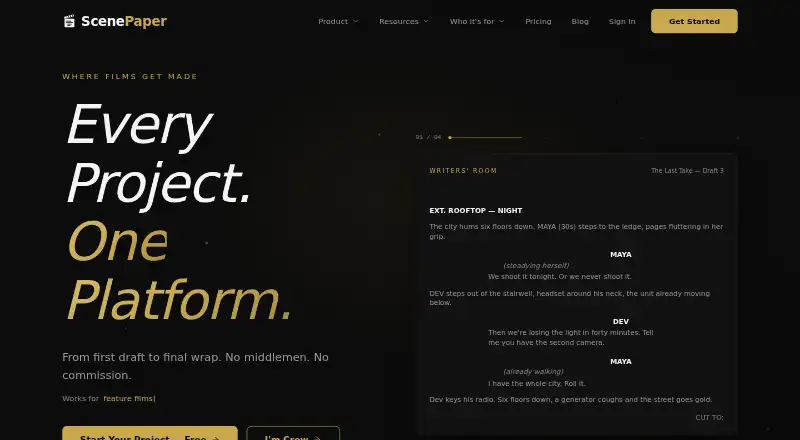
ScenePaper is a browser-based project OS for film, television, and content work from development through wrap, with tools for finding and hiring crew. The Writers' Room supports Fountain screenwriting, revision colours, collaboration, sides, and formatted PDF export. Production features include script breakdowns, stripboard scheduling, Day Out of Days, shot lists, storyboards, budgets, call sheets, daily reports, and department hubs. Supported work ranges from Reels, TikToks, and YouTube content to music videos, ads, documentaries, short films, OTT series, and features. Crew Cards are reviewed by administrators and include verified filmography and peer vouching; the platform takes no commission on hires arranged through it. Google sign-in and Calendar sync are available when connected. A developer API provides crew search, crew-call management, and analytics access, with rate limits of 60 requests per minute on Standard and 600 on Pro. ScenePaper says data in transit uses TLS and servers are in Mumbai on AWS ap-south-1, while uploaded files are stored on Cloudflare R2. Users can export or delete data from The Booth, and scripts use open Fountain plain text. The service runs in a browser, not offline, and has no service-level availability guarantee. Its plan is free.
Good
- Free plan includes every tool and every seat.
- Supports writing, breakdowns, scheduling, budgets, and call sheets.
- Crew Cards include reviewed filmography and peer vouching.
- Scripts use open Fountain plain text.
Watch out
- Runs in a browser rather than offline.
- Terms provide no service-level availability commitment.
- No mobile app platform is listed.
Who it suits
ScenePaper suits film, television, and content teams needing writing, production planning, and crew discovery tools. It may also fit developers who need programmatic access to crew search, calls, or analytics.
Verdict
ScenePaper brings script development, production workflows, and crew discovery into a free browser-based service. Its offline and availability limits are worth noting for teams planning their workflows.
Plans and prices
From ScenePaper's own pricing page, checked 14 Oct 2026.
| Plan | Price | What it gives you |
|---|---|---|
| Free | Free | Every tool · every seat · unlimited screenplays · 15 script templates · No paid tier; no trial countdown; no credit card |
The facts
Each one read from ScenePaper's own pages, with the date it was checked.
What it does
- API
- The developer API provides programmatic crew search, crew-call management, and analytics access with scoped bearer-token keys.checked 30 Sep 2026
- API gateway
- API requests must use the gate.scenepaper.com gateway; direct backend access is not supported.checked 14 Oct 2026
- API limits
- The developer page lists 60 requests per minute for Standard and 600 per minute for Pro.checked 14 Oct 2026
- Availability limit
- ScenePaper's terms state that there is no service-level commitment or guarantee that features or platform availability will continue.checked 30 Sep 2026
- Budgeting
- Budgets include cost reports and change orders routed through an approval chain.checked 14 Oct 2026
- Call sheets
- Call sheets are generated from schedules and include revisions, read receipts and turnaround compliance checks.checked 14 Oct 2026
- Crew marketplace
- Productions can search verified crew, publish crew calls, track submissions, issue contracts and record wrap reports.checked 14 Oct 2026
- Data location
- Primary servers are stated to be in Mumbai on AWS ap-south-1, while uploaded files use Cloudflare R2.checked 14 Oct 2026
- Data portability
- Scripts use open Fountain plain text, and users can download PDFs or request a full account export.checked 14 Oct 2026
- Data storage
- ScenePaper says its servers are in Mumbai, India on AWS ap-south-1 and uploaded files are stored on Cloudflare R2.checked 30 Sep 2026
- Department workflows
- Dedicated hubs are listed for art, VFX, sound and post-production.checked 14 Oct 2026
- File compatibility
- Final Draft files can be imported and scripts can be exported as FDX.checked 14 Oct 2026
- Formats
- ScenePaper supports Instagram Reels, TikToks, YouTube Shorts and videos, music videos, ad films, documentaries, short films, OTT series, and feature films.checked 30 Sep 2026
- Hiring fees
- ScenePaper says it charges zero commission, finder's fee or percentage on hires arranged through the platform.checked 14 Oct 2026
- Integrations
- The privacy policy identifies Google sign-in and Google Calendar as connected third-party services.checked 14 Oct 2026
- Legal operator
- Terms identify Geenesh S, an individual in India, as the builder and operator rather than a company.checked 14 Oct 2026
- Limit: offline use
- ScenePaper acknowledges that it runs in a browser rather than offline.checked 14 Oct 2026
- Limit: payments
- The service does not handle payments, payroll, insurance or liability for equipment rentals.checked 14 Oct 2026
- Limit: product maturity
- The pricing page says ScenePaper is young and some tools may be less refined than dedicated alternatives.checked 14 Oct 2026
- Limit: service guarantee
- The terms provide no service-level commitment and do not guarantee that features or platform availability will continue.checked 14 Oct 2026
The company
- Founded
- The opened official pages do not state a founding year.checked 14 Oct 2026
- Funding and ownership
- The opened official pages describe an independent individual project and do not state outside funding or corporate ownership.checked 14 Oct 2026
- Headquarters
- The operator gives Coimbatore, Tamil Nadu, India as the operating and postal location.checked 14 Oct 2026
- Maker role
- The author page describes Geenesh S as founder and sole operator who designed and wrote the platform end to end.checked 14 Oct 2026
The full review of ScenePaper
ScenePaper is a browser-based project workspace for film, television, and online video, spanning script development, production planning, and crew hiring. It suits teams that want those stages together and can rely on an internet connection. Its free access to every tool and seat is a strong starting point, though the service offers no availability guarantee and no offline mode.
Overview
ScenePaper covers work from development through wrap, with tools for both creative preparation and production coordination. Its range of supported formats runs from Reels, TikToks, and YouTube videos to music videos, documentaries, OTT series, and feature films. That breadth makes it relevant to teams working across short-form and longer productions; it does not, on the stated terms, promise continuity of service or offline access, so it is a poor fit for workflows that must keep running without a connection.
Key features
Writing and production planning
The Writers' Room supports Fountain scripts, revision colours, collaboration, sides, and formatted PDF export. For productions moving from script to schedule, ScenePaper adds breakdowns, stripboard scheduling, Day Out of Days, shot lists, storyboards, budgets, call sheets, daily reports, and department hubs. This is an unusually broad workflow in one service, useful for teams trying to keep planning materials together rather than spread across separate tools.
Crew discovery and API
Crew Cards are reviewed by administrators and include verified filmography and peer vouching, giving hiring teams signals to assess potential crew. ScenePaper takes zero commission on hires arranged through its platform. Developers can use scoped bearer-token keys for crew search, crew-call management, and analytics; documented rate limits are 60 requests per minute on Standard and 600 on Pro.
Data and availability
Google sign-in and Calendar sync are available when connected. ScenePaper says data in transit is protected with TLS and HTTP Strict Transport Security; its servers are in Mumbai on AWS ap-south-1, and uploaded files are stored on Cloudflare R2. Users can export or delete data from The Booth, and scripts use open Fountain plain text, which helps with portability. The trade-off is operational: the browser service does not work offline, and its terms make no service-level commitment or guarantee that features or availability will continue. General support is by email.
Pricing
The Free plan costs nothing and includes every tool and every seat, with no credit card required. It includes script breakdown, location management, production scheduling, call sheets, budget tracking, and crew and cast management. With no stated seat or project cap, it is a compelling option for teams that need the listed capabilities without a software charge. There is no free trial because the plan itself is free. The API has separate Standard and Pro rate limits, but no API plan prices are given; teams needing higher request capacity should confirm the applicable custom pricing.
Platforms
ScenePaper runs on the web and offers an API. It has no mobile app platforms, and its browser-based operation means no offline workflow. That suits connected teams working in a browser, not crews who need a dedicated mobile app or dependable offline access on location.
Who it's for
ScenePaper is best suited to film, TV, and content teams that want scriptwriting, scheduling, production paperwork, and crew discovery in one free workspace. Its open script format and data export options also matter to users who want a path to take their material with them. Teams with strict uptime requirements, offline needs, or a need for native mobile apps should look elsewhere.
Pros and cons
- Pro: Every tool and seat is included in the free plan, making it practical for teams to adopt a broad production workflow without a per-seat charge.
- Pro: Fountain support, PDF export, and production planning tools connect writing with scheduling and paperwork.
- Pro: Crew discovery combines reviewed profiles and peer vouching, and hires carry no platform commission.
- Con: Browser-only, online operation rules it out for offline work and users seeking a mobile app.
- Con: No service-level commitment or continuity guarantee is a meaningful risk for productions depending on uninterrupted access.
Alternatives
For a free comparison focused on production scheduling, browse Film Production Scheduling Software; for broader management tools, see Video Production Management Software.
- Production Slate is worth considering for teams wanting Android or iOS apps and a free plan with explicit caps of two projects, 15 crew, and five shoot days.
- Shamel Studio offers a free web plan limited to one project, with editing tools and community support.
- PreProducer is an option for teams seeking a paid single-project arrangement, with a free plan and free trial also available.
- Dramatify may suit teams considering a paid service with mobile apps; its Non-Fiction STARTER requires at least three seats and includes 100 Mb storage.
- Cinetech offers a web free account with a demo project and read-only access, plus a Scheduling plan at $15 a month.
- Gorilla Scheduling is an alternative for macOS, Windows, and web users; its free tier limits collaboration and some reports and exports.
- CineSched is a free, open-source option for macOS.
- FilmBase is a paid alternative for macOS and Windows that works offline once installed; its monthly plan is $39 a month.
Verdict
Choose ScenePaper if your film or video team wants writing, production planning, and crew discovery together without a software fee. Its breadth and all-tools, all-seats free plan are the central reasons to pick it. Look elsewhere if offline access, a mobile app, or a service-level commitment is essential to your production.
Alternatives to ScenePaper
- 1

Celtx
Free planAndroidiOSWebExtension8.2From $11.24 a month - 2
Autodesk Flow Production Tracking
AndroidiOSWebAPI7.8 - 3
Studiovity
AndroidiOSWebAPI7.8 - 4

Gorilla Scheduling
Free planWebmacOSWindows7.7Free plan - 5
StudioBinder
Free planWeb7.5From $29 a month - 6

Production Slate
Free planAndroidiOSWeb7.4From $99 a year