
ScanSearch
ScanSearch runs live, on-demand SYN scans and service detection to show current network exposure for specified targets.
What ScanSearch is
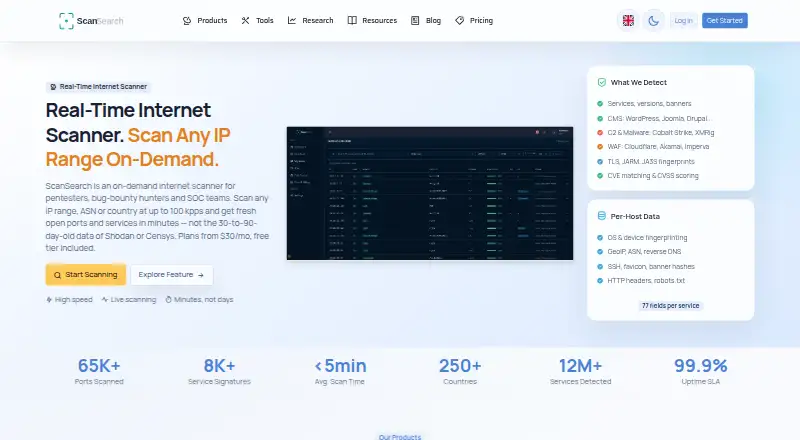
ScanSearch runs live, on-demand SYN scans and service detection to show current network exposure for specified targets. Targets can be IP addresses, CIDR or country ranges, ASNs, and resolved domains. Its Nmap-based engine identifies software, versions, and protocols using more than 12,000 signatures across over 1,200 services. Depending on enabled modules, scan results may include TLS/SSL details, HTTP security headers, geolocation, technology stack, and CVE matches. Results are available in a live dashboard and can be exported as TXT, JSON, or CSV. A REST API supports JSON, webhooks, batch operations, a Python SDK, and a CLI. Additional tools include Dork Search, which automates Google dork queries and offers a catalog of more than 1,000 prepared queries, and Attack Surface Monitoring, with scheduled scans, change tracking, dashboards, and alerts. Scan data is retained for seven days on free accounts and 90 days on paid accounts. ScanSearch requires permission to scan any target and describes its use as authorized security testing, network administration, and research. Its paid Internet Scanner plan is $0.30 per kpps/month.
Good
- Supports IPs, CIDR ranges, ASNs, and resolved domains.
- Provides TXT, JSON, and CSV exports.
- REST API includes webhooks and batch operations.
- Monitoring offers scheduled scans and change tracking.
- Free plans are available.
Watch out
- Free Internet Scanner has no API access.
- Free scan exports are limited to 100 rows.
- Free-account scan data is retained for seven days.
- Scanning targets requires permission.
Who it suits
ScanSearch is intended for security researchers, penetration testers, red teams, bug bounty hunters, blue teams, and defenders. It is for authorized scanning, network administration, and research where users have permission to scan targets.
Verdict
ScanSearch pairs live exposure scans with search and monitoring tools, with API and export options varying by plan. Confirm you have permission for every target before scanning.
Plans and prices
From ScanSearch's own pricing page, checked 30 Sep 2026.
| Plan | Price | What it gives you |
|---|---|---|
| Internet Scanner — paid | $0.30 a month | 100–10,000 kpps · Unlimited results per scan · Full CSV/JSON export · Queue up to 10 scans · API access · 90-day data retention · per kpps/month |
| Dork Search — Pro | $39 a month | 30 searches per hour · 15 pages per search · Up to 1,000 results · Batch mode (10 queries) · Full CSV/JSON export · API access · /month |
| Attack Surface Monitoring — Pro | $49 a month | 25 monitored assets · Daily scans · 30 days history · Email alerts · No webhook notifications · API access · /month |
| Dork Search — Business | $99 a month | 100 searches per hour · 50 pages per search · Up to 5,000 results · Batch mode (50 queries) · Full CSV/JSON export · API access · /month |
| Attack Surface Monitoring — Business | $149 a month | 100 monitored assets · Scans every 6 hours · 90 days history · Email alerts · Webhook notifications · API access · /month |
| Dork Search — Free | — | 2 searches per hour · 3 pages per search · Up to 20 results · No batch mode · Limited export · No API access · /month |
| Internet Scanner — Enterprise | Priced on request | Volume discounts on speed · Dedicated scan servers · Unlimited scan queue · Scheduled and recurring scans · Webhook and SIEM integration · SLA and dedicated account manager · Custom |
| Internet Scanner — Free | — | 1 kpps scan speed · 1 scan at a time · Up to 1,000 results per scan · Export limited to 100 rows · No API access · /month |
| Attack Surface Monitoring — Free | — | 1 monitored asset · Weekly scans · 7 days history · No email alerts · No webhook notifications · No API access · /month |
The facts
Each one read from ScanSearch's own pages, with the date it was checked.
What it does
- API and integrations
- The REST API supports JSON, webhooks, batch operations, and an official Python SDK and CLI.checked 30 Sep 2026
- Compliance
- The Internet Scanner page labels the service GDPR compliant.checked 30 Sep 2026
- Dork Search
- Dork Search automates Google dork queries and offers a catalog of more than 1,000 pre-built queries, batch processing, and TXT, CSV, or JSON exports.checked 30 Sep 2026
- Enrichment
- Scan results can include TLS/SSL details, HTTP security headers, geolocation, technology stack, and CVE matches, depending on enabled modules.checked 30 Sep 2026
- Exports
- Scanner results can be viewed in a live dashboard and exported as TXT, JSON, or CSV.checked 30 Sep 2026
- Intended users
- ScanSearch identifies security researchers, penetration testers, red teams, bug bounty hunters, blue teams, and defenders as intended users.checked 30 Sep 2026
- Monitoring
- Attack Surface Monitoring offers scheduled scans, change tracking, team dashboards, and email or webhook alerts for new exposures.checked 30 Sep 2026
- Privacy
- The privacy policy says scan data is stored in the account and accessible only to the account holder, and that ScanSearch does not sell, rent, or share personal data or scan results with third parties except for listed service and legal exceptions.checked 30 Sep 2026
- Retention
- The privacy policy states scan data is retained for 7 days on free accounts, 90 days on paid accounts, and as agreed for Enterprise accounts.checked 30 Sep 2026
- Security
- The privacy policy says ScanSearch uses HTTPS encryption, secure password hashing, firewall protection, and regular security audits.checked 30 Sep 2026
- Service detection
- Its Nmap-based detection engine identifies software, version, and protocol using more than 12,000 signatures covering over 1,200 services.checked 30 Sep 2026
- Support
- The site advertises live support and says it typically replies within minutes.checked 30 Sep 2026
- Targets
- Targets can include IPs, CIDR ranges, country ranges, ASNs, and resolved domains.checked 30 Sep 2026
- Use restrictions
- ScanSearch says users must have permission to scan any target and describes the service as intended for authorized security testing, network administration, and research.checked 30 Sep 2026
- What it does
- ScanSearch runs on-demand live SYN scans and service detection against specified targets and returns current network exposure results.checked 30 Sep 2026
The company
- Headquarters
- Spainchecked 28 Sep 2026
The full review of ScanSearch
ScanSearch is a cloud service for live internet exposure scans, Google dork research, and recurring attack-surface monitoring. It fits security researchers, penetration testers, red and blue teams, bug bounty hunters, and defenders who want these workflows connected to dashboards and automation. Its breadth is appealing, but separate products impose separate quotas, and every scan must be authorized.
Overview
The Internet Scanner performs on-demand live SYN scans and service detection against IP addresses, CIDR ranges, country ranges, ASNs, and resolved domains. Its Nmap-based engine uses more than 12,000 signatures spanning over 1,200 services to identify software, versions, and protocols. Depending on enabled modules, a result can add TLS/SSL information, HTTP security headers, geolocation, technology-stack data, and CVE matches. This makes it more informative than a simple open-port result, although the enrichment you receive depends on the modules enabled.
Results are shown in a live dashboard and can be exported as TXT, JSON, or CSV. Scan data is retained for seven days on free accounts and 90 days on paid accounts; Enterprise retention is agreed separately. ScanSearch says data is accessible only to the account holder and is not sold, rented, or shared except for stated service and legal exceptions. HTTPS, secure password hashing, firewall protection, and regular security audits are cited security measures, and the Internet Scanner page labels the service GDPR compliant.
Key features
Automation and integration
The REST API handles JSON, webhooks, and batch operations, with an official Python SDK and CLI. That is a practical advantage for pipelines, repeated investigations, and teams that do not want to work solely in a browser. Live support is advertised with replies typically arriving within minutes.
Dork Search
Dork Search automates Google dork queries and includes more than 1,000 pre-built queries. Batch processing and TXT, CSV, and JSON exports suit repeatable discovery, but its hourly, page, and result ceilings vary sharply by plan.
Attack Surface Monitoring
Monitoring adds scheduled scans, change tracking, team dashboards, and alerts for newly exposed assets. Business adds webhook notifications and much more frequent scanning; Pro is limited to email alerts and daily scans. These are useful distinctions for deciding whether the service can feed an existing response process.
Pricing
ScanSearch is freemium, with a free plan and a free trial. The pricing note says paid plans start at $30/mo, while individual product prices are as follows.
- Internet Scanner — Free: price not listed, billed monthly. It allows 1 kpps, one scan at a time, up to 1,000 results per scan, exports limited to 100 rows, and no API access. It is suitable for occasional, small checks, not automation.
- Internet Scanner — paid: $0.30 a month, billed per kpps/month for 100–10,000 kpps. It provides unlimited results per scan, full CSV/JSON export, a queue of up to 10 scans, API access, and 90-day retention. The higher throughput and automation fit regular scanning, although the per-kpps billing deserves careful budget checking.
- Internet Scanner — Enterprise: custom pricing. Volume speed discounts, dedicated scan servers, an unlimited queue, scheduled and recurring scans, webhook and SIEM integration, an SLA, and a dedicated account manager target larger operations.
- Dork Search — Free: price not listed, billed monthly. Two searches per hour, three pages per search, 20 results, no batch mode, limited export, and no API access make it a trial tier.
- Dork Search — Pro: $39 a month. It raises capacity to 30 searches per hour, 15 pages and 1,000 results per search, with batches of 10 queries, full CSV/JSON export, and API access.
- Dork Search — Business: $99 a month. At 100 searches per hour, 50 pages, 5,000 results, and 50-query batches, it is the choice for heavier discovery workloads.
- Attack Surface Monitoring — Free: price not listed, billed monthly. One asset, weekly scans, seven days of history, and no alerts or API access are enough for a single low-frequency watch.
- Attack Surface Monitoring — Pro: $49 a month for 25 assets, daily scans, 30 days of history, email alerts, and API access, but no webhooks.
- Attack Surface Monitoring — Business: $149 a month for 100 assets, scans every six hours, 90 days of history, email alerts, webhook notifications, and API access.
Platforms
ScanSearch is cloud-deployed and covers internet targets. Listed platforms are web, Linux, and API, making it a natural fit for browser users and Linux-based automation rather than a conventional desktop scanner.
Who it's for
Choose ScanSearch when you need current exposure data plus service fingerprinting, enrichment, exports, and an API. Security teams benefit most from Monitoring's history and alerts; researchers and bug bounty hunters may value Dork Search and batch operations. It is less suitable for anyone wanting a single, unrestricted desktop tool or unmetered capability on a free tier. Permission to scan every target is mandatory, and the product is positioned for authorized testing, administration, and research.
Pros and cons
- Pros: broad target types and deep signature coverage; optional TLS, header, geolocation, technology, and CVE enrichment; TXT/JSON/CSV exports; Python SDK, CLI, webhooks, and batch API support; monitoring with change history and alerts; stated account-level scan-data privacy and security controls.
- Cons: scanner, dork, and monitoring quotas are separate; free tiers restrict speed, retention, exports, alerts, or API access; Pro monitoring has no webhooks; paid prices range widely and the Internet Scanner's per-kpps billing can be difficult to forecast; authorized-target restrictions rule out casual scanning.
Alternatives
For a directory of port-scanning options, see Port Scanner Software.
- Naabu is a free, MIT-licensed port scanner for Linux, macOS, Windows, self-hosted use, and API workflows; choose it when you want open-source deployment without ScanSearch's hosted product tiers.
- NetsCLI is a free MIT-licensed option for Linux, macOS, and Windows, with a Rust library and MCP server; it suits developers seeking a local, Rust-oriented tool.
- Nmap is free for end users across Linux, macOS, Windows, and self-hosted deployments; pick it for the established open-source scanner rather than a cloud dashboard.
- RustScan is a free open-source port scanner for Android, Linux, macOS, Windows, and self-hosted use.
- Masscan is free software under the GNU Affero General Public License v3 for Linux, macOS, Windows, and self-hosting.
- Unicornscan is free GPL software with API, Linux, and web support alongside self-hosted deployment.
- Angry IP Scanner is a free GPLv2 application for Linux, macOS, and Windows.
- Pentest-Tools Port Scanner offers a free tier and web/API access, with a NetSec plan starting at $95 a month.
Verdict
ScanSearch is a strong choice for authorized security practitioners who want live internet scanning, enrichment, searchable discovery, and scheduled monitoring in one cloud service. Its main reason to choose it is the combination of broad fingerprinting and automation interfaces; its main reason to look elsewhere is the fragmented quotas and paid tiers, especially if a free, self-hosted port scanner is all you need.
Alternatives to ScanSearch
- 1
Avidemux
Free planOpen sourceWebLinuxmacOSWindows7.3Free plan - 2
Masscan
Free planOpen sourceLinuxmacOSSelf-hostedWindows7.2Free plan - 3
Nmap
Free planLinuxmacOSSelf-hostedWindows7.0From $9,980 a month - 4
Naabu
Free planAPILinuxmacOSSelf-hosted6.8Free plan - 5
Pentest-Tools Port Scanner
Free planWebAPI6.8From $95 a month - 6
NetsCLI
Free planLinuxmacOSWindows6.6Free plan