Masscan
Masscan is a command-line TCP port scanner designed to scan many machines across wide address ranges.
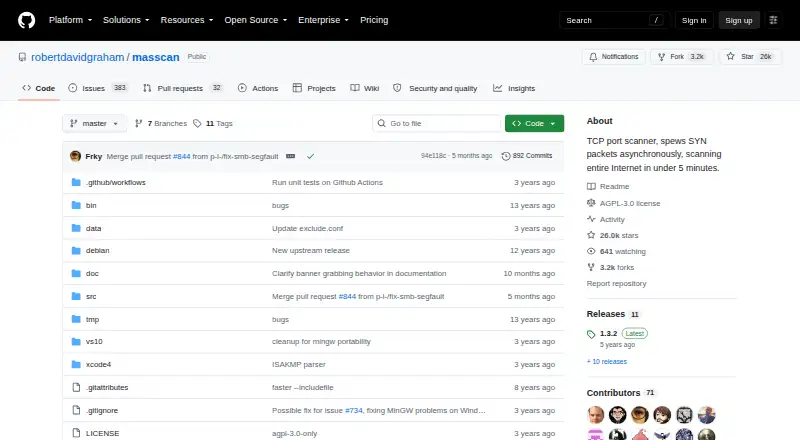
What Masscan is
Masscan is a command-line TCP port scanner designed to scan many machines across wide address ranges. The project says it can transmit 10 million packets per second from one machine. It supports asynchronous transmission and arbitrary port and address ranges, and can scan IPv4 and IPv6 together. Banner checks are available for FTP, HTTP, IMAP4, memcached, POP3, SMTP, SSH, SSL, SMBv1, SMBv2, Telnet, RDP, and VNC. Output options include XML, binary, grepable, JSON, and list formats. Its usage and output are intended to be familiar to Nmap users, with some Nmap-compatible options. Masscan runs on Linux, macOS, and Windows and is available for self-hosting. It is free software under the GNU Affero General Public License version 3; the license notice states that it carries no warranty. Users must specify ports and provide IP addresses or simple ranges as targets, rather than DNS names. The README also warns that Masscan's custom TCP/IP stack can conflict with the local stack, and describes using a separate source IP or firewalling its source port as ways to address that issue.
Good
- Supports arbitrary port and address ranges.
- Can scan IPv4 and IPv6 together.
- Offers multiple output formats, including JSON and XML.
- Banner checks cover a range of listed services.
Watch out
- Targets must be IP addresses or simple ranges.
- Ports must be specified.
- Custom TCP/IP stack can conflict with the local stack.
- License notice states there is no warranty.
Who it suits
Masscan is aimed at users scanning many machines over broad IP ranges. Its target and port requirements make it important to plan scan inputs explicitly.
Verdict
Masscan is built for wide-range scanning and offers several output formats and banner checks. Its target requirements and possible conflict with the local TCP/IP stack are key operational considerations.
Plans and prices
From Masscan's own pricing page, checked 15 Oct 2026.
| Plan | Price | What it gives you |
|---|---|---|
| Free | Free | Internet-scale scanning · arbitrary IP and port ranges · command-line use |
| Masscan | Free | Free software under the GNU Affero General Public License v3 |
The facts
Each one read from Masscan's own pages, with the date it was checked.
What it does
- Address and port ranges
- Masscan accepts arbitrary IP address ranges and port ranges, including IPv4 and IPv6 examples.checked 15 Oct 2026
- Asynchronous scanning
- It sends SYN packets asynchronously and uses a design comparable to scanrand, Unicornscan and ZMap.checked 15 Oct 2026
- Banner checks
- Banner checking is supported for FTP, HTTP, IMAP4, memcached, POP3, SMTP, SSH, SSL, SMBv1, SMBv2, Telnet, RDP, and VNC.checked 5 Oct 2026
- Banner-grab hazard
- The host stack can send reset packets after SYN-ACK responses, terminating connections before Masscan captures banners.checked 15 Oct 2026
- Banner protocols
- Banner checking is documented for FTP, HTTP, IMAP4, memcached, POP3, SMTP, SSH, SSL, SMBv1, SMBv2, Telnet, RDP and VNC.checked 15 Oct 2026
- Build requirements
- The basic Linux build requires Git, Make and a C compiler such as GCC or Clang, with no other major dependencies described.checked 15 Oct 2026
- Compatibility
- Masscan's usage and output are designed to be familiar to Nmap users, with some Nmap-compatible options.checked 5 Oct 2026
- Configuration export
- The --echo option prints the current configuration so it can be saved and reused as an input configuration file.checked 15 Oct 2026
- Copyright date
- The licence notice identifies copyright as 2013 Robert David Graham.checked 15 Oct 2026
- Custom TCP/IP stack
- Masscan includes its own ad hoc TCP/IP stack, which can conflict with the host operating system stack.checked 15 Oct 2026
- Distributed scans
- The Debian manual documents --shard for dividing a scan across machines and resume indexes for assigning chunks to workers such as Amazon EC2 instances.checked 15 Oct 2026
- High-speed integration
- PF_RING ZC can be used beyond about two million packets per second with a compatible Intel 10-gigabit adapter and drivers.checked 15 Oct 2026
- Integrations
- The project describes PF_RING DNA support for high-speed packet transmission and says Masscan can use PF_RING ZC when the adapter name indicates it.checked 5 Oct 2026
- Intended users
- The README describes Masscan as tuned for scanning many machines across wide ranges, while Nmap is described as designed for intensive scanning of a single machine or small range.checked 5 Oct 2026
- IPv6
- IPv4 and IPv6 can be scanned together, without a separate IPv6 mode.checked 5 Oct 2026
- Kali package
- Kali lists Masscan as a TCP port scanner installable with sudo apt install masscan, with an installed size of about 516 KB and libc6 and libpcap dependencies.checked 15 Oct 2026
- Licence
- Masscan is released under the GNU Affero General Public License version 3.checked 15 Oct 2026
- License
- Masscan is free software under the GNU Affero General Public License version 3, with no warranty stated in the license notice.checked 5 Oct 2026
- Limit: command-line interface
- The same review lists the lack of a graphical interface and the need for command-line operation as disadvantages.checked 15 Oct 2026
- Limit: documentation depth
- A university evaluation found Masscan's documentation mainly consisted of its README and C source, with less documentation than ZMap.checked 15 Oct 2026
- Limit: host inspection
- The same evaluation records that Masscan does not provide operating-system detection and offers a smaller capability set than Nmap.checked 15 Oct 2026
- Limit: network overload
- A Masscan usage review warns that setting the transmission rate too high can overload networks or cause IP blocking.checked 15 Oct 2026
- Limit: shallow vulnerability coverage
- A 2025 IoT-security paper describes Masscan and similar scanners as broad discovery tools that do not detect deeper firmware or device-specific vulnerabilities.checked 15 Oct 2026
- Limit: virtual networking
- A BSides security-crawler presentation reports that Masscan performed poorly with some virtual network configurations, leading the team to build a custom asynchronous TCP scanner.checked 15 Oct 2026
The full review of Masscan
Masscan is a command-line TCP port scanner for operators surveying many machines across broad address ranges. It suits users who can define IP targets and ports precisely and who can manage network-level configuration. Its exceptional scan breadth is persuasive, but DNS-name targeting and unadjusted coexistence with the local TCP/IP stack make it a specialist choice.
Overview
Masscan is designed for Internet-scale TCP scanning rather than intensive examination of one host or a small range. Arbitrary port and address ranges, asynchronous transmission and a stated ability to send up to 10 million packets per second from one machine put coverage and throughput at the center of the product. That orientation is valuable for inventory and exposure surveys, but it requires disciplined target definition: users must specify ports, and targets are IP addresses or simple ranges rather than DNS names.
The command-line deployment is free software under the GNU Affero General Public License version 3. The license notice provides no warranty, so organizations should account for their own operational and legal review before incorporating it into a service.
Key features
High-volume, flexible scanning
Masscan accepts arbitrary port and address ranges and sends probes asynchronously. The claimed 10-million-packets-per-second ceiling makes it a strong fit when scanning many machines matters more than detailed, host-by-host investigation. It is less suitable for workflows built around entering hostnames or relying on automatic port selection.
Banner checks and address families
Service detection covers FTP, HTTP, IMAP4, memcached, POP3, SMTP, SSH, SSL, SMBv1, SMBv2, Telnet, RDP and VNC. This gives broad protocol visibility after discovery, although the product's defining advantage remains scan scale rather than deep single-host analysis. IPv4 and IPv6 can be scanned together without switching to a separate IPv6 mode, which simplifies mixed-address inventories.
Output and Nmap familiarity
Results can be written as XML, binary, grepable output, JSON or a list. That range supports both machine processing and straightforward text-based workflows. Usage and output are intended to feel familiar to Nmap users, with some Nmap-compatible options, so experienced Nmap operators have a gentler transition even though Masscan's scanning emphasis is different.
High-speed packet transmission
PF_RING DNA support and the ability to use PF_RING ZC when the adapter name indicates it target high-speed packet transmission. These integrations matter most to operators already using compatible packet-processing infrastructure; they are not a substitute for understanding the network path and host configuration.
Pricing
Masscan — free (Free software under the GNU Affero General Public License v3). There is one free plan, no free trial period and no paid tier. That removes seat or quota charges for teams able to run the command-line software themselves, while the AGPLv3 terms and self-managed deployment place responsibility for compliance, infrastructure and operation on the user. Readers seeking a hosted service, commercial support tier or a packaged allowance should look elsewhere.
Platforms
Masscan runs on Linux, macOS and Windows, and supports self-hosted deployment. Its CLI form suits operators comfortable with local execution and network permissions rather than users looking for a browser-first interface.
Who it's for
Choose Masscan for wide-range surveys across many machines, especially when very high packet rates, mixed IPv4/IPv6 scanning and multiple export formats are priorities. It is a practical fit for security teams and network operators who can supply IP ranges and explicit ports, interpret banner results and isolate its traffic appropriately.
It is a poor fit when targets are primarily DNS names, when the job is an intensive scan of a single machine or small range, or when the scanner must run beside the local TCP/IP stack without special handling. The README warns that Masscan's custom TCP/IP stack can conflict with the local stack; using a separate source IP or firewalling its source port is described as a way to manage that risk.
Pros and cons
Pros
- Exceptional breadth: asynchronous scanning and a stated 10 million packets per second support Internet-scale coverage from one machine.
- Flexible scope: arbitrary address and port ranges let operators tailor large surveys rather than accept fixed scan boundaries.
- Useful service visibility: banner checks span common infrastructure and remote-access protocols.
- Workflow-friendly exports: XML, binary, grepable, JSON and list formats accommodate varied downstream tooling.
- Broad platform reach: Linux, macOS, Windows and self-hosting avoid dependence on a single operating environment.
Cons
- Manual targeting: ports are required and DNS names are not accepted as targets, adding preparation to hostname-driven workflows.
- Network conflict risk: the custom TCP/IP stack may interfere with the local stack unless source addressing or firewalling is arranged.
- Specialist depth: its wide-range design is not the natural choice for intensive, single-host investigation.
- Self-managed responsibility: the free AGPLv3 software carries no warranty in its license notice and provides no hosted plan.
Alternatives
Nmap is the better choice when intensive scanning of one machine or a small range is the priority; it is free, offers a free trial designation and runs on Linux, macOS, Windows and self-hosted environments.
Naabu is another free, open-source port-scanning option with Linux, macOS, Windows, self-hosted and API availability.
NetsCLI suits readers wanting a free MIT-licensed tool with Linux, macOS and Windows support.
RustScan is a free open-source alternative spanning Android, Linux, macOS, Windows and self-hosted use.
ScanSearch is worth considering when a web or API service and metered throughput are preferable; its paid Internet Scanner plan starts at $0.30 a month, billed per kpps/month.
Unicornscan is a free GPL option available through API, Linux, macOS, self-hosted and web deployments.
Angry IP Scanner is a free GPLv2 scanner for Linux, macOS and Windows.
Pentest-Tools Port Scanner fits users seeking a web or API service, with a free tier and a NetSec plan starting at $95 a month.
Browse the wider Port Scanner Software category when none of these deployment models matches your workflow.
Verdict
Masscan is the right pick for experienced operators who need fast, broad TCP coverage across explicitly defined IP ranges and ports, with banner checks and flexible exports at no software cost. Look elsewhere if you need DNS-based targeting, intensive single-host analysis or a managed service that avoids custom-stack network configuration.
Alternatives to Masscan
- 1
Avidemux
Free planOpen sourceWebLinuxmacOSWindows7.3Free plan - 2
Nmap
Free planLinuxmacOSSelf-hostedWindows7.0From $9,980 a month - 3
Naabu
Free planAPILinuxmacOSSelf-hosted6.8Free plan - 4

Pentest-Tools Port Scanner
Free planWebAPI6.8From $95 a month - 5

ScanSearch
Free planWebAPILinux6.8From $0.30 a month - 6
NetsCLI
Free planLinuxmacOSWindows6.6Free plan