Scalata
Scalata is a generative AI framework for regulated fields such as finance, healthcare, insurance, legal, and government.
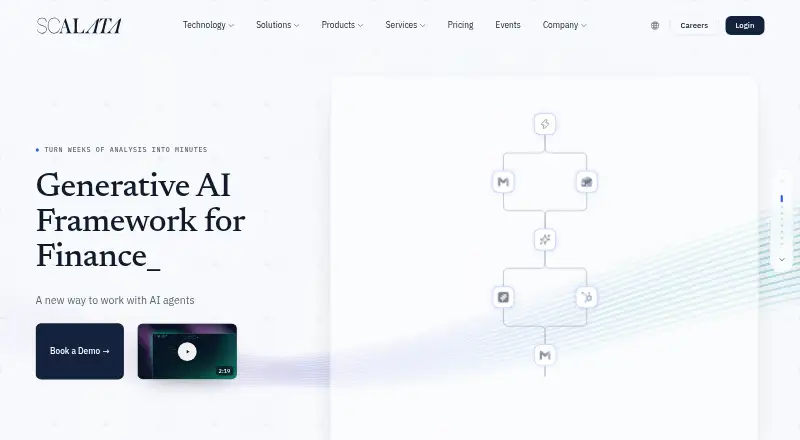
What Scalata is
Scalata is a generative AI framework for regulated fields such as finance, healthcare, insurance, legal, and government. Its tools cover document analysis, workflow automation, financial modeling, code generation, tables, charts, and portfolio summaries. The web service has a free plan and a Pro plan at $20 a month, billed monthly. Pro includes finance dashboards and market data, a knowledge base, workflows, and unlimited folders and shares. Enterprise adds firm-wide data connections and tools, and licenses support on-premises or VPC deployment. Listed connectors include Gmail, Outlook, Google Drive, Microsoft 365, Slack, Salesforce, Jira, HubSpot, Snowflake, PostgreSQL, Amazon S3, and Azure Blob Storage. Connector permissions can be set to allow, ask, or disable actions; writes require approval by default, while destructive actions are disabled or gated. Scalata says responses are grounded in customer data and cited, and that customers should review high-stakes outputs. It reports encryption in transit and at rest, segregated cloud environments, and least-privilege access. Its SOC 2 examination report is available to customers and prospects under NDA on request.
Good
- Free plan with up to five folders and shares
- Pro includes finance dashboards and market data
- Connector actions have configurable controls
- Enterprise supports on-premises or VPC deployment
- Customers retain rights to submitted data
Watch out
- Web platform only
- Pro costs $20 a month
- Max is marked coming soon
- High-stakes outputs require customer review
Who it suits
Scalata may suit financial and other regulated organizations, including hedge funds, banks, private-credit funds, servicers, trustees, and asset holders. Its described tools also suit teams that need data-connected analysis and controlled workflows.
Verdict
Scalata combines analysis and workflow tools with configurable connector controls for regulated settings. The free plan is available, while Pro adds finance-focused capabilities and Enterprise offers deployment options for organizations needing them.
Plans and prices
From Scalata's own pricing page, checked 8 Oct 2026.
| Plan | Price | What it gives you |
|---|---|---|
| Free | Free | 350k every 5 hours, 7M a week · Gemini 2.5 Flash Lite, GPT-5.6 Luna, Claude Haiku 4.5 · up to 5 folders · up to 5 shares |
| Pro | $20 a month | 5x Free usage: 1.75M every 5 hours, 35M a week · finance dashboards and market data · knowledge base · workflows · unlimited folders and shares · billed monthly |
| Max | $100 a month | 5x Pro usage: 8.75M every 5 hours, 175M a week · high thinking level · market alerts · workflow and agent builders · custom connectors · billed monthly; coming soon |
The facts
Each one read from Scalata's own pages, with the date it was checked.
What it does
- Analysis
- Its specialized systems include document analysis, workflow automation, financial modeling, code generation, tables, charts, and portfolio summaries.checked 8 Oct 2026
- Connector controls
- Connector actions can be set to Allow, Ask, or Disabled, with writes requiring approval by default and destructive actions disabled or gated.checked 8 Oct 2026
- Deployment
- Enterprise licenses support on-premises or VPC deployment, according to the pricing FAQ.checked 8 Oct 2026
- Enterprise
- Scalata Enterprise offers firm-wide data connections, dashboards, portfolios, widgets, workflows, agents, reports, apps, and governance.checked 8 Oct 2026
- Governance
- The maker says answers are grounded in customer data and cited, and high-stakes outputs should be reviewed and validated by customers before acting.checked 8 Oct 2026
- Integrations
- The maker lists connectors including Gmail, Outlook, Google Drive, Microsoft 365, Slack, Salesforce, Jira, HubSpot, Snowflake, PostgreSQL, Amazon S3, and Azure Blob Storage.checked 8 Oct 2026
- Intended users
- The maker says it serves hedge funds, banks, private-credit funds, servicers, trustees, and asset holders.checked 8 Oct 2026
- Product
- Scalata describes itself as a generative AI framework for regulated industries, including finance, healthcare, insurance, legal, and government.checked 8 Oct 2026
- Security
- The maker states that data is encrypted in transit with TLS 1.2+ and at rest with AES-256, with segregated cloud environments and least-privilege access.checked 8 Oct 2026
- SOC 2
- Scalata says its controls are independently examined against SOC 2 Trust Services Criteria and its current report is available to customers and prospects under NDA on request.checked 8 Oct 2026
- Support
- The enterprise page describes built-in support and directs prospective customers to contact sales or book a demo.checked 8 Oct 2026
The company
- Data ownership
- Scalata states that customers retain rights to submitted data and that customer data is not sold or monetized.checked 8 Oct 2026
Money
- Plan limits
- The pricing page says prices are per user and billed monthly, and annual billing saves 20%.checked 8 Oct 2026
The full review of Scalata
Scalata is a web-based generative AI framework aimed at regulated-industry work. It suits finance and other organizations that need analytical tools connected to controlled business data. Its broad toolkit and governance options are strong, but free usage is tightly capped and the top Max plan is still coming soon.
Overview
Scalata combines document analysis, workflow automation, financial modeling, code generation, tables, charts, and portfolio summaries in one framework. That breadth favors teams handling varied analytical and operational jobs rather than users looking for a single-purpose assistant. Responses are grounded in customer data and include citations, which supports review, although customers remain responsible for validating high-stakes results before taking action.
Enterprise is designed for firm-wide deployment, adding shared data connections plus dashboards, portfolios, widgets, workflows, agents, reports, apps, and governance. It is therefore more appropriate for institutions coordinating multiple teams than for an individual wanting a lightweight chatbot.
Key features
Connectors and controlled actions
Scalata connects with Gmail, Outlook, Google Drive, Microsoft 365, Slack, Salesforce, Jira, HubSpot, Snowflake, PostgreSQL, Amazon S3, and Azure Blob Storage. The mix covers communications, files, collaboration, CRM, project work, and major data stores. Administrators can set each connector to Allow, Ask, or Disabled. Write operations require approval by default, while destructive actions are disabled or gated, a meaningful safeguard when AI is allowed to interact with operational systems.
Security and governance
Data is encrypted in transit using TLS 1.2 or newer and at rest with AES-256. Segregated cloud environments and least-privilege access provide a security posture suited to regulated workloads. Scalata says its controls are independently examined against SOC 2 Trust Services Criteria, with the current report available to customers and prospects under NDA. Customers retain rights to submitted data, and the company says it does not sell or monetize customer data.
Enterprise deployment
Enterprise licensing supports on-premises or VPC deployment, giving organizations with stricter infrastructure requirements alternatives to a shared cloud setup. Built-in support and sales-led demos are available for prospective enterprise customers. Prospective matter checks and automated search add particular relevance for legal and compliance-oriented workflows.
Pricing
Prices are per user and billed monthly; annual billing saves 20 percent. The Free plan costs nothing and includes 350k usage every five hours and 7M weekly, access to Gemini 2.5 Flash Lite, GPT-5.6 Luna, and Claude Haiku 4.5, plus up to five folders and five shares. It is useful for trying the framework or light personal work, but the usage windows and sharing caps make it a poor fit for sustained team workloads.
Pro costs $20 a month per user, billed monthly. It raises usage to 1.75M every five hours and 35M weekly, and adds finance dashboards and market data, a knowledge base, workflows, and unlimited folders and shares. This is the practical starting point for finance professionals and small teams that need recurring analysis and collaboration.
Max costs $100 a month per user and is marked coming soon. When released, it is planned to provide 8.75M usage every five hours and 175M weekly, a high thinking level, market alerts, workflow and agent builders, and custom connectors. Organizations needing those capabilities today must consider Pro or pursue an Enterprise arrangement with custom pricing.
Platforms
Scalata runs on the web. The browser-only approach suits mixed-device offices, but there is no stated native mobile or desktop application.
Who it's for
The maker positions Scalata for hedge funds, banks, private-credit funds, servicers, trustees, and asset holders, as well as regulated organizations in healthcare, insurance, legal, and government. Pro is the clearest fit for individual professionals and smaller groups; Enterprise is intended for firm-wide governance, connections, and deployment control. Casual users and teams wanting a simple standalone assistant will likely find its regulated-workflow orientation excessive.
Pros and cons
- Pros: Broad coverage from document work and modeling to workflows, code, charts, and portfolio summaries.
- Pros: Granular Allow, Ask, and Disabled connector settings, with approval gates for writes, reduce the risk of unintended changes.
- Pros: Encryption, segregated environments, least-privilege access, SOC 2 examination, and customer data ownership address common governance requirements.
- Cons: Free usage and folder/share limits restrict serious ongoing use.
- Cons: Max is not yet available, so its higher quotas, alerts, builders, and custom connectors cannot currently be relied on.
- Cons: The web-only platform offers no stated native apps for mobile or desktop use.
Alternatives
For a legal-focused comparison, see Legal Conflict Checking Software. Choose CaseFox instead when you need a cross-platform legal practice product with a free forever Solo plan, or paid professional features. Caddi is another web-based freemium option for users who prefer an individual plan with monthly credit and loop allowances. Digitslaw suits firms seeking client, matter, time, calendar, messaging, and document functions across several platforms. Reflekt Legal is aimed at call handling and appointment workflows, including a free 30-call tier. Centerbase is a paid, multi-platform legal operations option with a payments product. Affinisio Conflicts Clearance Compliance Centre focuses on conflict-clearance compliance through API, self-hosted, and web deployment. Mitratech CaseCloud is a paid case-management alternative with personalized-demo pricing. Client Conflict Check is suited to firms wanting dedicated conflict searches, including a $199-per-year solo-firm plan.
Verdict
Choose Scalata if your regulated organization needs one AI framework for analysis, workflows, and governed connections to business systems. Its main reason to look elsewhere is the combination of capped free usage, web-only access, and a Max tier that is not yet available; teams needing predictable high-volume capacity or a narrower legal tool may be better served by a specialized alternative.
Alternatives to Scalata
- 1
CaseFox
Free planAndroidiOSWebAPI8.1From $45 a month - 2
Digitslaw
Free planAndroidiOSWebmacOS8.0Free plan - 3
Client Conflict Check
AndroidiOSWeb7.4From $199 a year - 4
OBE Legal Intake Software
AndroidiOSWebAPI7.4From $1,400 a month - 5
Caddi
Free planWebAPIExtension7.3From $250 a month - 6
RTG Conflicts
WebLinuxmacOSSelf-hosted7.3From $3 a month