Scaladoc
Scaladoc is Scala’s documentation tool for turning comments in Scala code into documentation about the code’s structure.
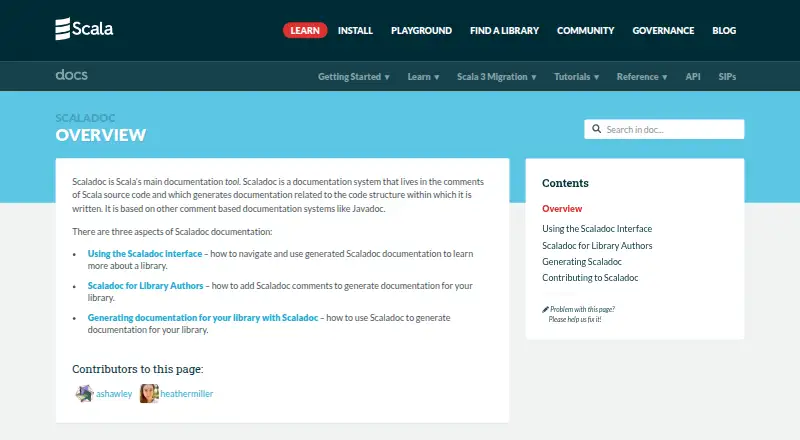
What Scaladoc is
Scaladoc is Scala’s documentation tool for turning comments in Scala code into documentation about the code’s structure. Library authors can use it to document code, while library users can consult the resulting API references. Comments support Markdown in Scala 3 and the older Wikidoc syntax, with tags for documenting parameters, return values, exceptions, examples, versions and deprecation. Comments can also be inherited from superclasses and traits, either automatically or with an explicit tag.
Scaladoc generates HTML documentation through sbt or its command-line tool; sbt is described as the easier choice for complex projects. Generated pages can include package navigation, type hierarchies, supertypes, known subclasses and links to online source where available. It can also produce static sites for documentation and blog posts. Searching methods and fields by type is available, though the feature is still in development. Inputs include Scala source code, TASTy files and JAR files. The tool is free, with no paid plans or usage limits stated.
Good
- Generates HTML API documentation
- Supports Markdown in Scala 3
- Can inherit comments from parent types
- Creates static documentation sites
- Accepts Scala source, TASTy and JAR files
Watch out
- Type-based search is still in development
- Direct command is harder for complex projects
Who it suits
Scaladoc is for Scala library authors who need API documentation and developers or library users who need to consult it. It is especially relevant to projects that want generated HTML references or static documentation sites.
Verdict
Scaladoc provides a free way to generate and publish reference material from Scala code comments. For a complex project, sbt is described as the easier generation route.
Plans and prices
From Scaladoc's own pricing page, checked 9 Oct 2026.
| Plan | Price | What it gives you |
|---|---|---|
| Scaladoc | Free | No paid plans or usage limits stated |
The facts
Each one read from Scaladoc's own pages, with the date it was checked.
What it does
- Audience
- Scaladoc documentation helps library users learn about a library, library authors write documentation, and developers generate library documentation.checked 9 Oct 2026
- Comment inheritance
- Scaladoc can inherit comments from superclasses and traits implicitly or through the @inheritdoc tag.checked 9 Oct 2026
- Comment tags
- Tags include @param, @tparam, @return, @throws, @example, @since, and @deprecated for documenting code entities.checked 9 Oct 2026
- Generated interface
- Generated Scaladoc can show package breadcrumbs, linear supertypes, known subclasses, type hierarchies, and links to online source when available.checked 9 Oct 2026
- Generation
- API documentation can be generated as HTML using sbt or the scaladoc command-line tool, with sbt described as the easier option for complex projects.checked 9 Oct 2026
- Integrations
- The Scala documentation names sbt as the easiest and most commonly used way to generate Scaladoc from Scala code.checked 9 Oct 2026
- Limit
- The direct scaladoc command is harder to use with complex projects containing multiple Scala source files and library dependencies.checked 9 Oct 2026
- Maintainer context
- The Scala Center describes itself as an independent not-for-profit center at EPFL that coordinates open-source development of Scala libraries and tools.checked 9 Oct 2026
- Markup
- Scaladoc comments support markup, including Markdown in Scala 3 and legacy Wikidoc syntax.checked 9 Oct 2026
- Purpose
- Scaladoc is Scala’s main documentation tool and generates documentation related to the structure of Scala source code from comments in that code.checked 9 Oct 2026
- Search
- Scaladoc supports searching for methods and fields by their types, and the documentation describes this feature as still in development.checked 9 Oct 2026
- Security
- The Scala security policy says releases are cryptographically signed with PGP keys and encourages private vulnerability reports.checked 9 Oct 2026
- Static sites
- Scaladoc can create static sites for documentation and blog posts alongside generated API documentation.checked 9 Oct 2026
Alternatives to Scaladoc
- 1

Scalar
Free planOpen sourceWebAPILinuxmacOS8.4From $150 a month - 2

Redocly
WebAPIExtension7.0From $10 a month - 3

Sphinx
Free planWebAPILinuxmacOS7.0Free plan - 4

Asciidoctor
Free planWebAPIExtensionLinux6.9Free plan - 5
JSON Schema for Humans
Free planLinuxmacOSSelf-hostedWindows6.5Free plan - 6
StepShot
Free planmacOS6.5CN¥269 one-time