
Saneops
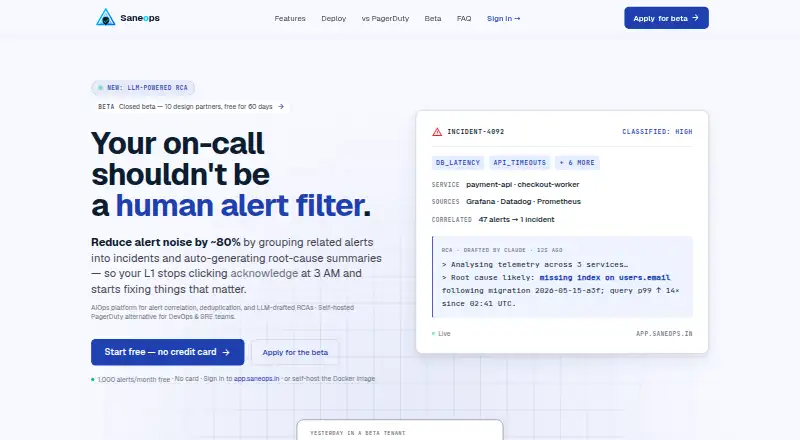
Saneops is an AIOps platform for DevOps and SRE teams that correlates and deduplicates alerts and drafts root-cause analyses for incidents.
What Saneops is
Saneops is an AIOps platform for DevOps and SRE teams that correlates and deduplicates alerts and drafts root-cause analyses for incidents. It groups alerts by time window and label similarity, with adjustable thresholds per tenant. Matching payloads are deduplicated using content hashes, and CEL-based rules can drop known-noise alerts. For incident analysis, Saneops supports customer-provided Claude, OpenAI or Ollama keys. Listed integrations include Grafana, Datadog, PagerDuty, Prometheus, Slack, Microsoft Teams, OpsGenie, Zenduty and generic webhooks. Teams can use the hosted cloud service or a self-hosted Docker image, which can run air-gapped. The maker says self-hosted alert data remains inside the customer’s network and secrets are encrypted at rest. Its security page lists bcrypt passwords, tenant isolation and rate limits. The Free tier is free and includes 1,000 alerts per month with no credit card. The separate closed beta offers the full product free for 60 days to ten design partners, who are asked to give feedback and attend a weekly 30-minute sync. Saneops says it is not currently SOC 2, ISO 27001, HIPAA or PCI-DSS certified.
Good
- Free tier includes 1,000 alerts per month.
- Correlates and deduplicates alerts with adjustable thresholds.
- Self-hosted deployment can run air-gapped.
- Supports customer-provided Claude, OpenAI or Ollama keys.
Watch out
- The maker says it is not currently SOC 2 certified.
- The maker says it is not currently ISO 27001 certified.
- Closed beta participants are asked to attend weekly syncs.
Who it suits
Saneops suits DevOps and SRE teams handling alert volume, particularly organizations with 50–500 engineers that cannot justify a dedicated AIOps team. Teams can choose hosted or self-hosted deployment.
Verdict
Saneops combines alert grouping, deduplication and drafted incident analysis, with both hosted and self-hosted options. Teams should weigh its stated certification status and the beta participation expectations.
Plans and prices
From Saneops's own pricing page, checked 8 Oct 2026.
| Plan | Price | What it gives you |
|---|---|---|
| Free tier | Free | 1,000 alerts/month · no credit card |
| Free tier (beta) | Free | 1,000 alerts/month · no credit card · full product during 60-day beta |
The facts
Each one read from Saneops's own pages, with the date it was checked.
What it does
- Alert correlation
- It groups alerts using time windows and label similarity with tenant-specific thresholds.checked 15 Oct 2026
- Beta terms
- The closed beta offers the full product free for 60 days to ten design partners, who are asked to provide feedback and attend a weekly 30-minute sync.checked 8 Oct 2026
- CEL drop rules
- Users can filter known-noise alerts with Kubernetes-style CEL expressions.checked 15 Oct 2026
- Cloud deployment
- Saneops Cloud is hosted by the vendor, uses HTTPS and managed backups, and is advertised as usable within five minutes.checked 15 Oct 2026
- Cloud hosting
- The FAQ says cloud data is hosted in Singapore on managed Postgres, with a DPA available; US and EU regions are planned before general availability.checked 8 Oct 2026
- Compliance
- Saneops says it is not currently SOC 2, ISO 27001, HIPAA, or PCI-DSS certified and processes personal data in line with GDPR and India's DPDP Act 2023.checked 8 Oct 2026
- Compliance status
- The vendor says it is not SOC 2, ISO 27001, HIPAA or PCI-DSS certified, while aligning processing with GDPR and India's DPDP Act 2023.checked 15 Oct 2026
- Content-hash deduplication
- Identical payloads from multiple monitoring tools are collapsed into one alert with the sources attached.checked 15 Oct 2026
- Data residency
- Cloud data is hosted in Singapore on managed Postgres; US and EU regions are planned before general availability.checked 15 Oct 2026
- Deduplication and rules
- It deduplicates matching payloads using content hashes and supports CEL-based rules to drop known-noise alerts.checked 8 Oct 2026
- Deployment
- Saneops offers a hosted cloud service and a self-hosted Docker image; the site says the self-hosted option can run air-gapped.checked 8 Oct 2026
- Ingestion model
- Alerts enter through webhooks, with no agent or SDK required.checked 15 Oct 2026
- Integrations
- The site lists Grafana, Datadog, PagerDuty, Prometheus, Slack, Microsoft Teams, OpsGenie, Zenduty, Claude, OpenAI, Ollama and generic webhooks.checked 15 Oct 2026
- Intended users
- The maker describes Saneops as built for organizations with 50–500 engineers that cannot justify a dedicated AIOps team.checked 8 Oct 2026
- Licence
- Saneops is proprietary; paid customers may receive source under NDA, while the beta ships as a compiled Docker image.checked 15 Oct 2026
- Limit: beta maturity
- The product is offered through a closed beta with ten design-partner slots and requires weekly feedback meetings from participants.checked 15 Oct 2026
- Limit: certification
- Organizations requiring SOC 2, ISO 27001, HIPAA or PCI-DSS certification cannot rely on current stated certifications because the vendor says none are held.checked 15 Oct 2026
- Limit: deployment effort
- Self-hosting requires Docker Compose and customer-managed infrastructure, even though the vendor estimates about ten minutes to the first alert.checked 15 Oct 2026
- LinkedIn beta result
- A company LinkedIn post reports a beta tenant processing about 800 alerts daily with roughly 30 pages after severity gating, an approximately 80% reduction.checked 15 Oct 2026
- LinkedIn incident example
- Another LinkedIn post reports a 27-alert database incident condensed to one incident, with RCA confirmation in four minutes instead of 47 minutes of investigation.checked 15 Oct 2026
- LinkedIn operations features
- The LinkedIn description lists DAG runbooks with manual, event and cron triggers, maintenance windows, multi-channel notifications, audit logs, Prometheus metrics and per-tenant RBAC.checked 15 Oct 2026
- LinkedIn provider support
- The LinkedIn product description lists BYOK support for Anthropic, OpenAI, Gemini, Grok, DeepSeek, Ollama and OpenAI-compatible providers.checked 15 Oct 2026
- LinkedIn stress test
- The maker reported a stress test of 1,780 alerts becoming 31 incidents, or 97% noise reduction, without custom rule tuning.checked 15 Oct 2026
- LinkedIn topology correlation
- A LinkedIn post describes merging database and API alerts with no shared labels by using a service-graph dependency relationship.checked 15 Oct 2026
The full review of Saneops
Saneops is an AIOps platform for DevOps and SRE teams looking to cut alert noise and give responders a drafted incident analysis. It is aimed at organizations with 50–500 engineers that do not have a dedicated AIOps team. Its strongest case is a free entry point plus an air-gapped self-hosting option; unresolved post-beta pricing and absent major certifications narrow its fit.
Overview
Saneops combines alert correlation, duplicate suppression, noise rules, and LLM-drafted root-cause analyses in an incident workflow. That makes it relevant to operations teams where repeated or noisy alerts consume attention, but a larger AIOps program would be hard to justify. The hosted service is an option for teams that prefer not to deploy it themselves; self-hosting better suits organizations that need alert data to remain inside their network.
There are meaningful security and procurement trade-offs. The maker says secrets are encrypted at rest and lists bcrypt passwords, tenant isolation, and rate limits. It also says Saneops is not SOC 2, ISO 27001, HIPAA, or PCI-DSS certified. Cloud data is hosted in Singapore on managed Postgres, with a DPA available; US and EU regions are planned before general availability. Teams with data residency or certification requirements should weigh those constraints before choosing the hosted service.
Key features
- Alert correlation: Alerts are grouped by time window and label similarity, with thresholds adjustable per tenant. The ability to tune grouping gives teams some control over how aggressively signals are combined, though it requires choosing thresholds that suit their alert patterns.
- Deduplication and noise rules: Content hashes identify matching payloads, and CEL-based rules can drop known-noise alerts. These controls address repeat traffic directly, but teams need to define which alerts are safe to suppress.
- Drafted RCA: Saneops produces a root-cause analysis draft for each incident and can use customer-provided Claude, OpenAI, or Ollama keys. This gives responders a starting point without requiring a single built-in model choice; it remains a draft rather than a stated substitute for incident investigation.
- Integrations: The supported list includes Grafana, Datadog, PagerDuty, Prometheus, Slack, Microsoft Teams, OpsGenie, Zenduty, Claude, OpenAI, Ollama, and generic webhooks. That range covers monitoring, alerting, collaboration, and model providers relevant to its workflow.
- Deployment: Saneops offers hosted cloud service and a self-hosted Docker image, which can run air-gapped. The latter is the clearer fit for teams that cannot send alert data outside their own network.
Pricing
The Free tier costs nothing and includes 1,000 alerts/month, alert deduplication, and routing rules, with no credit card required. That is a useful way for a smaller team to start, but the 1,000-alert monthly cap may constrain an organization handling a high volume of incidents.
The closed beta is free for 60 days and offers the full product to ten design partners. In return, participants are asked to provide feedback and attend a weekly 30-minute sync, so it is not a no-commitment trial. Post-beta pricing has not been finalized. Beta participants who convert are offered 50% off year one and locked-in pricing for two years, but teams should not assume what the eventual standard price will be.
Platforms
Saneops is available as a web service or self-hosted software. A Docker image supports self-hosting, including air-gapped operation; hosted cloud data is currently in Singapore. The maker says self-hosted alert data stays within the customer's network.
Who it's for
Saneops is most suited to DevOps and SRE teams in organizations with 50–500 engineers that need alert management and drafted analysis without building a dedicated AIOps function. It is a more natural fit for teams able to tune their own grouping and noise rules and, if joining the beta, commit to regular feedback. Buyers requiring major security certifications or a specific US or EU cloud region should look elsewhere for now.
Pros and cons
- Pro: Alert grouping, hash-based deduplication, and CEL noise rules target several common sources of alert clutter in one platform.
- Pro: Air-gapped self-hosting and customer-provided LLM keys give organizations control over deployment and model credentials.
- Pro: The 0.00 USD free tier includes 1,000 alerts/month without requiring a credit card.
- Con: The free tier's 1,000-alert monthly allowance can be limiting for higher-volume teams.
- Con: Beta access is limited to ten design partners and carries weekly meeting and feedback expectations.
- Con: No SOC 2, ISO 27001, HIPAA, or PCI-DSS certification may rule it out where those certifications are mandatory.
- Con: Cloud hosting is in Singapore, while US and EU regions are only planned; post-beta pricing is unsettled.
Alternatives
AIOps Platforms and Alert Management Software are useful starting points for comparing the category. NetAI is worth considering when a free Core platform for 1–10 devices or a Windows and Linux option matters more than Saneops's stated alert-volume model. BMC Helix AIOps is a paid alternative for teams seeking a web, Linux, or Windows platform and willing to contact sales for pricing.
Selector is another paid option with a free plan and web, API, Linux, and self-hosted platforms. Digitate ignio AIOps may suit teams that prefer event-priced offerings, including IT Event Management at $0.10, paid once and Document Assist at $0.30, paid once. ScienceLogic AI Platform is an alternative for buyers seeking hybrid cloud observability and 400+ out-of-the-box integrations, with a stated Skylar One Standard price from $5 USD per device/month.
Vitria VIA AIOps is a paid option for teams considering API, self-hosted, or web deployment. Causely may suit organizations willing to pay $2,000/month for its Professional Edition, which covers up to 500 services and includes published integrations and a dedicated Slack/Teams channel. Dell APEX AIOps Incident Management is another paid alternative, with subscription pricing stated in a customer quote.
Verdict
Choose Saneops if your DevOps or SRE team needs practical alert grouping and drafted incident analysis, has up to 1,000 monthly alerts on the free tier, or needs an air-gapped self-hosted deployment. Its combination of noise controls and deployment choice is compelling for organizations without a dedicated AIOps team. Look elsewhere if certification is a procurement requirement, Singapore cloud hosting does not meet your needs, or you need settled post-beta pricing before committing.
Getting started
- Visit https://saneops.in/.
- Choose the hosted cloud service or the self-hosted Docker image.
- Use the web platform or self-hosted deployment; the self-hosted option can run air-gapped.
- Start with the Free tier at no cost, covering 1,000 alerts per month with no credit card.
- For the closed beta, contact [email protected]; it offers 60 days free to ten design partners and asks for feedback and a weekly 30-minute sync.
- Connect from the listed integrations or generic webhooks, and provide a Claude, OpenAI, or Ollama key for LLM-drafted RCAs.
Limits worth knowing
The Free tier covers 1,000 alerts per month. The closed beta provides the full product free for 60 days to ten design partners, with feedback and a weekly 30-minute sync requested; pricing after beta is not finalized.
Questions
What does Saneops cost?
The Free tier is listed as free. Post-beta pricing has not been finalized.
Is there a free plan or trial?
Yes. The Free tier includes 1,000 alerts per month and requires no credit card. Separately, a closed beta offers the full product free for 60 days to ten design partners.
Which platforms and deployment options does it support?
Saneops lists web and self-hosted platforms. It offers hosted cloud service and a self-hosted Docker image, which can run air-gapped.
What integrations does Saneops list?
The list includes Grafana, Datadog, PagerDuty, Prometheus, Slack, Microsoft Teams, OpsGenie, Zenduty, Claude, OpenAI, Ollama, and generic webhooks.
Who makes Saneops?
The site says it is built by Omprakash Kumar.
Does Saneops have security certifications?
Saneops says it is not currently SOC 2, ISO 27001, HIPAA, or PCI-DSS certified. Its security page lists bcrypt passwords, tenant isolation, and rate limits.
Alternatives to Saneops
- 1
NetAI
Free planWebAPILinuxSelf-hosted7.7From $5.99 a month - 2
ScienceLogic AI Platform
WebAPILinuxSelf-hosted6.8From $5 a month - 3

Automic Continuous Delivery Automation
WebAPILinuxSelf-hosted6.5 - 4

Causely
WebAPILinuxSelf-hosted6.3From $2,000 a month - 5
 6.3From $6 a month
- 6
CloudFabrix Data-centric AIOps Platform
WebAPISelf-hosted6.2From $19,999 a month