
SaliencyLab
SaliencyLab is an AI-native ad-testing platform for brands and agencies evaluating creative before media spend.
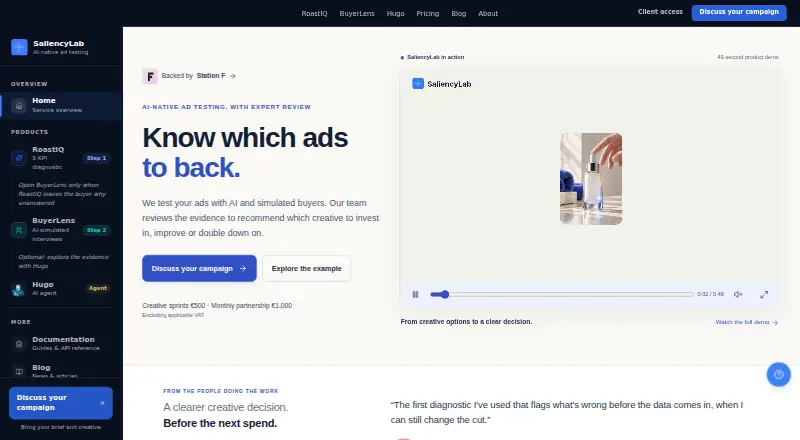
What SaliencyLab is
SaliencyLab is an AI-native ad-testing platform for brands and agencies evaluating creative before media spend. Its RoastIQ diagnostic assesses five KPIs: Beat the Skip, Get Noticed, Brand Impact, Sell Proposition, and Build Brand. BuyerLens runs scenario simulations with synthetic users to explore possible buyer resistance; these are not real consumer panel interviews. The Hugo agent can run RoastIQ, explore synthetic interviews, query benchmarks, and show its reasoning trace through one conversation. Supported creative files are MP4, MOV, JPG, PNG, and WebP, with videos up to 60 seconds; GIF and HEIC are not supported. Listed channels include Instagram Feed, Reels, and Stories, TikTok, YouTube Pre-roll and Shorts, Facebook Feed, and Display; TV is not supported. The company says KPI scores are modeled diagnostics, not predictions of sales, ROAS, attributed conversion, or in-market success. The web and API platform has a free plan with 10 analyses per month, up to three daily, but no BuyerLens, Hugo, or brief generation. Pro costs €99 a month and includes BuyerLens, Hugo, brief generation, MCP access, and report export.
Good
- RoastIQ evaluates creative against five named KPIs.
- BuyerLens explores resistance with synthetic users.
- Hugo can query benchmarks and show its reasoning trace.
- Free plan includes 10 analyses per month.
- Pro includes report export and MCP access.
Watch out
- Synthetic interviews are not a real consumer panel.
- TV advertising is not supported.
- GIF and HEIC are unsupported.
- Scores do not predict sales or ROAS.
Who it suits
SaliencyLab suits brand and agency marketers or strategists who want to assess ad creative before committing media spend. It is especially relevant to teams seeking diagnostic scores or simulated buyer-resistance exploration rather than sales predictions.
Verdict
SaliencyLab offers creative diagnostics and simulated buyer exploration, with a free tier and paid Pro plan at €99 a month. Treat its scores as modeled diagnostics, not forecasts of market performance.
Plans and prices
From SaliencyLab's own pricing page, checked 2 Oct 2026.
| Plan | Price | What it gives you |
|---|---|---|
| Free | Free | 10 analyses/month (up to 3/day) · 5-KPI diagnostic and verdict · platform and category benchmark context · visual attention timeline · 1 teammate seat · no BuyerLens, Hugo, or brief generation · forever |
| Pro | €99 a month | 300 analyses/month (30/day) · BuyerLens up to 12 personas per study and 50 runs/workspace/month · Hugo AI agent · brief generation · up to 5 seats · MCP access · report export · €99/month |
| Launch with Confidence | €500, paid once | One brand · one campaign · up to 6 creatives · prioritized shortlist · annotated frames and editing recommendations · 30-minute decision call · one review of up to 6 revised creatives · €500 / sprint |
| Creative Decision Partner | €1,000 a month | One brand · 2 cycles · up to 6 creatives per cycle · two reserved review slots · two campaign briefs · shared decision log · €1,000 / month |
| Enterprise | Priced on request | Everything in Pro · custom benchmark pools · tailored BuyerLens rollout · custom seats and persona library · dedicated support · contracted support terms · Custom |
The facts
Each one read from SaliencyLab's own pages, with the date it was checked.
What it does
- Accuracy limits
- The company says its five KPI scores are modeled diagnostics and does not claim they predict sales, ROAS, attributed conversion, or in-market success.checked 2 Oct 2026
- Advertising channels
- The pricing FAQ lists Instagram Feed, Reels, and Stories; TikTok; YouTube Pre-roll and Shorts; Facebook Feed; and Display, and says TV is not supported.checked 2 Oct 2026
- AI agent
- Hugo can run RoastIQ, explore synthetic buyer interviews, query benchmarks, and show its reasoning trace through one conversation.checked 2 Oct 2026
- Audience
- SaliencyLab says it is for brands and agencies, including marketers and strategists who need to assess creative before media spend.checked 2 Oct 2026
- Buyer interviews
- BuyerLens runs scenario simulations with synthetic users to explore possible buyer resistance, and is not a real consumer panel.checked 2 Oct 2026
- Certifications
- SaliencyLab says it does not yet hold SOC 2 Type II or ISO/IEC 27001 certifications and relies on the compliance posture of infrastructure providers.checked 2 Oct 2026
- Core diagnostic
- RoastIQ assesses creative against five KPIs: Beat the Skip, Get Noticed, Brand Impact, Sell Proposition, and Build Brand.checked 2 Oct 2026
- Creative formats
- RoastIQ supports MP4, MOV, JPG, PNG, and WebP files, with videos up to 60 seconds; GIF and HEIC are unsupported.checked 2 Oct 2026
- Data protection
- SaliencyLab says customer uploads are not used to train its models and Google Vertex AI API inputs and outputs are not retained for training.checked 2 Oct 2026
- Hosting and retention
- The primary database and object storage are hosted in Supabase EU (Frankfurt); active account uploads and results are retained while the account is active, with deletion from active systems within 30 days after deletion.checked 2 Oct 2026
- Integrations and API
- Pro includes Hugo agent and MCP access for connected AI clients; REST API and webhooks are listed as private preview.checked 2 Oct 2026
- Purpose
- SaliencyLab describes itself as an AI-native ad testing platform that combines AI diagnostics, simulated buyers, and team review to help choose which creative to invest in or improve.checked 2 Oct 2026
- Security
- The security page states that traffic uses TLS 1.3, data at rest is encrypted with AES-256, and workspace isolation is enforced with row-level security.checked 2 Oct 2026
- Support
- The Enterprise plan includes dedicated support and contracted support terms.checked 2 Oct 2026
The company
- Founded
- 2025checked 28 Sep 2026
- Headquarters
- Paris, Francechecked 28 Sep 2026
The full review of SaliencyLab
Overview
SaliencyLab is an AI-native platform for assessing advertising creative through modeled diagnostics, synthetic-buyer scenarios, and team review. It suits brand and agency teams weighing which work to refine before committing media spend. Its structure can make creative review more disciplined, but its scores cannot tell you how a campaign will perform.
Key features
RoastIQ assesses creative across five KPIs: Beat the Skip, Get Noticed, Brand Impact, Sell Proposition, and Build Brand. Its verdict, platform and category benchmark context, and visual attention timeline give teams several angles for comparing work. That makes it useful for deciding what to discuss or revise, not for forecasting commercial results: SaliencyLab does not claim the scores predict sales, ROAS, attributed conversion, or in-market success.
BuyerLens simulates interviews with synthetic users to explore possible buyer resistance. This can help a team interrogate an idea, but it is not evidence from a real consumer panel. Pro supports up to 12 personas per study and 50 runs per workspace each month.
Hugo combines RoastIQ, synthetic interviews, benchmark queries, and a reasoning trace in one conversation. Pro also includes MCP access for connected AI clients. REST API and webhooks are in private preview, so teams that need established programmatic integrations should not choose Pro on that expectation.
RoastIQ accepts MP4, MOV, JPG, PNG, and WebP, with video capped at 60 seconds; GIF and HEIC are unsupported. The supported ad contexts are Instagram Feed, Reels, and Stories, TikTok, YouTube Pre-roll and Shorts, Facebook Feed, and Display. TV is not supported, which rules it out for teams whose review workflow centers on television creative. AI variant generation is not included.
SaliencyLab says customer uploads are not used to train its models, and that Google Vertex AI inputs and outputs are not retained for training. Traffic uses TLS 1.3, stored data is encrypted with AES-256, and workspace isolation uses row-level security. Its primary database and object storage are hosted in Supabase EU (Frankfurt). Active-account uploads and results remain while the account is active; after account deletion, they are removed from active systems within 30 days. The company does not yet hold SOC 2 Type II or ISO/IEC 27001 certifications.
Pricing
The free plan costs nothing, billed forever. It allows 10 analyses per month, up to three per day, and includes the five-KPI diagnostic and verdict, benchmark context, visual attention timeline, and one teammate seat. It excludes BuyerLens, Hugo, and brief generation. This is a sensible way for a solo reviewer to assess a small volume of creative, but the daily and monthly caps and lack of simulated interviews make it a limited team workflow.
Pro costs €99 a month, billed €99/month. It raises capacity to 300 analyses monthly, up to 30 per day, and adds BuyerLens, Hugo, brief generation, MCP access, report export, and up to five seats. The combination fits teams that need recurring diagnostics and collaborative exploration; it still offers modeled analysis rather than validated market prediction, and BuyerLens runs remain capped at 50 per workspace monthly.
Launch with Confidence costs €500, paid once, billed €500 / sprint. It covers one brand and campaign, up to six creatives, a prioritized shortlist, annotated frames and editing recommendations, a 30-minute decision call, and one review of up to six revised creatives. It is better suited to a defined campaign decision than ongoing high-volume use.
Creative Decision Partner costs €1,000 a month, billed €1,000 / month. It provides one brand, two cycles, up to six creatives per cycle, two reserved review slots, two campaign briefs, and a shared decision log. That service-oriented cadence may suit teams wanting recurring structured decisions, but the creative ceiling is modest for broad testing programs.
Enterprise has custom pricing and includes everything in Pro, custom benchmark pools, a tailored BuyerLens rollout, custom seats and persona library, dedicated support, and contracted support terms. It is the plan for organizations needing tailored scale or support arrangements; those needs are not covered by the fixed-seat Pro tier.
Platforms
SaliencyLab is available on web and through an API. Pro includes MCP access, while REST API and webhooks remain in private preview. The combination is most useful to teams comfortable with a web workflow and connected AI clients; teams requiring mature API or webhook access should wait.
Who it's for
SaliencyLab is aimed at brands and agencies, particularly marketers and strategists who want to assess creative before media spend. It is a good fit when the goal is to compare, critique, or improve a manageable set of digital ads. It is a poor fit when decisions require actual consumer-panel evidence, a reliable sales forecast, TV support, or AI-generated variants.
Pros and cons
- Pros: Five defined creative KPIs, benchmark context, and an attention timeline give review discussions a consistent frame.
- Pros: Pro combines diagnostics, synthetic-buyer exploration, reporting, and up to five seats for teams working across review stages.
- Pros: A forever-free plan permits up to 10 analyses monthly, enough for occasional evaluation without a subscription.
- Cons: Synthetic interviews are not real-panel research, and KPI scores are not claims about sales or campaign outcomes.
- Cons: The free tier omits BuyerLens and Hugo, while Pro limits BuyerLens to 50 runs per workspace each month.
- Cons: GIF, HEIC, TV, AI variant generation, and production-ready REST API or webhook access are absent.
Alternatives
Ad Creative Testing Tools is the broader category list for comparing options.
Choose Lumen Research if you want an attention-technology suite spanning Android, iOS, macOS, Windows, web, and browser extension; its pricing is custom, with a demo requested.
Kettio is another freemium web and API option; its free tier scores 20 ads monthly, allows two ads per comparison, and includes four pre-built buyer personas.
Marpipe is a freemium web and extension option whose free Catalog Creative plan supports exploring design possibilities, previewing generative designs, and launching DPA on all platforms.
AdTest.AI is a paid alternative with a free trial and Creator plan at $30 a month, including 20 credits at $1.50 per test.
RealEye is a paid alternative with a free trial; its Basic annual plan costs $325 a month and includes unlimited studies and 20 own participants per month.
Predis.ai is a paid alternative with a free trial and a Core plan at $24 a month, billed $288 Billed Yearly, with 1,300 credits monthly and publishing to 10 channels.
Toluna Creative Pre-Test Instant is another paid web option.
Watchable is another paid web option.
Verdict
SaliencyLab is best for brand and agency teams that want a repeatable way to diagnose and refine digital creative before media spend, especially when Pro’s synthetic interviews and team tools are useful. Its principal limitation is decisive: modeled scores and simulated buyers cannot replace real consumer evidence or predict campaign results. Choose it for structured creative discussion, not as proof that an ad will work.