Rust Playground
Rust Playground is a web tool for trying Rust when a local installation or compiler is unavailable.
What Rust Playground is
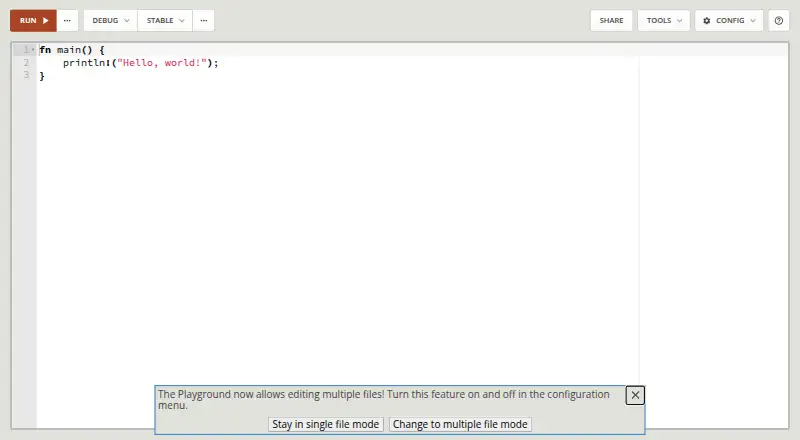
Rust Playground is a web tool for trying Rust when a local installation or compiler is unavailable. Its editor offers syntax highlighting, and code can be compiled in debug or release mode using the stable, beta, or nightly Rust channel. The available crates include the top 100 by all-time downloads, crates from the Rust Cookbook, and their dependencies; some may be excluded if they do not compile on Linux or stable Rust, or have invalid feature selections. Users can run rustfmt and Clippy, and inspect LLVM IR, assembly, or Rust MIR. Code can be loaded from or saved to a GitHub Gist and shared. Rust documentation and mdbook examples can link code to the Playground for running or editing. Docker containers provide and isolate compilers and tools, but compilation and execution have no outside network access and are subject to memory and time limits. The most recently entered code is automatically stored in browser local storage, shared across windows as one resource. The project is open source under Apache License 2.0 or MIT. A self-hosted server requires a configured GitHub token for loading and saving Gists. The free plan costs nothing.
Good
- Compile against stable, beta, or nightly Rust.
- Run rustfmt and Clippy in the editor.
- Inspect LLVM IR, assembly, or Rust MIR.
- Share code through GitHub Gists.
- Supports runnable documentation and mdbook examples.
Watch out
- Compilation and execution have no network access.
- Memory and compilation or execution time are limited.
- Some otherwise eligible crates are excluded.
- Self-hosted Gist access requires a GitHub token.
Who it suits
Rust Playground suits people who want to experiment with code without a local compiler, or who want to share runnable examples through Gists. Developers considering self-hosting should account for the GitHub token requirement for Gist access.
Verdict
Rust Playground brings compilation, formatting, linting, and code inspection into a browser workflow. Network isolation, resource limits, and crate eligibility constraints shape what code can run there.
Plans and prices
From Rust Playground's own pricing page, checked 12 Oct 2026.
| Plan | Price | What it gives you |
|---|---|---|
| Free | Free | Compilation and execution time limited · Memory limited · No network access during compilation or execution |
The facts
Each one read from Rust Playground's own pages, with the date it was checked.
What it does
- Audience
- The Playground is for experimenting with Rust when a local installation or compiler is unavailable.checked 12 Oct 2026
- Available crates
- It provides the top 100 crates by all-time downloads, Rust Cookbook crates, and their dependencies.checked 11 Oct 2026
- Code persistence
- The most recently entered code is automatically saved in browser local storage, which is shared across windows as a single resource.checked 12 Oct 2026
- Code tools
- Users can run rustfmt and Clippy and inspect LLVM IR, assembly, or Rust MIR.checked 11 Oct 2026
- Compiler output
- It can display LLVM IR, assembly, or Rust MIR for source code.checked 12 Oct 2026
- Crate availability
- Some otherwise eligible crates may be excluded if they do not compile on Linux or stable Rust, or have invalid feature flag selections.checked 12 Oct 2026
- Crates
- It includes the top 100 crates by all-time downloads, crates from the Rust Cookbook, and their dependencies.checked 12 Oct 2026
- Deployment options
- nonechecked 22 Sep 2026
- Disk limitation
- The project README says its sandbox has no disk space limits and recommends limiting the temporary directory when running a server.checked 11 Oct 2026
- Editor
- It provides a browser editor with syntax highlighting.checked 12 Oct 2026
- Full-stack runtime
- Nochecked 22 Sep 2026
- Gist setup
- For a self-hosted server, a GitHub token must be configured to load and save gists.checked 11 Oct 2026
- Integration
- Rust documentation and mdbook examples can link code to the Playground for users to run or edit.checked 12 Oct 2026
- Integrations
- The interface uses React, the backend uses Axum, and code sharing uses GitHub Gist.checked 11 Oct 2026
- Isolation
- Docker containers provide compilers and tools and help isolate them; compiler containers have no network connection to the outside world.checked 12 Oct 2026
- Network limit
- Compiler containers have no network connection to the outside world.checked 11 Oct 2026
- Open source
- The repository is licensed under Apache License 2.0 or MIT, at the user's option.checked 11 Oct 2026
- Purpose
- The Playground lets people experiment with Rust before installing it locally or when a compiler is unavailable.checked 12 Oct 2026
- Resource limits
- Compiler and executable memory use and total compilation and execution time are limited by the container.checked 12 Oct 2026
- Rust channels
- Code can be compiled in debug or release mode against stable, beta, or nightly Rust.checked 12 Oct 2026
- Rust versions and modes
- Users can compile in debug or release mode with the current stable, beta, or nightly Rust channel.checked 11 Oct 2026
- Security reporting
- The Playground follows the Rust organization’s security reporting procedures for vulnerability reports.checked 12 Oct 2026
- Self-hosting
- The project documents how to build and run the server and download its compiler containers; a GitHub token is required to load and save Gists on a self-hosted server.checked 12 Oct 2026
Money
- Free plan
- Yeschecked 22 Sep 2026
Alternatives to Rust Playground
- 1

Replit
Free planAndroidiOSWebLinux8.4From $18 a month - 2

Playcode
Free planAndroidiOSWebAPI8.2From $25 a month - 3

StackBlitz
Free planAndroidiOSWebAPI8.2Free plan - 4

JDoodle
Free planAndroidiOSWebAPI8.0From $4 a month - 5

CodeHS
Free planAndroidiOSWeb7.6From $990 a year - 6

Google Colab
Free planWebAPIExtensionSelf-hosted7.6Free plan