RunbookAI
RunbookAI is a self-hosted, open-source tool for investigating production incidents.
What RunbookAI is
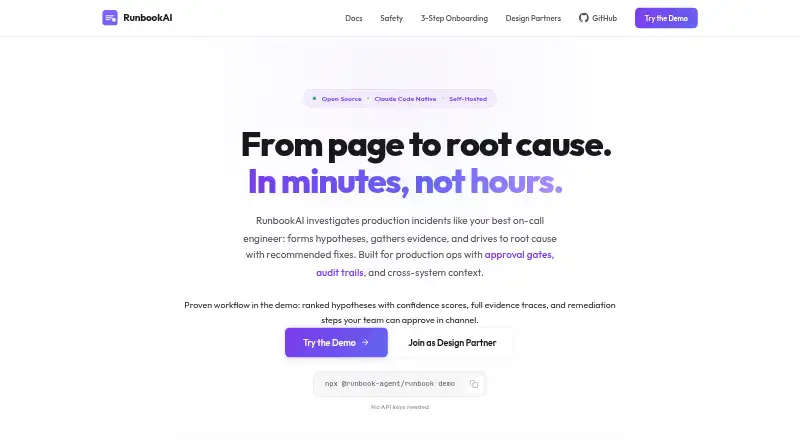
RunbookAI is a self-hosted, open-source tool for investigating production incidents. Its workflow gathers incident context, ranks possible explanations, checks them against infrastructure, identifies a root cause, and recommends remediation. Users can ask natural-language questions across AWS, Kubernetes, and CloudWatch, or run step-by-step runbooks. Infrastructure queries are read-only by default, and every action that changes infrastructure requires explicit human approval. RunbookAI records hypotheses, evidence, proposed actions, approval decisions, and execution results locally. It can index operational knowledge from local files, Confluence, and Google Drive. Documented integrations include AWS, Kubernetes, PagerDuty, OpsGenie, Slack, and Claude Code. A self-hosted shared knowledge server offers runbooks, postmortems, and known issues through a REST API and an MCP endpoint; CLI mode is also available. The maker says it runs within the user's infrastructure, sends no telemetry, and sends LLM calls directly to the configured provider without proxying or storing prompts. Requirements include Bun 1.0+ or Node.js 20+ and an Anthropic API key for Claude. There is no hosted service or control plane.
Good
- Infrastructure queries are read-only by default
- Mutating actions require human approval
- Local audit trail records investigation and execution
- Indexes local files, Confluence, and Google Drive
- MIT-licensed and self-hosted
Watch out
- No hosted service or control plane
- Requires Bun 1.0+ or Node.js 20+
- Claude use requires an Anthropic API key
Who it suits
RunbookAI is aimed at SRE teams investigating production workloads, particularly teams running AWS and Kubernetes. It suits teams prepared to self-host and meet its runtime and API-key requirements.
Verdict
RunbookAI puts incident investigation, runbooks, and shared operational knowledge under a team's own deployment. Teams should be prepared to manage self-hosting and the listed runtime and provider requirements.
The facts
Each one read from RunbookAI's own pages, with the date it was checked.
What it does
- Audit trail
- RunbookAI logs investigation hypotheses, evidence, proposed actions, approval decisions and execution results locally.checked 4 Oct 2026
- Claude Code
- The shared knowledge server exposes an MCP endpoint that Claude Code can use to query operational knowledge.checked 4 Oct 2026
- Data handling
- The maker says RunbookAI runs within the user's infrastructure, sends no telemetry, and sends LLM calls directly to the configured provider without proxying or storing prompts.checked 4 Oct 2026
- Deployment
- RunbookAI offers CLI mode and a self-hosted shared knowledge server, with no hosted service or control plane.checked 4 Oct 2026
- Deployment and license
- RunbookAI is self-hosted and released under the MIT License.checked 4 Oct 2026
- Incident workflow
- Its investigation workflow gathers incident context, ranks hypotheses, tests them against infrastructure, identifies a root cause and suggests remediation.checked 4 Oct 2026
- Infrastructure queries
- The CLI supports natural-language queries across AWS, Kubernetes, and a knowledge base.checked 4 Oct 2026
- Integrations
- Documented integrations include AWS, Kubernetes, PagerDuty, OpsGenie, Slack and Claude Code.checked 4 Oct 2026
- Intended users
- The maker describes it as an incident-response tool for SRE teams and is onboarding teams running production workloads on AWS and Kubernetes.checked 4 Oct 2026
- Investigation
- Its investigation workflow gathers incident context, tests ranked hypotheses against infrastructure, and suggests remediation steps.checked 4 Oct 2026
- Knowledge sources
- RunbookAI can index knowledge from local files, Confluence and Google Drive.checked 4 Oct 2026
- Open source
- RunbookAI is released under the MIT License.checked 4 Oct 2026
- Purpose
- RunbookAI investigates production incidents by forming hypotheses, gathering evidence and recommending fixes.checked 4 Oct 2026
- Requirements
- The documentation lists Bun 1.0+ or Node.js 20+ and an Anthropic API key for Claude as requirements.checked 4 Oct 2026
- Runbooks
- It can execute step-by-step runbooks, with approval gates for mutating actions.checked 4 Oct 2026
- Safety
- Infrastructure queries are read-only by default, and every mutating action requires explicit human approval.checked 4 Oct 2026
- Safety controls
- Every mutating action requires explicit human approval, while infrastructure queries are read-only by default.checked 4 Oct 2026
- Shared knowledge server
- A self-hosted server lets a team query shared runbooks, postmortems and known issues through a REST API and an MCP endpoint.checked 4 Oct 2026
- Support
- The documentation directs users with questions or issues to GitHub Issues or Discussions.checked 4 Oct 2026
Alternatives to RunbookAI
- 1
 7.2Free plan
- 2

Tines
Free planWebAPILinuxSelf-hosted7.2Free plan - 3

Rundeck
Free planWebAPILinuxmacOS6.8Free plan - 4

StackStorm
Free planWebAPILinuxSelf-hosted6.4Free plan - 5
Parachute
WebAPI6.3From $49 a month - 6
Shuffle
Free planWebAPILinuxSelf-hosted6.3Free plan