RTMsim
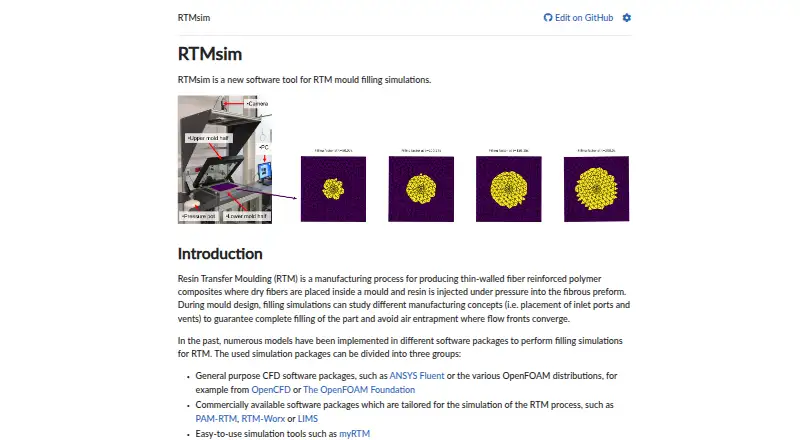
The facts below are what the maker publishes about RTMsim, checked and dated. Our editors have not written about it yet.
The facts
Each one read from RTMsim's own pages, with the date it was checked.
What it does
- Command line and API
- After installing the Julia package, users can run simulations and access RTMsim functions without using the GUI.checked 11 Oct 2026
- Data export
- Yeschecked 24 Sep 2026
- Delivery mode
- desktopchecked 24 Sep 2026
- Extensibility
- Additional equations, such as degree-of-cure modeling, can be added, and existing equations can be modified for cases such as variable cavity thickness.checked 12 Oct 2026
- GUI
- The GUI can start and continue simulations, inspect meshes and plot filling and pressure distributions.checked 11 Oct 2026
- Headless limitation
- The repository README says running RTMsim on headless machines is currently unsupported due to package GLMakie issues.checked 12 Oct 2026
- Inlet selection
- Users can select inlet ports interactively, and the tutorials describe cascade injection using additional inlet ports.checked 11 Oct 2026
- Installation requirement
- RTMsim was developed and tested with Julia 1.8 and is installed through Julia’s package manager from its GitHub repository.checked 12 Oct 2026
- Intended users
- The documentation describes using filling simulations during mould design to study inlet and vent placement and avoid incomplete filling or trapped air.checked 12 Oct 2026
- Interface and plotting
- The GUI supports mesh inspection, simulation start and continuation, interactive inlet selection, and plots of filling and pressure results.checked 12 Oct 2026
- License
- The public repository identifies RTMsim as licensed under GPL-2.0.checked 12 Oct 2026
- Material properties
- Users can specify preform thickness, porosity, permeability and principal permeability directions for multiple regions.checked 11 Oct 2026
- Mesh accuracy
- The documentation says a mesh refinement study is needed because coarse meshes can predict filling time with an error of approximately 20% in the described case.checked 11 Oct 2026
- Mesh input
- The simulation uses a three-node triangular shell mesh on the part’s mid-surface, which must be generated with a separate meshing tool.checked 11 Oct 2026
- Mesh limitation
- RTMsim does not include mesh generation; a compatible triangular shell mesh with predefined regions must be prepared separately.checked 11 Oct 2026
- Model capabilities
- The documentation says the model targets accurate filling patterns and filling times and supports non-isotropic preform permeability.checked 12 Oct 2026
- Offline access
- Yeschecked 24 Sep 2026
- Programming interface
- The installed package exposes functions for running simulations and plotting meshes, sets, and results without using the GUI.checked 12 Oct 2026
- Purpose
- RTMsim is a Julia module for simulating resin transfer mould filling.checked 12 Oct 2026
- Simulation inputs
- The model uses a triangular shell mesh of the part’s mid-surface, with cell sets for injection ports and regions with differing preform thickness, porosity, and permeability.checked 12 Oct 2026
- Simulation model
- The model simulates flow through a porous cavity and tracks the flow front using a volume-of-fluid equation.checked 11 Oct 2026
Money
- Free plan
- Yeschecked 24 Sep 2026
Where it runs
- Linux limitation
- The Linux GUI is described as experimental, and the documented Linux workflow runs simulations from the Julia terminal.checked 12 Oct 2026
- Linux support
- The Linux GUI is described as experimental; the guide documents running simulations from the Julia terminal.checked 11 Oct 2026
Alternatives to RTMsim
- 1

SimFlow
Free planWebLinuxmacOSWindows8.2From €8,000 a year - 2

COMSOL Multiphysics
WebAPILinuxmacOS7.7 - 3
FeenoX
Free planWebAPILinuxSelf-hosted7.5Free plan - 4
myPhysicsLab
Free planWebLinuxmacOSSelf-hosted7.5Free plan - 5

OpenFOAM
Free planLinuxmacOSSelf-hostedWindows7.3Free plan - 6
MPTRAC
Free planWebLinuxSelf-hosted7.2Free plan