rPraxis
rPraxis is web-based software from Bray Health that builds full-year residency rotation schedules with constraint optimization.
What rPraxis is
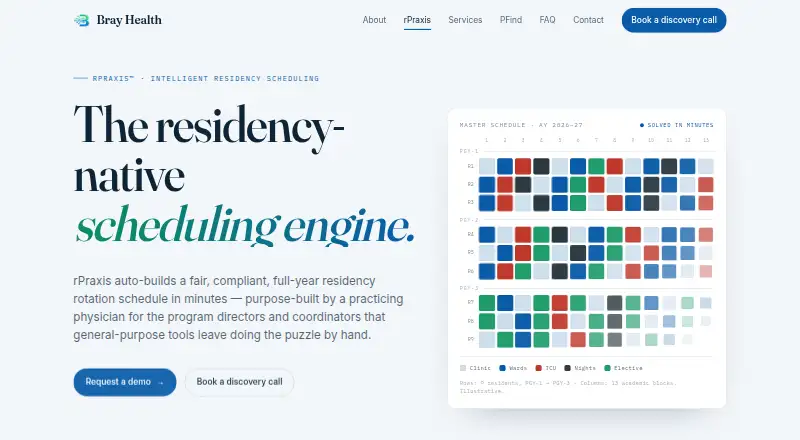
rPraxis is web-based software from Bray Health that builds full-year residency rotation schedules with constraint optimization. Programs configure their X+Y pattern, academic-year dates, and cycle length. Scheduling places continuity-clinic weeks first, assigns core services next, then fills remaining blocks with subspecialty and elective rotations. Its engine uses Google OR-Tools CP-SAT. Programs can manage residents by PGY level, cohort, and continuity group, with bulk CSV import available. The system tracks accreditation and specialty-specific graduation requirements alongside residents’ cumulative completion history. Residents use token login to view schedules and submit rotation preferences. Role-based access is scoped to superadmins, program directors, APDs, PAs, office managers, and chief residents, and each program has an isolated SQLite database. The product page states that it uses secure authentication and role-based access; Bray Health describes isolated cloud infrastructure, encryption in transit and at rest, and audit logging for its solutions. rPraxis is aimed mainly at internal medicine residencies of about 25–60 residents, though fellowships and other block- or X+Y-scheduled specialties are also identified as potential users. Its focus is full-year rotation schedules, not call or shift scheduling. Pricing is on request.
Good
- Builds full-year schedules using constraint optimization
- Supports X+Y patterns and academic-year configuration
- Tracks graduation requirements and cumulative completion
- Residents can submit preferences through token login
- Includes bulk resident import by CSV
Watch out
- Pricing is available on request
- Call and shift scheduling are outside its focus
- Not affiliated with or endorsed by an accrediting body
Who it suits
rPraxis is aimed primarily at mid-size internal medicine residency programs of about 25–60 residents. Fellowships and other specialties using block or X+Y schedules may also be a fit if they need annual rotation scheduling rather than call or shift scheduling.
Verdict
rPraxis focuses on the annual rotation-planning process, including resident records, requirements tracking, and preference submissions. Programs should assess whether its full-year scope fits their needs and request pricing through Bray Health.
Plans and prices
From rPraxis's own pricing page, checked 7 Oct 2026.
| Plan | Price | What it gives you |
|---|---|---|
| Per-program annual license | Priced on request | No per-resident fees · No seat math · No surprise add-ons · Annual; pricing scoped to your program on a short discovery call |
The facts
Each one read from rPraxis's own pages, with the date it was checked.
What it does
- Access controls
- Role-based access is scoped for superadmins, program directors, APDs, PAs, office managers, and chief residents.checked 7 Oct 2026
- Accreditation disclaimer
- rPraxis is described as an independent scheduling solution not affiliated with, accredited by, or endorsed by an accrediting body.checked 7 Oct 2026
- Data isolation
- Each program has its own isolated SQLite database.checked 7 Oct 2026
- Intended users
- The product is aimed primarily at mid-size internal medicine residencies of about 25–60 residents, with fellowships and other block- or X+Y-scheduled specialties also identified as potential users.checked 7 Oct 2026
- Notable limit
- The product page says rPraxis optimizes full-year academic rotation schedules, while call and shift scheduling are described as outside its focus.checked 7 Oct 2026
- Program setup
- Programs can configure their X+Y pattern, academic-year dates, and cycle length.checked 7 Oct 2026
- Purpose
- rPraxis builds full-year residency rotation schedules automatically using constraint optimization.checked 7 Oct 2026
- Requirements tracking
- The product tracks accreditation and specialty-specific graduation requirements and residents’ cumulative completion history.checked 7 Oct 2026
- Resident management
- Resident records include PGY level, cohort, and continuity group, with bulk CSV import.checked 7 Oct 2026
- Resident portal
- Residents use token login to view schedules and submit rotation preferences.checked 7 Oct 2026
- Scheduling process
- It places continuity-clinic weeks first, assigns core services next, then fills remaining blocks with subspecialty and elective rotations.checked 7 Oct 2026
- Security
- The product page states that it uses secure authentication and role-based access; Bray Health’s FAQ describes isolated cloud infrastructure, encryption in transit and at rest, and audit logging for its solutions.checked 7 Oct 2026
- Solver
- The scheduling engine uses Google OR-Tools CP-SAT.checked 7 Oct 2026
- Support and sales
- Bray Health invites programs to request a demo or book a discovery call, and says its team builds, deploys, and supports the tools it recommends.checked 7 Oct 2026
The company
- Headquarters
- Gainesville, Florida, United Stateschecked 28 Sep 2026
Alternatives to rPraxis
- 1
Amion
AndroidiOSWebAPI7.8From $399 a year - 2

CoverED
AndroidiOSWeb6.8From $30 a month - 3
MedRez.net
AndroidiOSWeb6.6From $450 a year - 4
Resident Vacation Scheduler
Free planiOS6.6$299 one-time - 5
TigerConnect Physician Scheduling
AndroidiOSWebAPI6.6 - 6
MyEvaluations
AndroidiOSWeb6.5From $299 a month