Routerly
Routerly is a self-hosted gateway that routes application requests to AI providers, tracks usage costs, and enforces budgets.
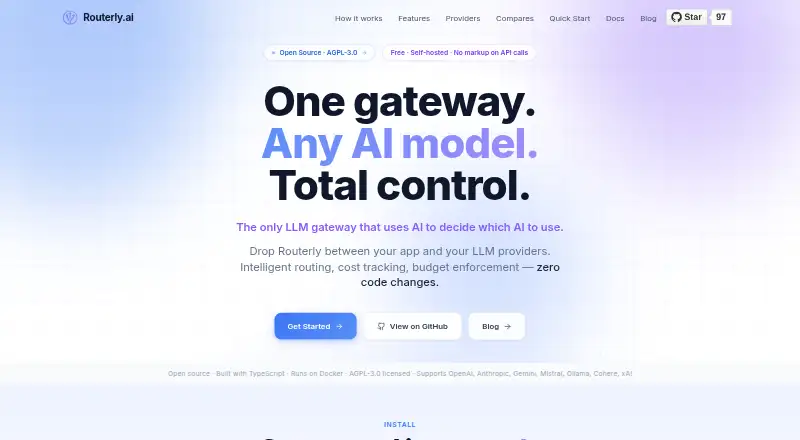
What Routerly is
Routerly is a self-hosted gateway that routes application requests to AI providers, tracks usage costs, and enforces budgets. Its configurable policies cover model choice, cost, provider health and performance, capability and context, budgets, rate limits, and fairness. Routerly accepts OpenAI and Anthropic wire formats, including streaming, so compatible clients can connect by changing the base URL. Supported providers include OpenAI, Anthropic, Google Gemini, Ollama, Mistral, Cohere, xAI, and custom HTTP endpoints. Cost tracking works per token with built-in pricing presets or custom model prices. Budgets can be set globally, per project, or per token, and can measure cost, calls, or token use over rolling or calendar periods. Projects can keep separate tokens, model pools, routing settings, and budget limits. Routerly stores configuration and usage records in JSON files without requiring an external database. It can be deployed with Docker or an installer on Windows, macOS, or Linux. The self-hosted software is free under AGPL-3.0 and adds no markup to API calls.
Good
- Free self-hosted software under AGPL-3.0
- Supports OpenAI and Anthropic formats with streaming
- Budget limits can track cost, calls, or tokens
- Project-specific tokens, model pools, and settings
- No external database required
Watch out
- Requires self-hosted deployment
- Prompts and API keys remain on the user's infrastructure
Who it suits
Routerly is aimed at developers and teams, including SaaS groups and local-first projects, that want to manage AI-provider routing and budgets on their own infrastructure. It may suit users who need project-level separation and compatible OpenAI- or Anthropic-format clients.
Verdict
Routerly brings provider routing, cost visibility, and budget controls into a self-hosted gateway. Its infrastructure control and configuration flexibility come with the requirement to deploy and operate it yourself.
Plans and prices
From Routerly's own pricing page, checked 30 Sep 2026.
| Plan | Price | What it gives you |
|---|---|---|
| Free self-hosted | Free | Free · Self-hosted · No markup on API calls · AGPL-3.0 |
The facts
Each one read from Routerly's own pages, with the date it was checked.
What it does
- API compatibility
- It supports OpenAI and Anthropic wire formats with streaming, so clients can use Routerly by changing the base URL.checked 30 Sep 2026
- Budget controls
- Budgets can be set globally, per project, or per token, and can track cost, calls, or token usage over rolling or calendar windows.checked 30 Sep 2026
- Data handling
- Routerly is self-hosted, and its maker says prompts and API keys stay on the user's infrastructure.checked 30 Sep 2026
- Deployment
- The maker provides Docker and installer-based deployment, and says the installer supports Windows, macOS, and Linux.checked 30 Sep 2026
- Integrations
- The site names Cursor, Open WebUI, OpenClaw, LangChain, and LlamaIndex as clients or frameworks that can connect to Routerly.checked 30 Sep 2026
- Intended users
- The site describes Routerly as built for developers and use cases ranging from indie projects to enterprise deployments, including SaaS teams and local-first development.checked 30 Sep 2026
- License and pricing
- Routerly is free to self-host under the AGPL-3.0 license, and the site says it adds no markup to API calls.checked 30 Sep 2026
- Product
- Routerly is a self-hosted gateway between applications and AI providers that routes requests, tracks costs, and enforces budgets.checked 30 Sep 2026
- Project isolation
- Each project can have separate Bearer tokens, model pools, routing configuration, and budget limits.checked 30 Sep 2026
- Providers
- Supported providers include OpenAI, Anthropic, Google Gemini, Ollama, Mistral, Cohere, xAI, and custom HTTP endpoints.checked 30 Sep 2026
- Routing
- Its routing engine uses up to nine configurable policies, including LLM selection, cost, health, performance, capability, context, budget, rate limits, and fairness.checked 30 Sep 2026
- Security
- The documentation says provider API keys and project tokens are AES-256 encrypted at rest, and user passwords are bcrypt-hashed.checked 30 Sep 2026
- Storage and dependencies
- Routerly stores configuration and usage records in JSON files and does not require an external database.checked 30 Sep 2026
Money
- Cost tracking
- Routerly tracks per-token costs and supports built-in pricing presets and custom model pricing.checked 30 Sep 2026
The full review of Routerly
Routerly is a self-hosted gateway for developers who want to manage AI provider routing, costs, and budgets in one place. It is strongest for teams that value control over infrastructure and project-level settings; running the gateway yourself is part of the deal.
Overview
Routerly sits between applications and AI providers, giving developers a shared point for routing requests and tracking usage. It supports OpenAI and Anthropic wire formats, including streaming, so compatible clients can connect by changing the base URL. Supported providers include OpenAI, Anthropic, Google Gemini, Ollama, Mistral, Cohere, xAI, and custom HTTP endpoints.
Projects can have separate Bearer tokens, model pools, routing configurations, and budget limits. Routerly stores configuration and usage records in JSON files rather than requiring an external database. Its maker says prompts and API keys stay on the user's infrastructure; provider API keys and project tokens are AES-256 encrypted at rest, while user passwords are bcrypt-hashed.
Key features
Policy-based routing
Up to nine configurable policies cover model selection, cost, provider health, performance, capability, context, budget, rate limits, and fairness. This breadth gives teams room to shape routing around operational priorities, while also making Routerly more than a simple pass-through. Fallback routing is supported for directing requests elsewhere when needed.
Cost tracking and budgets
Per-token cost tracking uses built-in pricing presets or custom model pricing. Budgets can apply globally, per project, or per token, and measure cost, calls, or token usage across rolling or calendar windows. That granularity is useful for keeping separate projects within limits, though teams must configure their own gateway and model pricing.
Client compatibility
The OpenAI and Anthropic wire formats and streaming support let compatible applications connect through a base-URL change. Routerly names Cursor, Open WebUI, OpenClaw, LangChain, and LlamaIndex among the clients and frameworks that can connect to it.
Pricing
Free self-hosted: free. The plan is self-hosted, licensed under AGPL-3.0, and adds no markup to API calls. It is a practical fit for developers and teams willing to operate their own gateway; there is no paid hosted tier or trial described in this offer. Provider API usage remains subject to the providers themselves.
The trade-off is operational responsibility: Docker and installer-based deployment are provided, but Routerly is not a managed service. The installer supports Windows, macOS, and Linux.
Platforms
Routerly supports API, Linux, macOS, self-hosted, web, and Windows. Docker and installer-based deployment give teams multiple ways to run it, including on the major desktop operating systems.
Who it's for
Routerly suits developers, SaaS teams, and local-first projects that want configurable provider routing, cost tracking, and budget controls without handing prompt traffic to a hosted gateway. Its project isolation can help teams separate credentials and limits. It is a poor fit for buyers seeking a managed gateway or those unwilling to deploy and maintain infrastructure.
Pros and cons
- Pros: Up to nine routing policies and fallback routing give teams meaningful control over request handling.
- Pros: Project-specific tokens, model pools, routing, and budgets support separation between workloads.
- Pros: JSON storage avoids an external database dependency, and the self-hosted AGPL-3.0 offer adds no markup to API calls.
- Cons: Self-hosting means deployment and operation remain the user's responsibility.
- Cons: Cost visibility depends on configuring pricing presets or custom model prices to match the models in use.
Alternatives
For more options, browse LLM Gateway Software.
- YoloRouter is another free self-hosted option; choose it if a single binary with SQLite out of the box and optional PostgreSQL better suits your deployment.
- Kong Gateway has an open-source gateway at no cost and a Konnect free trial; consider it if you want an API gateway rather than a gateway centered on AI provider routing.
- Apache APISIX is a free, self-hosted API gateway option.
- Manifest offers unlimited self-hosted use on its Free plan, alongside cloud routing capped at 10,000 requests per month; consider it if those cloud request terms fit better.
- OpenRouter offers hosted access to 25+ free models from four free providers, with 50 requests per day and five workspaces on Free; pick it if those hosted model options are preferable to operating your own gateway.
- Requesty offers 200 requests per day on Free, including routing, caching, fallbacks, spend tracking, analytics, and EU data residency; consider it if a hosted free tier and daily request allowance suit your needs.
- Helicone is a freemium, open-source alternative for API, self-hosted, and web use.
- LiteLLM offers a free, self-hosted open-source plan with 100+ providers, virtual keys, spend tracking, budgets, and rate limits; consider it if that stated provider breadth and feature set is the better match.
Verdict
Choose Routerly if you want an infrastructure-controlled gateway with flexible provider routing, per-token cost visibility, and budgets that can be scoped to projects and tokens. Its free, no-markup, AGPL-3.0 self-hosted offer is compelling for developers prepared to run it themselves. Look elsewhere if you need a managed service rather than another system to deploy and operate.
Getting started
- Open the Routerly website.
- Choose Docker or installer-based deployment.
- Install on Windows, macOS, or Linux, or use Docker.
- Connect a compatible client using the Routerly base URL.
- Configure providers, routing policies, and budgets.
Limits worth knowing
The free plan is self-hosted and licensed under AGPL-3.0. API calls have no Routerly markup.
Questions
How much does Routerly cost?
The Free self-hosted plan is free. Routerly adds no markup to API calls.
Is there a free plan or trial?
Routerly offers a free self-hosted plan. There is no free trial.
Which platforms does Routerly support?
Routerly lists API, Linux, macOS, self-hosted, web, and Windows platforms. Its installer supports Windows, macOS, and Linux.
Which AI providers can connect?
Supported providers include OpenAI, Anthropic, Google Gemini, Ollama, Mistral, Cohere, xAI, and custom HTTP endpoints.
Which clients or frameworks integrate with Routerly?
The site names Cursor, Open WebUI, OpenClaw, LangChain, and LlamaIndex as clients or frameworks that can connect.
What license does Routerly use?
Routerly is free to self-host under the AGPL-3.0 license.
Alternatives to Routerly
- 1
Manifest
Free planOpen sourceWebAPILinuxSelf-hosted8.7From $19 a month - 2

LangSmith
Free planWebAPILinuxmacOS8.6$39 usage-based - 3

Bifrost
Free planOpen sourceWebAPILinuxmacOS8.3Free plan - 4
LLM Gateway
Free planOpen sourceWebAPIExtensionLinux8.2Free plan - 5
Eden AI
WebAPI8.1$5.50 one-time - 6
TrueFoundry AI Gateway
Free planWebAPILinuxSelf-hosted8.0From $499 a month