
Bifrost
Bifrost is an AI gateway and control plane for routing, governing, and securing traffic involving model calls, MCP tools, and agents.
What Bifrost is
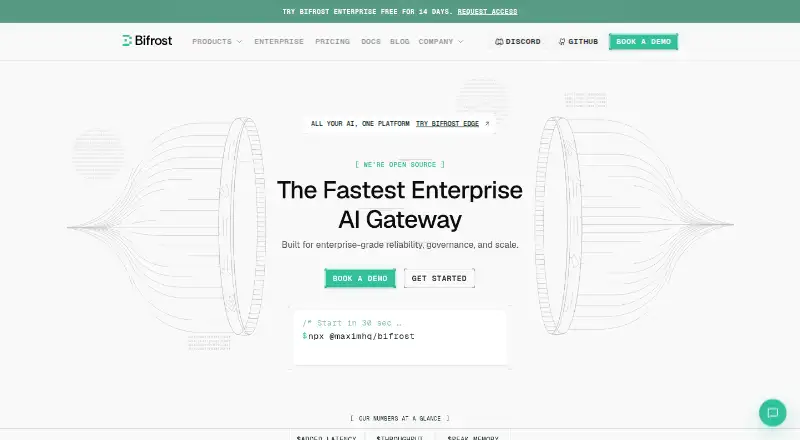
Bifrost is an AI gateway and control plane for routing, governing, and securing traffic involving model calls, MCP tools, and agents. It provides access to more than 20 AI providers through a single OpenAI-compatible API. Weighted load balancing, retries, provider failover, and semantic caching support request routing and reliability. Virtual keys let teams set permissions, budgets, rate limits, and routing for each consumer. Bifrost can connect to external MCP tool servers and expose their tools to clients such as Claude Desktop. Documented SDK integrations include OpenAI, Anthropic, Google GenAI, LiteLLM, and LangChain. Built-in monitoring, Prometheus metrics, and OpenTelemetry tracing integrations cover observability. The free OSS edition is aimed at developers, small teams, and self-managed deployments; it can run through NPX, Docker, Kubernetes, or a Go binary. Enterprise adds controls including SSO, role-based access, audit logs, guardrails, vault integrations, and private VPC deployments. Enterprise pricing is custom, and an enterprise license is available with a 14-day trial. OSS support includes documentation, community, and self-management; Enterprise includes SLA-backed support and direct access to engineers.
Good
- Free OSS edition is available for self-hosting.
- Connects to 20+ providers through one API.
- Supports retries, load balancing, and provider failover.
- Virtual keys control permissions, budgets, and rate limits.
- Includes monitoring and tracing integrations.
Watch out
- Enterprise pricing is custom.
- OSS support is documentation, community, and self-management.
- Enterprise trial lasts 14 days.
Who it suits
The OSS edition suits developers and small teams that can manage a self-hosted deployment. Enterprise targets teams running production AI systems at scale and needing additional controls or SLA-backed support.
Verdict
Bifrost centralizes provider access, routing, and controls for AI traffic, with a free self-managed edition and a separate Enterprise offering. Teams should weigh the OSS support model against Enterprise controls and support requirements.
Plans and prices
From Bifrost's own pricing page, checked 21 Oct 2026.
| Plan | Price | What it gives you |
|---|---|---|
| OSS | Free | self-hosted Docker, Kubernetes or Go binary · drop-in API · observability · budgets and virtual keys · routing rules · CLI · fallbacks · caching · MCP gateway · plugins · free forever |
| Enterprise | Priced on request | OSS features · guardrails · cluster mode · adaptive load balancing · SAML/OIDC SSO · vault integrations · federated MCP authentication · log exports · audit logs · RBAC · SLA-backed support · VPC/on-prem/air-gapped deployment · custom pricing |
The facts
Each one read from Bifrost's own pages, with the date it was checked.
What it does
- Budget controls
- Teams can set spending limits and track costs by teams, projects and models.checked 21 Oct 2026
- Compliance
- The maker states support for SOC 2 Type II, ISO 27001, HIPAA and GDPR requirements.checked 21 Oct 2026
- Deployment
- Bifrost can run as a self-hosted binary or through npx, Docker and Kubernetes, including private-cloud and disconnected environments.checked 21 Oct 2026
- Documentation
- The project publishes API references, integration guides, deployment guides, architecture material and a changelog in its documentation site.checked 21 Oct 2026
- Enterprise controls
- Enterprise features include SSO, role-based access control, audit logs, guardrails, vault integrations, and private VPC deployments.checked 4 Oct 2026
- Enterprise identity
- Enterprise governance integrates with SAML/OIDC identity providers and supports role-based access control.checked 21 Oct 2026
- Governance
- Virtual keys let teams control access permissions, budgets, rate limits, and routing per consumer.checked 4 Oct 2026
- Intended users
- The OSS edition is presented for developers, small teams, and self-managed deployments, while Enterprise is for teams running production AI systems at scale.checked 4 Oct 2026
- Limit: documentation
- G2's review summary says some users find the documentation insufficiently detailed, making the product harder to understand and use.checked 21 Oct 2026
- MCP gateway
- Bifrost centralizes MCP tool connections, authentication, governance and policy enforcement.checked 21 Oct 2026
- MCP tools
- Bifrost acts as an MCP client and server, connecting to external tool servers and exposing tools to clients such as Claude Desktop.checked 4 Oct 2026
- Model access
- Bifrost unifies access to 20+ AI providers through a single OpenAI-compatible API.checked 4 Oct 2026
- Notable news
- Product Hunt records Bifrost's launch on August 6, 2025 and ranks it third product of the day.checked 21 Oct 2026
- Observability
- Built-in observability includes OpenTelemetry support and a dashboard for request monitoring.checked 21 Oct 2026
- Open-source licence
- The public Bifrost repository is licensed under Apache License 2.0.checked 21 Oct 2026
- Performance claim
- The maker reports about 11 microseconds of gateway overhead at 5,000 requests per second on a t3.xlarge benchmark machine.checked 21 Oct 2026
- Performance comparison
- The maker's benchmark reports 54-times faster P99 latency, 9.5-times higher throughput and 68% lower memory use than LiteLLM in its stated test.checked 21 Oct 2026
- Praise: integrations
- G2 reviewers praise simple integration and setup, including the ability to connect workflows without extensive instrumentation.checked 21 Oct 2026
- Praise: monitoring
- G2 reviewers praise real-time monitoring and alerting for helping identify and resolve live quality or safety issues.checked 21 Oct 2026
- Praise: Trustpilot service
- Trustpilot reviewers describe the service as effective for evaluating AI agents and praise the experience compared with a prior tool.checked 21 Oct 2026
- Pricing tracking
- PriceTrack lists two active plans, free monthly OSS and custom yearly Enterprise, with the last recorded pricing change on August 4, 2026.checked 21 Oct 2026
- Product
- Bifrost is an enterprise AI gateway and control plane for routing, governing, and securing AI traffic, including LLM calls, MCP tools, and agents.checked 4 Oct 2026
The company
- Company facts
- LinkedIn lists Bifrost by Maxim AI as a privately held software company founded in 2023, headquartered in San Francisco, with 11–50 employees.checked 21 Oct 2026
- Legal maker
- The official AI-information page identifies the legal entity behind Maxim AI as H3 Labs Inc.checked 21 Oct 2026
The full review of Bifrost
Bifrost is a self-hostable gateway for teams managing AI model, tool, and agent traffic. It is best suited to developers and organizations that want centralized routing and per-consumer controls. Its appeal is broad provider access and operational control in one system; teams that need enterprise support or access governance should consider the custom-priced Enterprise edition.
Overview
Bifrost connects to more than 20 AI providers through a single OpenAI-compatible API, giving teams one gateway for model requests instead of separate provider integrations. It also handles MCP tools as both a client and server, connecting to external tool servers and exposing tools to clients such as Claude Desktop. That breadth makes it relevant to teams coordinating tools and agents as well as LLM calls.
Weighted load balancing, retries, automatic provider failover, and semantic caching address reliability and repeated requests. Virtual keys add permissions, budgets, rate limits, and routing controls for individual consumers. These capabilities are most useful when several applications or users share AI infrastructure; Bifrost is an operational layer, not a hosted model catalog for casual users.
Key features
- Provider routing: The unified API and routing controls centralize access across providers. Failover and retries can help keep traffic moving when a provider has trouble, while weighted balancing distributes requests.
- Consumer governance: Virtual keys provide per-consumer permissions, budgets, rate limits, and routing. This gives teams a way to govern shared usage rather than treating every request alike.
- MCP support: Bifrost can connect to external MCP servers and expose tools to clients, extending its role beyond model-request routing.
- Monitoring and integrations: Built-in request monitoring, Prometheus metrics, and OpenTelemetry tracing support operational visibility. Documented SDK integrations include OpenAI, Anthropic, Google GenAI, LiteLLM, and LangChain.
- Security and deployment: Security measures include dependency and code scanning, Docker image scanning, and hardened non-root production containers. Teams can run the HTTP API gateway with NPX or Docker; self-hosting options also include Kubernetes and a Go binary.
Pricing
Bifrost uses a freemium model, with a free OSS edition and a separate Enterprise offering. The OSS plan costs free, is free forever, and supports self-hosted use through NPX, Docker, Kubernetes, or a Go binary under Apache 2.0. It includes documentation, community, and self-management support, making it the practical starting point for developers and smaller teams willing to operate the gateway themselves.
Enterprise has custom pricing for production deployments and is free for 14 days on an enterprise license. It adds SSO, role-based access control, audit logs, guardrails, vault integrations, and private VPC deployments, along with SLA-backed support and direct access to engineers. Those controls and support matter for teams operating AI systems at scale, but custom pricing means buyers should weigh the additional operational assurances against the self-managed OSS option.
Platforms
Bifrost supports API, Linux, macOS, web, and Windows environments, as well as self-hosted deployment. Its deployment choices suit teams integrating a gateway into their existing infrastructure rather than looking for a single hosted desktop app.
Who it's for
Bifrost is a strong fit for developers and small teams that want an open-source, self-managed gateway, especially when they need provider failover, usage controls, or MCP connectivity. Larger teams running production AI systems may find Enterprise's access controls, private deployment options, and direct support more appropriate. It is less compelling for individuals who only want a simple place to browse or call models without operating routing infrastructure.
Pros and cons
- Pro: One OpenAI-compatible API covers 20+ providers, reducing the need to manage separate model connections.
- Pro: Virtual keys combine permissions, budgets, rate limits, and routing controls for shared use.
- Pro: Self-hosting options span NPX, Docker, Kubernetes, and a Go binary, with the OSS edition free forever under Apache 2.0.
- Con: OSS support relies on documentation, community, and self-management; SLA-backed support and direct engineer access require Enterprise.
- Con: Enterprise pricing is custom, so teams cannot compare its cost from a fixed published price.
Alternatives
LLM Gateway Software is the category list for comparing gateway options. Routerly is worth considering for a free self-hosted option with no markup on API calls; its plan uses AGPL-3.0, rather than Bifrost OSS's Apache 2.0. YoloRouter offers a free self-hosted single binary with SQLite included and PostgreSQL optional, which may suit teams prioritizing that deployment shape.
Kong Gateway is another option, with a free open-source API gateway and a free Konnect trial. Manifest may fit teams that want a cloud request allowance alongside unlimited self-hosting: its free plan includes 10,000 routed requests per month on Cloud, unlimited agents, and seven-day dashboard retention. OpenRouter may suit users seeking a hosted model-access service: its free plan has 25+ free models, four free providers, five workspaces, and 50 requests per day, with inference using credits.
Requesty is a free-plan alternative with 200 requests per day, routing, caching, fallbacks, spend tracking, analytics, and EU data residency. TrueFoundry AI Gateway offers a Developer plan capped at three users, 10,000 requests per user per month, five model accounts, and five MCP servers, which may suit teams whose needs fit those quotas. Helicone is another freemium, open-source option for teams considering a different gateway.
Verdict
Choose Bifrost if your team wants to self-host a central gateway for multi-provider AI traffic and needs routing, per-consumer controls, or MCP support in the same system. Its free-forever OSS plan makes that operational foundation accessible, while Enterprise adds production controls and stronger support. Look elsewhere if you want a simpler hosted model service or need Enterprise capabilities at a predictable fixed price.
Getting started
- Visit https://www.getmaxim.ai/bifrost.
- Choose the OSS edition for free self-hosted use, or Enterprise for production deployments.
- For OSS, run Bifrost using NPX, Docker, Kubernetes, or a Go binary.
- For Enterprise, use the 14-day free license trial.
Limits worth knowing
The OSS plan is for self-hosted use and includes documentation, community, and self-management support. Enterprise is available at custom pricing, with a 14-day free license trial.
Questions
Is Bifrost free?
Its OSS plan costs nothing and is billed free forever for self-hosted use.
Is there an Enterprise trial?
Yes. The Enterprise plan offers a free 14-day trial on an enterprise license.
What platforms does Bifrost support?
Listed platforms are API, Linux, macOS, self-hosted, web, and Windows.
Is Bifrost open source?
The OSS edition is licensed under Apache 2.0.
Who makes Bifrost?
The listed website is https://www.getmaxim.ai/bifrost.
What deployment options are available?
The OSS plan lists NPX, Docker, Kubernetes, and a Go binary for self-hosting. Bifrost can also run as an HTTP API gateway using NPX or Docker.
Alternatives to Bifrost
- 1
LangSmith
Free planWebAPILinuxmacOS8.0$39 usage-based - 2
Manifest
Free planOpen sourceWebAPILinuxSelf-hosted7.9From $19 a month - 3
TrueFoundry AI Gateway
Free planWebAPILinuxSelf-hosted7.6From $499 a month - 4
YoloRouter
Free planOpen sourceWebAPILinuxmacOS7.5Free plan - 5
Eden AI
WebAPI7.4$5.50 one-time - 6
LLM Gateway
Free planOpen sourceWebAPIExtensionLinux7.4Free plan