YoloRouter
YoloRouter is an OpenAI-compatible gateway that routes AI model requests across multiple providers.
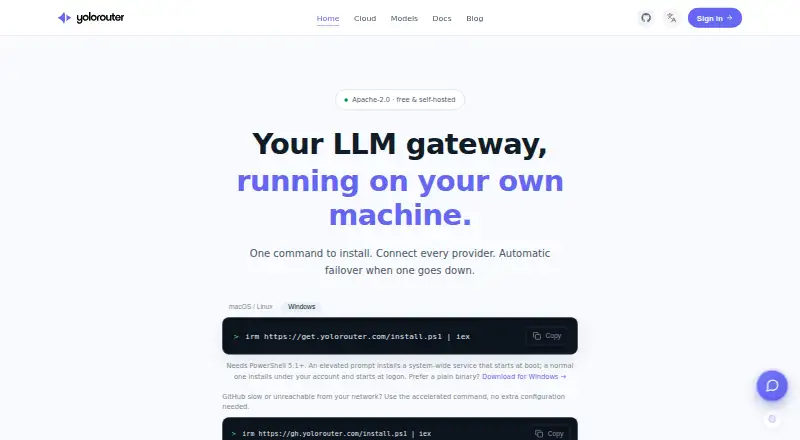
What YoloRouter is
YoloRouter is an OpenAI-compatible gateway that routes AI model requests across multiple providers. It accepts OpenAI Chat Completions and Responses, Anthropic Messages, and Gemini generateContent protocols, and translates between supported formats when clients and providers differ. Routing options include ordered provider candidates, failover, and upstream key pooling. Streaming uses Server-Sent Events with usage tracking; the gateway also exposes OpenAI Images and Videos APIs, billing delivered images or video seconds. API keys can be restricted with model allowlists, rate and concurrency limits, cumulative budget caps, optional expiry, and instant revocation. Its admin console supports multiple users, OAuth2/OIDC single sign-on, usage visibility, and account controls. The self-hosted distribution is a single binary with an embedded console, SQLite by default, and optional PostgreSQL. The self-hosted plan is free. Upstream keys are encrypted at rest with AES-256, while admin credentials and API keys are hashed. Cloud billing uses top-up credits, with no subscription or minimum spend.
Good
- Supports four API protocol families.
- Provides provider failover and key pooling.
- API keys can have budget caps and expiry.
- Self-hosted plan is free.
- SQLite default with optional PostgreSQL.
Watch out
- Self-hosted deployment requires operating the gateway.
- Cloud billing uses top-up credits.
- Cloud has no subscription or minimum spend.
Who it suits
YoloRouter is designed for teams already shipping AI features that need multi-model access, provider failover, cost optimization, quota management, or request observability. It also suits teams seeking a self-hosted gateway with access controls.
Verdict
YoloRouter brings provider routing, protocol translation, access controls, and usage tracking into one gateway. Teams should weigh self-hosting against cloud top-up billing and configure key limits to match their needs.
Plans and prices
From YoloRouter's own pricing page, checked 15 Oct 2026.
| Plan | Price | What it gives you |
|---|---|---|
| Self-hosted | Free | single binary · SQLite default · PostgreSQL optional · bring your own upstream keys · Free |
The facts
Each one read from YoloRouter's own pages, with the date it was checked.
What it does
- Access controls
- API keys can have model allowlists, rate and concurrency limits, budget caps, expiry and instant revocation.checked 15 Oct 2026
- API compatibility
- The API supports OpenAI Chat Completions, OpenAI Responses, Anthropic Messages, and Gemini generateContent protocols.checked 30 Sep 2026
- API reference
- The documentation provides an OpenAPI-generated reference with schemas, parameters and a live playground.checked 15 Oct 2026
- Architecture
- The backend uses Go with Gin, GORM and goose, while the Vue 3 and TypeScript frontend is embedded with go:embed.checked 15 Oct 2026
- Deployment
- The product is distributed as a single binary with an embedded admin console and no Node runtime requirement.checked 15 Oct 2026
- External licence record
- The external mirror identifies the repository licence as Apache-2.0.checked 15 Oct 2026
- Key rotation
- Provider key pools automatically skip rate-limited, unauthorized or quota-exhausted keys.checked 15 Oct 2026
- Limit: input lengths
- MiniMax accepts up to 10,000 characters and Zhipu up to 1,024, with upstream errors returned for excess input.checked 15 Oct 2026
- Limit: media URLs
- Returned image and video URLs retain the upstream provider's expiry because YoloRouter does not rehost them.checked 15 Oct 2026
- Limit: Responses images
- Responses input_image entries are dropped when translation to another egress protocol is required.checked 15 Oct 2026
- Limit: speech failover
- Speech requests do not fail over because voice selections are vendor-specific.checked 15 Oct 2026
- Limit: video cancellation
- Video jobs have no cancellation endpoint in the supported task dialects.checked 15 Oct 2026
- Media APIs
- The gateway exposes OpenAI Images and Videos APIs beside chat and bills delivered images or delivered seconds.checked 30 Sep 2026
- Model catalogue
- The models page lists 21 available models with pricing, context windows and capabilities.checked 15 Oct 2026
- Model pricing
- The pricing page lists Claude Opus 4.8 at input $5→$1.5 and output $25→$7.5.checked 15 Oct 2026
- Notable news
- Release v0.2.8 on October 11, 2026 added session observability and replay, capability enforcement, admin audit and media playground APIs.checked 15 Oct 2026
- Observability
- The console reports token and cost KPIs, usage breakdowns and full per-attempt request logs with CSV export.checked 15 Oct 2026
- Praise: repository description
- An external GitHub mirror describes YoloRouter as a free self-hosted gateway with four protocols and an embedded console.checked 15 Oct 2026
- Product
- YoloRouter is an OpenAI-compatible AI model routing gateway that routes requests across multiple AI providers.checked 30 Sep 2026
- Protocol translation
- It translates OpenAI Chat, OpenAI Responses, Anthropic Messages and Gemini requests between provider protocols.checked 15 Oct 2026
Money
- Cloud billing
- YoloRouter Cloud uses pay-as-you-go credits without a subscription or minimum spend.checked 15 Oct 2026
- Cost optimization
- YoloRouter can inject system prompts and compress bulky tool output while reporting measured savings.checked 15 Oct 2026
The company
- Company identity
- The public GitHub organization identifies itself only as YoloRouter and does not state a legal name, headquarters or founding year.checked 15 Oct 2026
Where it runs
- Install platforms
- Install documentation covers Docker, release binaries and service installers for Linux, macOS and Windows.checked 15 Oct 2026
The full review of YoloRouter
YoloRouter is an AI gateway that routes requests across providers through a compatible API. It suits teams building AI features that want to manage provider choice, access, and usage in one place. Its strongest case is self-hosted control; teams that prefer not to operate a gateway can use its usage-billed cloud service.
Overview
YoloRouter gives applications one endpoint for providers including OpenAI and Anthropic, with routing across ordered provider candidates, failover, and pooled upstream keys. That is useful when a team needs a request to have alternate provider paths or wants to manage multiple provider credentials centrally. The trade-off is an additional service to deploy or pay to use, so it is better suited to teams already operating AI features than to someone seeking a standalone assistant.
Key features
Protocol translation and routing
The API supports OpenAI Chat Completions and Responses, Anthropic Messages, and Gemini generateContent. YoloRouter can translate between those supported protocols, so clients and providers need not use the same interface. Streaming uses Server-Sent Events and tracks usage. This combination is practical for multi-provider applications, though it covers only the protocols named above.
Media and cost controls
The gateway exposes OpenAI Images and Videos APIs alongside chat, charging for delivered images or delivered seconds. It can also compress bulky tool output before forwarding it to upstream models and reports measured savings. These capabilities are relevant to teams managing media requests or large tool responses; the savings depend on the output being compressed, rather than representing a fixed reduction in cost.
Keys, budgets, and team administration
API keys can have model allowlists, rate and concurrency limits, cumulative budget caps, optional expiry, and instant revocation. Those controls help teams constrain usage by key and cut off access when needed. The admin console supports multiple users, OAuth2/OIDC single sign-on, per-user usage visibility, and administrative account controls, making the gateway more suitable for shared team operations than for a single developer who needs only a basic endpoint.
Deployment and security
YoloRouter is distributed as a single binary with an embedded admin console; it needs no Node runtime, uses SQLite by default, and can optionally use PostgreSQL. That keeps the deployment choice straightforward for teams comfortable managing their own infrastructure, but self-hosting still means operating the gateway and its storage. Upstream provider keys are encrypted at rest with AES-256, while admin credentials and API keys are hashed. Security vulnerabilities should be reported through GitHub's private Security Advisories flow, not public issues or pull requests.
Pricing
The Self-hosted plan costs nothing and includes the single binary, SQLite out of the box, and optional PostgreSQL. It is the clearest fit for teams willing to run the service themselves and wanting to avoid a subscription charge. Its price does not remove the operational work of deployment and administration.
YoloRouter Cloud uses top-up credits, with no subscription or minimum spend, and charges only for usage. That suits teams wanting a managed billing model tied to consumption rather than a recurring subscription; they should account for usage-based charges. The listed plan information gives no cloud quota or credit rate, so no cost estimate can be drawn from it.
Platforms
YoloRouter supports API, Linux, macOS, self-hosted deployment, web, and Windows. The single-binary distribution and SQLite default are particularly relevant to teams choosing self-hosting; the platform range also accommodates API-based use across common desktop and server environments.
Who it's for
YoloRouter is aimed at teams already shipping AI features that need multi-model access, provider failover, usage visibility, or quota management. It is a strong fit when one gateway's protocol translation, key controls, and routing can simplify operations across providers. It is a weaker fit for users who do not need that layer or teams unwilling to self-host and manage usage-based cloud charges.
Pros and cons
- Pro: Multiple supported protocols and provider failover can reduce provider-specific integration work and provide alternate routing paths.
- Pro: Per-key allowlists, limits, budgets, expiry, and revocation give teams concrete controls over access and consumption.
- Pro: The free self-hosted plan includes SQLite and optional PostgreSQL, while Cloud has no subscription or minimum spend.
- Con: Self-hosting means taking responsibility for running another service, even though it is packaged as a single binary.
- Con: Cloud billing is based on top-up credits and usage, so teams need to manage consumption rather than rely on a subscription price.
Alternatives
Choose Bifrost if its free forever OSS plan, self-hosted deployment options, or Enterprise plan better match your needs. Routerly is a free self-hosted alternative whose free plan states no markup on API calls and uses AGPL-3.0. Consider Kong Gateway if its 30-day free trial, no Gateway limits, and 30 days of analytics retention suit a time-limited evaluation. TensorZero is another free, fully self-hosted open-source option.
LLM Gateway may suit teams interested in its stated 200+ models across 40+ providers, with a free plan that includes 20 requests per minute on free models and charges 5% on credit usage. Choose OpenRouter if its free plan's 25+ free models, four free providers, five workspaces, and 50 requests per day fit your usage. Helicone is an alternative for readers looking for a product that describes itself as open source. LangSmith is worth considering if its Developer plan's one seat and 5,000 base traces per month, followed by pay-as-you-go, better match your tracing needs. Browse more options in LLM Gateway Software.
Verdict
Choose YoloRouter if your team needs one self-hosted gateway for multi-provider routing, protocol translation, and per-key usage controls. The free single-binary plan and broad routing controls are its main reasons to choose it; look elsewhere if your team does not want to operate a gateway or needs predictable subscription billing instead of Cloud top-up credits.
Getting started
- Open https://yolorouter.com/
- Choose the free self-hosted plan or YoloRouter Cloud
- For self-hosting, run the single binary on Linux, macOS, or Windows
- Use SQLite by default or configure optional PostgreSQL
- Connect supported AI clients and providers through the gateway endpoint
Limits worth knowing
The self-hosted plan is free at no cost. Cloud billing uses top-up credits and charges for usage, including delivered images or video seconds.
Questions
Is YoloRouter free?
The self-hosted plan is listed as free. YoloRouter Cloud uses top-up credits and charges only for usage.
Which protocols does it support?
It supports OpenAI Chat Completions, OpenAI Responses, Anthropic Messages, and Gemini generateContent protocols.
Which platforms can run YoloRouter?
Listed platforms are API, Linux, macOS, self-hosted, web, and Windows.
Can YoloRouter route around provider failures?
Yes. It offers ordered provider candidates and multi-provider failover.
Does it support team administration?
The admin console supports multiple users, OAuth2/OIDC single sign-on, per-user usage visibility, and administrative account controls.
What storage options are available for self-hosting?
SQLite is used by default, with PostgreSQL available as an option.
Alternatives to YoloRouter
- 1

LangSmith
Free planWebAPILinuxmacOS8.0$39 usage-based - 2
Manifest
Free planOpen sourceWebAPILinuxSelf-hosted7.9From $19 a month - 3

Bifrost
Free planOpen sourceWebAPILinuxmacOS7.6Free plan - 4
TrueFoundry AI Gateway
Free planWebAPILinuxSelf-hosted7.6From $499 a month - 5
Eden AI
WebAPI7.4$5.50 one-time - 6
LLM Gateway
Free planOpen sourceWebAPIExtensionLinux7.4Free plan