ROCKNIX
ROCKNIX is a free immutable Linux distribution for handheld gaming devices, focused on retro game emulation.
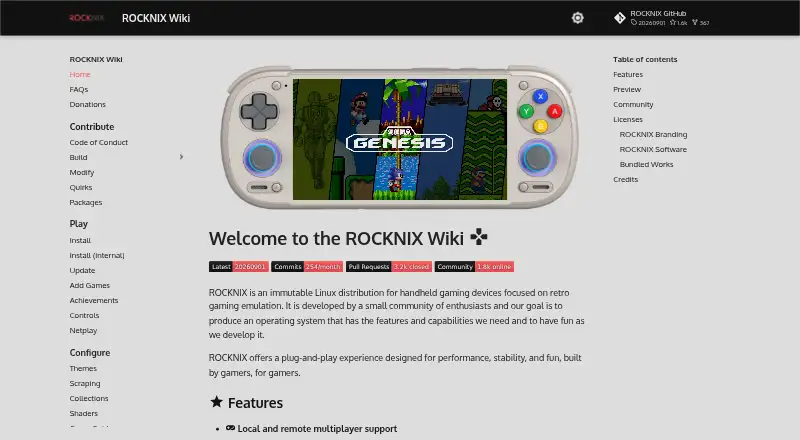
What ROCKNIX is
ROCKNIX is a free immutable Linux distribution for handheld gaming devices, focused on retro game emulation. To install it, users download a device image, flash it to an SD card or internal storage, and boot the device. It supports local and remote multiplayer, save states, video filters, touch controls on supported devices, and custom performance and power profiles. Bluetooth audio and controller connections, HDMI and USB audio/video output, and music and video playback are also listed. Cloud and LAN synchronization are available through Syncthing and rclone, while built-in VPN support covers WireGuard, Tailscale, and ZeroTier. ROCKNIX integrates with RetroAchievements and provides automatic game scraping; achievements need an internet connection, and support varies by emulator and game. Steam and Heroic Games Launcher are supported on arm64. There is no formal support, and the distribution is provided as-is through community help channels. Supported devices are listed in the wiki, and adding a device requires contributed work and direct access to that device.
Good
- Supports local and remote multiplayer
- Includes cloud and LAN synchronization options
- Offers built-in support for three VPN services
- Steam and Heroic support on arm64
Watch out
- No formal support; provided as-is
- Supported-device coverage is listed in the wiki
- Windows cannot currently read the primary Ext4 partition natively
Who it suits
ROCKNIX is for handheld gaming users seeking a Linux system focused on retro emulation. It may also suit users who want features such as multiplayer, synchronization, VPN support, or arm64 game launchers.
Verdict
ROCKNIX combines retro emulation with connectivity, synchronization, and selected game-launcher support. Check device support and the lack of formal assistance before installing it.
Plans and prices
From ROCKNIX's own pricing page, checked 2 Oct 2026.
| Plan | Price | What it gives you |
|---|---|---|
| ROCKNIX | Free | Community developed · provided as-is · device-specific support |
The facts
Each one read from ROCKNIX's own pages, with the date it was checked.
What it does
- Achievements
- ROCKNIX integrates with RetroAchievements, which requires an internet connection, and support varies by emulator and game.checked 2 Oct 2026
- Audience
- The project describes itself as a plug-and-play operating system built by gamers for gamers.checked 2 Oct 2026
- Cloud sync
- ROCKNIX supports cloud and LAN synchronization through Syncthing and rclone.checked 2 Oct 2026
- Connectivity
- ROCKNIX supports Bluetooth audio and controller connectivity plus HDMI and USB audio/video output.checked 2 Oct 2026
- Controls
- ROCKNIX provides in-game touch controls for supported devices.checked 2 Oct 2026
- Controls and performance
- It offers in-game touch controls on supported devices and custom performance and power profiles.checked 2 Oct 2026
- Experience
- ROCKNIX offers a plug-and-play experience designed for performance, stability and fun.checked 2 Oct 2026
- Game scraping
- The feature list includes automatic game scraping.checked 2 Oct 2026
- Game services
- ROCKNIX supports RetroAchievements and automatic game scraping.checked 2 Oct 2026
- Heroic
- ROCKNIX supports Heroic Games Launcher on arm64 for GOG, Epic Games Store and Amazon Prime Gaming titles.checked 2 Oct 2026
- Installation
- ROCKNIX is installed by downloading a device image, flashing it to an SD card or internal storage, and booting the device.checked 2 Oct 2026
- License and redistribution
- ROCKNIX branding is licensed for non-commercial use, and bundling it on devices requires express permission.checked 2 Oct 2026
- Licensing
- ROCKNIX build configuration, scripts and embedded utilities are licensed under GNU GPL Version 2, while its branding uses CC BY-NC-SA 4.0.checked 2 Oct 2026
- Media and connectivity
- Features include music and video playback, Bluetooth audio and controller connections, and HDMI and USB audio/video output.checked 2 Oct 2026
- Multiplayer
- ROCKNIX supports local and remote multiplayer.checked 2 Oct 2026
- Product
- ROCKNIX is an immutable Linux distribution for handheld gaming devices focused on retro gaming emulation.checked 2 Oct 2026
- Security defaults
- SSH and Samba are disabled by default in release builds, and the root password is regenerated after each reboot.checked 2 Oct 2026
- Security settings
- SSH and Samba are disabled by default in release builds; when enabled, the root password is regenerated after each reboot by default.checked 2 Oct 2026
- Storage limitation
- The primary Ext4 partition is not natively readable on Windows, so Windows users cannot currently access it to add games.checked 2 Oct 2026
- Support
- ROCKNIX offers no formal support and is provided as-is through community help channels.checked 2 Oct 2026
- Sync integrations
- Cloud and LAN synchronization are available via Syncthing and rclone.checked 2 Oct 2026
- Updates
- ROCKNIX can be updated over the air from EmulationStation or manually with an update tar file.checked 2 Oct 2026
Where it runs
- Device support limit
- Supported devices are listed in the wiki, and adding a device requires contributed work and direct access to that device.checked 2 Oct 2026
The company
- Steam
- ROCKNIX supports Steam on arm64, including native Linux games and Windows games through FEX and Proton.checked 2 Oct 2026
The full review of ROCKNIX
ROCKNIX is an immutable Linux distribution for retro gaming on supported handhelds, pairing emulation with connectivity and selected PC game launchers. It suits players who want a device-focused system rather than a general-purpose desktop; its appeal depends on having a supported device and being comfortable without formal support.
Its breadth is a strength, but device coverage, Windows game access and some integrations have clear boundaries. Check compatibility and storage needs before committing.
Overview
ROCKNIX aims to make a handheld gaming device ready for play after installation, with performance and power profiles alongside emulation features. Setup means downloading a device image, flashing it to an SD card or internal storage, then booting from it. Updates can be applied over the air through EmulationStation or manually with an update tar file.
As an immutable distribution, it is built around a dedicated gaming system rather than unrestricted desktop use. That focus makes it a plausible fit for a handheld you want to use primarily for games, but less suitable if you expect broad device compatibility or formal assistance. Supported devices are documented in the project wiki; adding a device requires contributed work and direct access to the hardware.
Key features
Emulation is the center of the experience: ROCKNIX supports multiple systems, save states, netplay and video filters. Local and remote multiplayer give players more ways to use that setup, while RetroAchievements add achievement tracking. Achievements require an internet connection, and compatibility varies by emulator and game.
On supported devices, in-game touch controls can help when physical controls are inconvenient. Custom performance and power profiles let users choose how to balance those priorities. Music and video playback, Bluetooth audio and controller connections, plus HDMI and USB audio/video output, extend the system beyond emulation.
Syncthing and rclone provide cloud and LAN synchronization, useful for users who want to keep data in sync across a network. Built-in VPN support covers WireGuard, Tailscale and ZeroTier. Automatic game scraping can reduce manual catalog work, though the system’s wider utility still depends on device compatibility.
For arm64 devices, ROCKNIX supports Steam, including native Linux games and Windows games through FEX and Proton. Heroic Games Launcher supports titles from GOG, Epic Games Store and Amazon Prime Gaming. These integrations broaden the library, but they are specifically tied to arm64 support and do not make every PC title a guaranteed fit.
Pricing
ROCKNIX costs nothing. The free community-developed plan is the only plan described; there is no free trial because the software is free. It comes with no formal support and is provided as-is, so users must be willing to rely on community help channels and handle device-specific issues themselves.
The build configuration, scripts and embedded utilities use GNU GPL Version 2, while the branding uses CC BY-NC-SA 4.0. Branding is non-commercial, and bundling ROCKNIX on devices requires express permission. Those terms matter to anyone redistributing or selling a device with ROCKNIX preinstalled.
Platforms
ROCKNIX is a Linux distribution for handheld gaming devices, with support limited to the devices documented by the project. Installation uses an image flashed to an SD card or internal storage. One practical constraint for Windows users: the primary Ext4 partition is not natively readable on Windows, so adding games from Windows is currently unavailable through that partition.
Security defaults are cautious for a gaming distribution: release builds disable SSH and Samba, and when enabled, the root password is regenerated after each reboot by default. Users who need network file access or remote administration must account for those defaults.
Who it's for
ROCKNIX is best for handheld owners whose device is supported and who want a focused emulation environment with multiplayer, synchronization and selected arm64 game-launcher support. It is a weaker choice for Windows users who need to manage games directly on the primary partition, owners of unsupported devices, or anyone who expects formal technical support.
Pros and cons
- Pros: Save states, netplay and video filters cover useful parts of the emulation experience rather than just launching games.
- Pros: Syncthing, rclone and three VPN integrations make network synchronization and private connectivity part of the system.
- Pros: Steam and Heroic support on arm64 opens access to selected Linux and Windows games and several PC storefronts.
- Cons: Device support is limited to documented hardware, and expanding it requires contributed work plus direct hardware access.
- Cons: The Ext4 system partition cannot be read natively by Windows, preventing Windows users from adding games there.
- Cons: There is no formal support; the software is provided as-is through community help channels.
- Cons: RetroAchievements require internet access and vary in support by emulator and game.
Alternatives
Choose RetroArch if a multi-platform emulator is a better fit than a handheld-focused Linux distribution; it is free, open source and runs on Android, iOS, Linux, macOS, the web and Windows. webЯcade is another free, open-source option for Android, iOS, macOS, web and Windows when browser-oriented access is preferable.
For a Linux desktop emulation option, RetroDECK is free software, with optional donations that do not grant perks or early access. ares is a free, open-source multi-system emulator for Linux, macOS and Windows, while Mednafen is a free open-source option for Linux and Windows.
Windows users looking for a standalone option can consider Ootake, which is freeware but Windows-only and comes without warranty or support. MagicEngine is a paid alternative at €15, paid once; its demo limits each game to five minutes, while registered users receive free updates. jgenesis is a free option for Linux, web and Windows.
For more category browsing, see Emulation Frontends and TurboGrafx-16 Emulators.
Verdict
Choose ROCKNIX if you own a supported handheld and want emulation with multiplayer, synchronization and useful connectivity in a dedicated Linux system. Its free price and feature range are compelling for self-reliant users, but limited device coverage, Windows storage friction and the absence of formal support make it a poor fit for anyone who needs a broadly compatible or supported setup.
Alternatives to ROCKNIX
- 1
Manic EMU
Free planOpen sourceiOSmacOSSelf-hosted8.2Free plan - 2

Provenance
Free planOpen sourceiOSmacOS8.2From $39.99 a year - 3
webЯcade
Free planOpen sourceAndroidiOSWebLinux7.9Free plan - 4
RetroArch
Free planAndroidiOSWebLinux7.7Free plan - 5
ares
Free planOpen sourceLinuxmacOSSelf-hostedWindows7.5Free plan - 6

OpenEmu
Free planOpen sourcemacOS7.3Free plan