
Rocket.Chat
Rocket.Chat is a messaging platform for teams, with channels, guest access and unlimited message history.
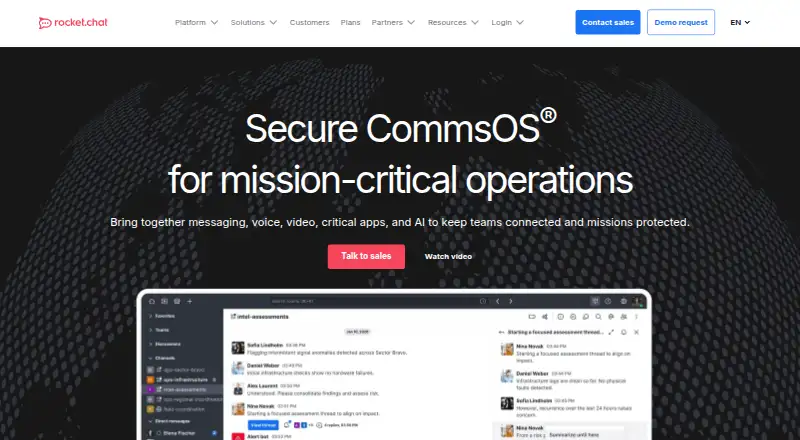
What Rocket.Chat is
Rocket.Chat is a messaging platform for teams, with channels, guest access and unlimited message history. It runs on the web, Windows, macOS, Linux, iOS and Android, and supports API and self-hosted use. Its listed integrations include GitHub, Google Calendar, Google Drive, Google Meet, Jira Cloud, Microsoft Teams, Pexip, Telegram, Trello, WhatsApp, Zapier and Zoom.
The Starter plan costs nothing, billed monthly, and is listed for up to 50 users. Community lists 100 concurrent users. Commercial describes dedicated cloud hosting and on-premises, private cloud, isolated VPC/VPN or air-gapped deployment, alongside messaging, calls, screen sharing, high availability, disaster recovery, an open API and custom integrations. Government describes sovereign cloud and air-gapped options, role-based access control, end-to-end encryption, identity integrations and tamper-evident audit logs. Defense lists air-gapped and SCIF-ready deployment, controlled federation, mission-critical communications, DoD ATO up to IL6 and FIPS 140-3 support with an add-on. Rocket.Chat was founded in 2015 and is headquartered in Wilmington, Delaware, United States.
Good
- Unlimited message history.
- Channels and guest access are supported.
- Works across web, desktop and mobile platforms.
- Offers API and self-hosted use.
- Integrations include Google Meet, Jira Cloud and Zoom.
- Starter includes up to 50 users at no cost.
Watch out
- Starter is limited to 50 users.
- Community lists 100 concurrent users.
Who it suits
Rocket.Chat suits teams that need messaging across desktop, mobile or web, with guest access, channels and integrations. Its named plans also address organizations seeking self-hosted or specialized cloud deployments and the listed government or defense controls.
Verdict
Choose Rocket.Chat if your team needs channels, guest access and unlimited message history across supported platforms. The free Starter plan covers up to 50 users; teams considering other plans should weigh their needs against plan-specific deployment options and the prices listed for those plans.
Plans and prices
From Rocket.Chat's own pricing page, checked 15 Oct 2026.
| Plan | Price | What it gives you |
|---|---|---|
| Community | Free | fully open-source · self-hosted · experimentation or small internal teams · no production-grade compliance, support or reliability features |
| Starter | Free | self-managed/self-hosted · up to 50 users · one workspace per organization · many premium capabilities with usage limits |
| Commercial | Priced on request | custom users · premium/dedicated hosting · on-premises, private cloud or isolated deployment |
| Defense | Priced on request | custom users · air-gapped/SCIF-ready · DoD ATO up to IL6 · FIPS license add-on available |
| Government | Priced on request | custom users · on-premises or sovereign cloud · air-gapped deployment · FIPS license add-on available |
The facts
Each one read from Rocket.Chat's own pages, with the date it was checked.
What it does
- AI
- Rocket.Chat provides AI features such as thread summarization, translation and answers based on records that each user is authorized to see.checked 15 Oct 2026
- API
- Rocket.Chat documents REST APIs for users, rooms, Omnichannel and other workspace capabilities, alongside a Realtime API and Livechat Widget API.checked 15 Oct 2026
- Capterra rating
- 4.3 out of 5 from 156 reviews.checked 15 Oct 2026
- Channels
- Yeschecked 20 Sep 2026
- Compliance
- Rocket.Chat states that its information-security program follows the ISO 27001 framework and documents GDPR, LGPD and FIPS 140-3-related controls.checked 15 Oct 2026
- Database and storage
- Rocket.Chat 8.x requires MongoDB 8.0 or later, and the documentation recommends S3, Google Cloud Storage or MinIO for uploaded files.checked 15 Oct 2026
- Developer documentation
- Developer documentation covers architecture, server, desktop and mobile development environments, Apps-Engine, customization, APIs, Omnichannel and contribution guidelines.checked 15 Oct 2026
- Federation
- The platform advertises native Matrix and XMPP federation for server-to-server interoperability.checked 15 Oct 2026
- Federation news
- A July 14, 2026 Rocket.Chat Labs article described moving Matrix federation into the Rocket.Chat server as an embedded library without a second backend or database.checked 15 Oct 2026
- G2 rating
- 4.2 out of 5 from 373 reviews.checked 15 Oct 2026
- Guest access
- Yeschecked 20 Sep 2026
- Integrations
- The marketplace lists integrations including Trello, Zapier, Zoom and Rocket.Chat AI, and supports public and private apps.checked 15 Oct 2026
- Licence
- Code outside the enterprise directories is MIT-licensed; enterprise directories use a separate enterprise licence and third-party components retain their original licences.checked 15 Oct 2026
- Limit: maintenance effort
- A Gartner reviewer says Rocket.Chat requires significant maintenance and experimentation rather than being a switch-on-and-forget service.checked 15 Oct 2026
- Limit: notifications and search
- Independent reviewers report inconsistent notifications, lag, and search results that can miss the intended messages.checked 15 Oct 2026
- Limit: support and operations
- Reviews mention difficulty contacting support and the need for Linux, hosting and infrastructure skills for self-managed deployments.checked 15 Oct 2026
Where it runs
- Client applications
- Official clients are available for Windows, macOS, Linux, iOS and Android.checked 15 Oct 2026
- GetApp rating
- 4.3 out of 5 from 156 reviews.checked 15 Oct 2026
The company
- Company headquarters and founding
- LinkedIn lists headquarters in Wilmington, Delaware and a 2015 founding year.checked 15 Oct 2026
- Company size
- LinkedIn lists Rocket.Chat as a privately held software-development company with 51–200 employees.checked 15 Oct 2026
- Founded
- 2015checked 23 Sep 2026
- Headquarters
- Wilmington, Delaware, United Stateschecked 23 Sep 2026
- Legal maker name
- The Apple App Store identifies the developer as Rocket.Chat Technologies Corp.checked 15 Oct 2026
Money
- Free plan
- Yeschecked 20 Sep 2026
The full review of Rocket.Chat
Overview
Rocket.Chat is a team messaging platform for organizations that want control over where their communications run, from standard apps to self-hosted and isolated deployments. Its strongest case is a team that needs channels, guest access, and message history without a stated cap; the trade-off is that the free Starter plan stops at 50 users, while pricing for the more specialized plans is custom.
Key features
Channels, guests, and history
Channels help teams keep conversations organized, and guest access makes it possible to include people outside the core team. Unlimited message history is a meaningful advantage for groups that need to refer back to older discussions rather than work around a stated retention window. These basics make Rocket.Chat a solid fit for ongoing team communication, though the feature list alone does not establish how its channel or guest controls compare with another platform.
Integrations and deployment
Rocket.Chat connects with GitHub, Google Calendar, Google Drive, Google Meet, Jira Cloud, Microsoft Teams, Pexip, Telegram, Trello, WhatsApp, Zapier, and Zoom. That breadth can reduce the need to keep work conversations entirely separate from project, file, meeting, and messaging services. Its supported platforms include web, Windows, macOS, Linux, iOS, Android, API, and self-hosted deployment, giving organizations more deployment choices than an app-only offering.
The higher-tier plans make deployment and security requirements a central part of the product. Commercial covers on-premises, private cloud, isolated VPC/VPN, or air-gapped deployment, as well as dedicated cloud hosting, high availability and disaster recovery, messaging, calls, screen sharing, an open API, and custom integrations. Government adds options such as sovereign cloud or air-gapped deployment, granular role-based access control, end-to-end encryption, SSO, LDAP, SAML 2.0, AD, and tamper-evident audit logs. Defense is aimed at still more specific environments, with air-gapped and SCIF-ready deployment, DoD ATO up to IL6, FIPS 140-3 support with an add-on, controlled federation, and mission-critical communications. Those provisions make Rocket.Chat relevant to organizations with demanding deployment needs, but the custom pricing means buyers should establish costs against their requirements.
Pricing
Starter
Starter is free at no cost, billed monthly, for up to 50 users. It is the clearest choice for a small team that wants channels, guests, unlimited history, and Rocket.Chat's supported platforms without a software charge. The 50-user ceiling is the key constraint: teams above it need to consider another plan.
Community
Community supports 100 concurrent users and has custom pricing. Its stated capacity is higher than Starter's 50-user maximum, but concurrent users and total user limits are not interchangeable measures. Teams should check how that capacity maps to their expected usage before choosing it.
Commercial, Government, and Defense
Commercial, Government, and Defense all have custom pricing. Commercial is the broad fit for organizations seeking hosting and deployment choices alongside high availability, disaster recovery, calls, screen sharing, or custom integrations. Government is better aligned with sovereign or air-gapped deployment and specified identity, encryption, access-control, and audit requirements. Defense is for organizations that need its stated SCIF-ready, DoD ATO, or controlled-federation provisions. These plans offer much more specialized deployment and security scope than the free entry plan, but their costs must be evaluated individually.
Platforms
Rocket.Chat supports web, Windows, macOS, Linux, iOS, and Android, as well as self-hosted deployment and an API. This range suits mixed-device teams and organizations that want a self-hosted option. The platform list is broad, but it does not specify feature parity across apps or deployment types.
Who it's for
Rocket.Chat is a strong candidate for small teams that want a free, cross-platform messaging service with guest participation and unlimited history, and for larger organizations whose deployment requirements include private, isolated, sovereign, or air-gapped environments. It is less straightforward for buyers who need a published price to compare plans up front, or for a team that cannot fit within Starter's 50-user cap and does not want to assess custom pricing.
Pros and cons
Pros
- Unlimited message history: Teams can retain conversations without a stated history cap.
- Free Starter for up to 50 users: Small groups can start without a software charge.
- Multiple deployment options: The plan range includes self-hosted, private, isolated, sovereign, and air-gapped possibilities.
- Broad integration list: Connections include work tools and communication services such as Jira Cloud, Google Drive, Zoom, WhatsApp, and Zapier.
Cons
- Starter stops at 50 users: Teams above the cap must consider a different plan.
- Paid-plan prices are custom: Buyers cannot compare the listed plans by a fixed published price.
- Community capacity is expressed as concurrent users: That may not answer how many total accounts a team can support.
Alternatives
- Secure Team Chat Software is a useful category to compare if security-focused team messaging is the main priority.
- Team chat apps is the broader category for comparing messaging options.
- Team Collaboration Software is worth considering when the search extends beyond team chat.
- Wire is another freemium option with a free plan across web, desktop, and mobile platforms; its source code is fully open source and available on GitHub for verification.
- 8seats may suit a smaller group prioritizing guests and a defined history window: its free Starter covers up to 10 employees, unlimited guests, 365-day message history, and 1 GB of storage.
- Crypho offers a free personal-use plan with encrypted calls and video calls, but limits users to one group and files to 3 MB.
- Troop Messenger is a paid-model alternative with a free trial and a Free Plan described for 1–50 users and 50 GB of storage.
- Celo is an option for teams of up to 10 users seeking HIPAA-compliant messaging on Android, iOS, or the web.
- Eleven for Business offers a free plan with every feature, up to three spaces, and 1 GB of files per space.
- Secretly for Teams may appeal to teams seeking encrypted chats, files, and one-to-one calls, with group calls up to eight.
- eXpress is another freemium option with a Corporate + SmartApps plan described as available on a customer server or in a secure cloud.
Verdict
Choose Rocket.Chat if your team needs channels, guest access, unlimited message history, and a path from a free 50-user plan to specialized deployment options. Its strongest reason to choose it is that breadth of deployment alongside everyday messaging; its clearest reason to look elsewhere is the combination of Starter's user cap and custom pricing across the other plans.
Getting started
- Visit https://www.rocket.chat/.
- Choose a supported platform: web, Windows, macOS, Linux, iOS or Android.
- Consider API or self-hosted use if that matches your deployment needs.
- Select Starter for up to 50 users, or review the Community, Commercial, Government and Defense plan descriptions.
Limits worth knowing
Starter costs nothing, billed monthly, and is listed for up to 50 users. Community lists 100 concurrent users.
Questions
Does Rocket.Chat have a free plan?
Yes. The Starter plan is listed as free, billed monthly, for up to 50 users.
Which platforms does Rocket.Chat support?
It supports web, Windows, macOS, Linux, iOS and Android, as well as API and self-hosted use.
What integrations are listed?
Integrations include GitHub, Google Calendar, Google Drive, Google Meet, Jira Cloud, Microsoft Teams, Pexip, Telegram, Trello, WhatsApp, Zapier and Zoom.
What do the Commercial, Government and Defense plans include?
Commercial describes dedicated cloud and other deployment options, messaging, calls and screen sharing. Government lists sovereign or air-gapped deployment and controls including end-to-end encryption and audit logs; Defense lists air-gapped and SCIF-ready deployment, controlled federation and mission-critical communications.
Who makes Rocket.Chat?
Rocket.Chat is made by Rocket.Chat, founded in 2015 and headquartered in Wilmington, Delaware, United States.
Alternatives to Rocket.Chat
- 1

Wire
Free planAndroidiOSWebLinux7.9From €7.45 a month - 2

Crypho
Free planAndroidiOSWebmacOS7.4From €379 a month - 3

8seats
Free planAndroidiOSWebmacOS7.3From $2.99 a month - 4

Celo
Free planAndroidiOSWeb7.3From $49 a month - 5

Teamwire
AndroidiOSWebAPI7.3From €3.45 a month - 6
Troop Messenger
Free planAndroidiOSWebLinux7.3From $2.50 a month