RISC-V GNU Toolchain
RISC-V GNU Toolchain is a free, open-source C and C++ cross-compiler for building bare-metal ELF or Linux ELF toolchains.
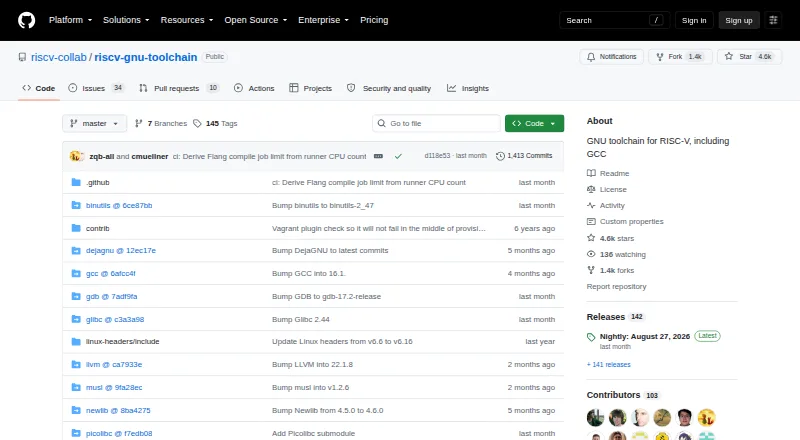
What RISC-V GNU Toolchain is
RISC-V GNU Toolchain is a free, open-source C and C++ cross-compiler for building bare-metal ELF or Linux ELF toolchains. Bare-metal builds can use Newlib or Picolibc; Linux builds can use glibc, musl, or uClibc. The default configuration targets RV64GC, with options for RV32 or RV64, architecture extensions, and ABIs. Multilib builds can target both 32-bit and 64-bit systems for Newlib and Linux/glibc toolchains. The project includes GCC, binutils, GDB, and supported C libraries. LLVM can be built alongside the toolchain using a configure flag, but that option cannot be combined with multilib configuration. Testing documentation covers DejaGNU and make check targets for GCC, Binutils, and glibc on Linux toolchains. Simulator choices include QEMU, GDB, and experimental Spike support, with availability depending on the toolchain. Hosts include Linux and macOS; Windows use is through a Linux subsystem or Cygwin. A build needs about 8 GiB of disk space, and cloning the repository takes around 6.65 GB. The development guidance is aimed at developers, advanced users, and people building with their own source trees.
Good
- Free, open-source C and C++ cross-compiler
- Builds bare-metal or Linux ELF toolchains
- Supports configurable RV32 and RV64 targets
- Bare-metal builds can use Newlib or Picolibc
- Includes GDB and documents simulator options
Watch out
- Build needs about 8 GiB of disk space
- Repository clone takes around 6.65 GB
- Windows use requires a Linux subsystem or Cygwin
- LLVM and multilib configuration flags cannot be combined
Who it suits
It suits developers and advanced users building RISC-V toolchains, including users working with their own source trees. Its configurable RV32 and RV64 targets support different architecture and ABI choices.
Verdict
RISC-V GNU Toolchain offers configurable RISC-V compiler builds for bare-metal and Linux targets, with libraries and debugging components. Its substantial disk requirements and developer-oriented setup are important to weigh first.
Plans and prices
From RISC-V GNU Toolchain's own pricing page, checked 30 Sep 2026.
| Plan | Price | What it gives you |
|---|---|---|
| RISC-V GNU Compiler Toolchain | Free | C and C++ cross-compiler · bare-metal or Linux ELF toolchain |
The facts
Each one read from RISC-V GNU Toolchain's own pages, with the date it was checked.
What it does
- Architecture and ABI
- It supports rv32i or rv64i with standard extensions and lists ilp32 and lp64 ABI variants.checked 30 Sep 2026
- Bare-metal libraries
- Bare-metal builds can use Newlib or Picolibc.checked 30 Sep 2026
- Build requirements
- The README says a build downloads about 200 MiB of upstream sources and needs about 8 GiB of disk space; cloning the repository takes around 6.65 GB.checked 29 Sep 2026
- Build size
- The README says cloning takes around 6.65 GB and a build needs about 8 GiB of disk space.checked 30 Sep 2026
- C libraries
- Bare-metal builds can use Newlib or Picolibc, while Linux builds can use glibc, musl, or uClibc.checked 29 Sep 2026
- Development audience
- The development section is described as intended for developers, advanced users, or users building with their own source tree.checked 30 Sep 2026
- License
- The repository has a LICENSE file containing licensing terms for the project and its included components.checked 29 Sep 2026
- LLVM integration
- LLVM can be built in combination with the toolchain using the --enable-llvm configure flag.checked 30 Sep 2026
- Multilib
- Multilib is available for Newlib and Linux/glibc toolchains; musl, uClibc, and Picolibc build a single variant.checked 30 Sep 2026
- Purpose
- The project provides a RISC-V C and C++ cross-compiler that can build bare-metal ELF or Linux ELF toolchains.checked 29 Sep 2026
- Security information
- The repository page shows a Security and quality section with 0 alerts.checked 30 Sep 2026
- Simulation
- The project documents QEMU, GDB, and experimental Spike simulators for testing, with QEMU as the maintained test-suite allowlist.checked 30 Sep 2026
- Support channel
- The repository provides an issue tracker and pull request interface on GitHub.checked 29 Sep 2026
- Supported host systems
- The README provides build prerequisites for Ubuntu, Fedora/CentOS/RHEL, Arch Linux, and macOS.checked 30 Sep 2026
- Testing
- The repository includes DejaGNU test support, and documents make check targets for GCC, Binutils, and glibc on Linux toolchains.checked 29 Sep 2026
- Test suite
- A port of the DejaGnu test suite is available, and make check and make report are wired for Newlib and Linux/glibc toolchains.checked 30 Sep 2026
- What it does
- It is a RISC-V C and C++ cross-compiler that builds bare-metal ELF or Linux ELF toolchains.checked 30 Sep 2026
- Who it is for
- The README describes its development section as intended for developers, advanced users, or people building with their own source trees.checked 29 Sep 2026
The company
- Headquarters
- Switzerlandchecked 28 Sep 2026
Where it runs
- Linux libraries
- Linux builds can use glibc, musl, or uClibc.checked 30 Sep 2026
- Platforms
- The README provides build instructions for Linux distributions and macOS, including Apple Silicon; it also discusses Linux subsystem or Cygwin builds on Windows.checked 29 Sep 2026
The full review of RISC-V GNU Toolchain
RISC-V GNU Toolchain brings together compiler, assembler, linker, and debugger components to build RISC-V programs for bare-metal or Linux systems. It is best for developers and advanced users who are comfortable building and configuring their own toolchain.
Overview
This open-source toolchain uses GCC for C and C++ cross-compilation, with binutils and GDB among its supporting components. Builders can choose Newlib or Picolibc for bare-metal targets, or glibc, musl, or uClibc for Linux. That breadth is useful when a project has a specific runtime requirement, but it means the builder must select a configuration suited to the target rather than rely on one universal setup.
The default is RV64GC; configurations can target RV32 or RV64 and select architecture extensions and ABIs. Autotools configure and Make form the build workflow. The repository provides an issue tracker and pull-request interface for project support.
Key features
Configurable targets and libraries
Multilib builds can cover both 32-bit and 64-bit targets for Newlib and Linux/glibc toolchains. This can serve projects supporting more than one target width from a shared toolchain. LLVM can be built alongside the toolchain with --enable-llvm, but that option cannot be combined with multilib, so projects needing both must choose a different build arrangement.
Debugging and testing
GDB is included, and the project documents QEMU and experimental Spike simulator options for running tests; support varies by toolchain. DejaGNU support and documented make check targets for GCC, Binutils, and glibc on Linux toolchains give developers a path to validate components. This is meaningful infrastructure for source-build users, not a turnkey graphical development environment.
Build footprint
A repository clone takes around 6.65 GB, and a build needs about 8 GiB of disk space in addition to downloading roughly 200 MiB of upstream sources. That is a substantial commitment for a compiler toolchain and can rule it out on storage-constrained machines or for users who only need a quick install.
Pricing
RISC-V GNU Compiler Toolchain — free. The free plan includes the C and C++ cross-compiler for bare-metal or Linux ELF toolchains, with an open-source license model. There is no free trial because the plan is free. It fits developers able to build and configure the software themselves; its price does not remove the storage and setup costs.
Platforms
The project supports Linux and macOS build prerequisites. Windows users can work through the Linux subsystem or Cygwin. The documented host prerequisites cover Ubuntu, Fedora/CentOS/RHEL, Arch Linux, and macOS, making Linux and Mac the more direct host choices.
Who it's for
This is a strong fit for embedded and systems developers who need control over RISC-V architecture settings, ABI, libraries, or multiple target widths, and who can manage a source-based build. It is less suitable for newcomers or anyone seeking a ready-to-use desktop IDE, since the workflow centers on configuration, Make, and substantial local storage.
Pros and cons
- Pros: Supports bare-metal and Linux ELF toolchains, with multiple library choices for each environment.
- Pros: Configurable RV32 and RV64 targets, extensions, ABIs, and supported multilib builds accommodate varied target requirements.
- Pros: Includes GDB and documents simulator and test-suite options useful for development and validation.
- Cons: The clone and build require significant disk space, making setup impractical on some machines.
- Cons: LLVM and multilib cannot be enabled together, constraining builds that need both.
- Cons: A source-oriented configuration workflow is a poor match for users looking for a ready-made IDE.
Alternatives
For a broader embedded-toolchain shortlist, see Embedded Systems Toolchains.
- Arm Keil MDK is worth considering when a freemium option with Keil Studio, Keil μVision, and Cortex-M device support better matches the project.
- C2000Ware is a free alternative for C2000 microcontroller work; its installer requires export approval.
- Infineon ModusToolbox is a free choice for an Infineon microcontroller development ecosystem across Windows, Linux, and macOS.
- CS+ offers a free IDE for development and production, though evaluation compiler limits apply when using an evaluation compiler.
- MPLAB X IDE is a free IDE option for most Microchip microcontrollers and digital signal controllers.
- PlatformIO Core is a free, open-source alternative for users seeking a different development workflow.
- QNX Software Development Platform has a non-commercial license for individual use, excluding commercial evaluation, development, and production.
- Renesas Flexible Software Package is free for use on any Renesas device.
Verdict
Choose RISC-V GNU Toolchain when you need a configurable RISC-V compiler stack for bare-metal or Linux targets and are prepared to build and maintain it. Its library and target flexibility is the reason to choose it; the substantial storage demands and constrained LLVM/multilib combination are good reasons to look elsewhere.
Alternatives to RISC-V GNU Toolchain
- 1

Arm Keil MDK
Free planWebAPIExtensionLinux7.9From 82.39 CHF a month - 2
C2000Ware
Free planWebLinuxmacOSWindows7.1Free plan - 3

PlatformIO IDE
Free planExtensionLinuxmacOSSelf-hosted7.0Free plan - 4

IAR Embedded Workbench
Free planExtensionLinuxWindows6.9Free plan - 5

Infineon ModusToolbox
Free planLinuxmacOSWindows6.8Free plan - 6
Buildroot
Free planLinuxSelf-hosted6.4Free plan