RemoteGazeUX
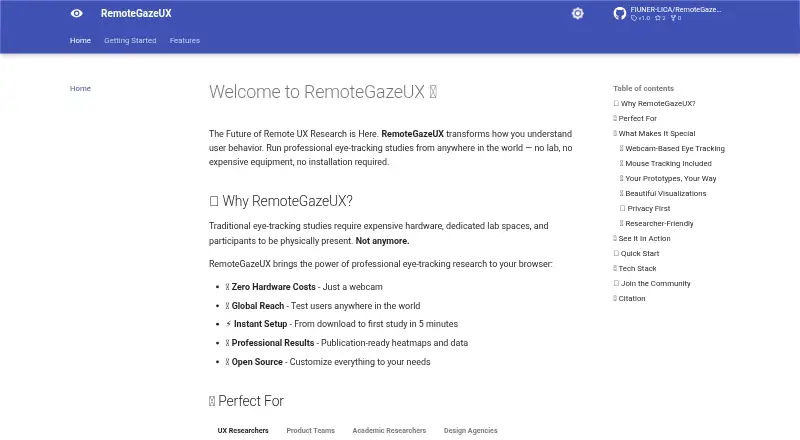
The facts below are what the maker publishes about RemoteGazeUX, checked and dated. Our editors have not written about it yet.
The facts
Each one read from RemoteGazeUX's own pages, with the date it was checked.
What it does
- Authentication
- Pages that display and manage participant data are protected so only registered users can access them; first run prompts creation of at least one administrator.checked 11 Oct 2026
- Calibration
- The gaze-tracking flow includes a calibration phase before presenting a prototype.checked 11 Oct 2026
- Configuration
- Users can modify configuration through a GUI by running `python src/config.py`.checked 11 Oct 2026
- Custom fields
- The data entry form can be modified to register other variables considered relevant.checked 11 Oct 2026
- Data access
- Pages that display or manage participant data are protected by authentication for registered users.checked 11 Oct 2026
- Data storage
- The README says credentials are stored in the SQLite database and advises protecting the database file.checked 11 Oct 2026
- Deployment
- The README instructs users to run the application with Python using run.py.checked 11 Oct 2026
- Exports
- The subjects page lets users preview or download some animations or heatmaps and download all data for a study.checked 11 Oct 2026
- Gaze capture
- The web application uses WebGazer.js to record participants’ gaze while presenting a prototype or image and assigning tasks.checked 11 Oct 2026
- Gaze tracking
- The application uses WebGazer.js to record participants’ gaze while they view a prototype or image and complete assigned tasks.checked 11 Oct 2026
- Integrations
- The listed technology stack includes Flask, WebGazer.js, heatmap.js, and SQLite.checked 11 Oct 2026
- Intended setting
- The maker describes the tool as intended for controlled environments and remote user studies.checked 11 Oct 2026
- Intended users
- The project describes its purpose as streamlining remote user studies and enabling reproducible collection of users’ behavior data.checked 11 Oct 2026
- License
- The repository identifies its license as GPL-3.0.checked 11 Oct 2026
- Purpose
- RemoteGazeUX is an open-source platform for remote usability testing of web prototypes using eye and mouse tracking.checked 11 Oct 2026
- Results
- Researchers can view gaze heatmaps and download subject data as CSV; the README also describes downloading all data for a study.checked 11 Oct 2026
- Security
- The maker says the tool is under development, has serious security vulnerabilities, and is not recommended for production use.checked 11 Oct 2026
- Security limitation
- The project says it is under development, has serious security vulnerabilities, and is not recommended for production use.checked 11 Oct 2026
- Study management
- Users can view studies and subjects, and access participant details and gaze-tracking data.checked 11 Oct 2026
- Support and contributions
- The project welcomes contributions and names Justo Garcia as main developer and maintainer, with an email contact in the README.checked 11 Oct 2026
- Technology
- The project lists Flask as its backend, WebGazer.js for gaze tracking, heatmap.js for plotting heatmaps, and SQLite as its database engine.checked 11 Oct 2026
Alternatives to RemoteGazeUX
- 1

Userfeel
Free planAndroidiOSWebmacOS8.3From $3,000 a year - 2

Maze
Free planAndroidiOSWebAPI8.1From $99 a month - 3

Ballpark
AndroidiOSWebAPI7.7From $125 a month - 4

PlaybookUX
Free planAndroidiOSWebmacOS7.7From $5,400 a year - 5

UXArmy
Free planAndroidiOSWeb7.6From $29 a month - 6

Lyssna
Free planAndroidiOSWeb7.5From $166 a month