
Redash
Redash is an open-source, self-hosted web platform for querying data, creating visualizations, and sharing dashboards within an organization.
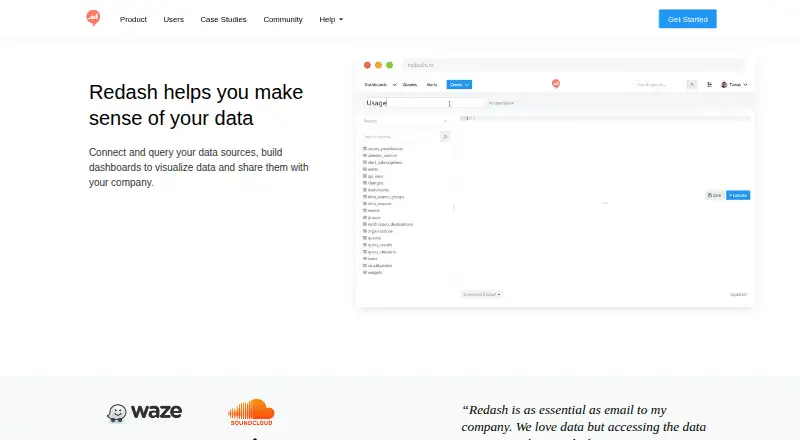
What Redash is
Redash is an open-source, self-hosted web platform for querying data, creating visualizations, and sharing dashboards within an organization. Its query editor includes schema browsing, autocomplete, keyboard shortcuts, and reusable snippets. Visualizations include charts, cohort views, pivot tables, boxplots, maps, counters, sankey diagrams, sunbursts, and word clouds. Dashboards can combine data from multiple sources and be shared by URL or embedded as widgets. Users can schedule result updates and set alerts for data events. Listed integrations include sources such as Amazon Athena, BigQuery, PostgreSQL, Snowflake, MongoDB, Google Analytics, Google Spreadsheets, JIRA, and Salesforce. Redash provides a REST API, plus password, Google OAuth, and SAML 2.0 authentication options. Deployment documentation covers Linux using Docker and Docker Compose. The hosted service at app.redash.io shut down effective November 30, 2021, so the listed Open source / self-hosted plan at no cost requires self-hosting.
Good
- Open-source self-hosted option costs nothing.
- Dashboards combine multiple data sources.
- Scheduled updates and alerts are supported.
- REST API access can be limited to a query.
Watch out
- Hosted service shut down November 30, 2021.
- Deployment is self-hosted on Linux.
- Larger deployments may need separate database and Redis servers.
Who it suits
Redash suits SQL users who want to explore data and share queries, visualizations, and dashboards with colleagues. It is for teams prepared to deploy and maintain a self-hosted service.
Verdict
Redash offers query, dashboard, sharing, and alerting tools for organizations that can host it themselves. The former hosted service is no longer available, so deployment and maintenance are part of choosing it.
Plans and prices
From Redash's own pricing page, checked 10 Oct 2026.
| Plan | Price | What it gives you |
|---|---|---|
| Open source / self-hosted | Free | Hosted service shut down; self-hosted version can be hosted free of charge |
The facts
Each one read from Redash's own pages, with the date it was checked.
What it does
- Alerts and refreshes
- Users can schedule result updates and set alerts for events in their data.checked 10 Oct 2026
- API
- Redash provides a REST API, and API calls support user keys or query keys with access limited to a query and its results.checked 10 Oct 2026
- Authentication
- Redash documents password login, Google OAuth, and SAML 2.0 authentication options.checked 10 Oct 2026
- Dashboards
- Users can combine data from multiple sources into dashboards and share them by URL or embed widgets.checked 10 Oct 2026
- Dashboard type
- interactivechecked 20 Sep 2026
- Data sources
- Amazon Athena; Amazon CloudWatch; Amazon CloudWatch Logs Insights; Amazon DynamoDB; Amazon Redshift; Axibase Time Series Database; Cassandra; ClickHouse; CockroachDB; CSV; Databricks; DB2 by IBM; Druid; Elasticsearch; Google Analytics; Google BigQuery; Google Spreadsheets; Graphite; Greenplum; Hive; Impala; InfluxDB; JIRA; JSON; Apache Kylin; OmniSciDB; MemSQL; Microsoft Azure Data Warehouse / Synapse; Microsoft Azure SQL Database; Microsoft SQL Server; MongoDB; MySQL; Oracle; PostgreSQL; Presto; Prometheus; Python; Qubole; Rockset; Salesforce; ScyllaDB; Shell Scripts; Snowflake; SQLite; TreasureData; Vertica; Yandex AppMetrica; Yandex Metricachecked 20 Sep 2026
- Deployment
- The official setup guide describes deployment on a Linux server using Docker and Docker Compose.checked 10 Oct 2026
- Deployment scale
- The setup guide says the reference configuration is suitable for small deployments and recommends separate database and likely Redis servers plus at least two Redash servers for larger deployments.checked 10 Oct 2026
- Embedded dashboards
- Yeschecked 20 Sep 2026
- Hosted service
- The hosted Redash service at app.redash.io shut down effective November 30, 2021, and the page says no new customer signups were allowed.checked 10 Oct 2026
- Integrations
- Listed data sources include Amazon Athena, BigQuery, PostgreSQL, Snowflake, MongoDB, Google Analytics, Google Spreadsheets, JIRA, and Salesforce.checked 10 Oct 2026
- Intended users
- Redash describes its audience as SQL users who explore, query, visualize, and share data so others in their organization can use it.checked 10 Oct 2026
- Purpose
- Redash lets users connect to and query data sources, build dashboards, visualize data, and share results with their organization.checked 10 Oct 2026
- Query editor
- The query editor supports schema browsing, autocomplete, keyboard shortcuts, and reusable snippets.checked 10 Oct 2026
- Scheduled refresh
- Yeschecked 20 Sep 2026
- Security configuration
- Authentication settings are controlled by admins through the UI and environment variables, and the documentation recommends disabling password login when users are expected to use Google OAuth or SAML.checked 10 Oct 2026
- Support
- Redash directs users who need support to its community GitHub Discussions Q&A category.checked 10 Oct 2026
- Visualizations
- Redash supports visualizations including charts, cohort, pivot table, boxplot, map, counter, sankey, sunburst, and word cloud.checked 10 Oct 2026
Where it runs
- Platform
- webchecked 20 Sep 2026