Racket Package Manager
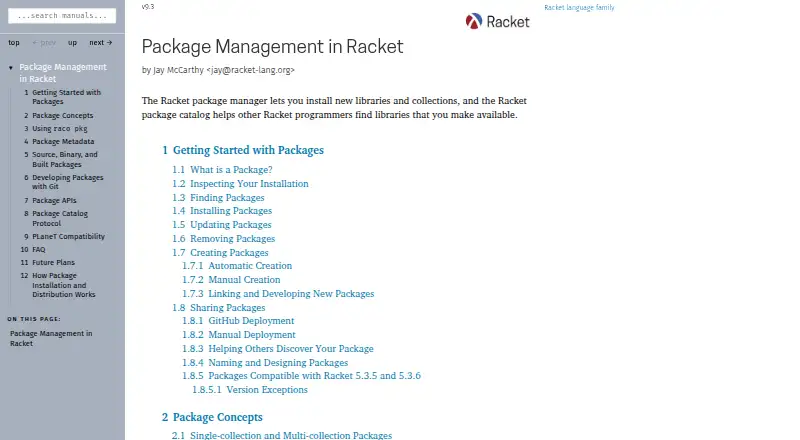
The facts below are what the maker publishes about Racket Package Manager, checked and dated. Our editors have not written about it yet.
The facts
Each one read from Racket Package Manager's own pages, with the date it was checked.
What it does
- Command line
- The raco pkg command provides package-management subcommands, and the graphical interface allows the same operations.checked 11 Oct 2026
- Compatibility limit
- Compiled bytecode in a binary package is specific to a Racket version, and the package source may be less immediately accessible to programmers.checked 11 Oct 2026
- Dependencies
- During installation, raco pkg can prompt to install missing dependencies or install them automatically with the --auto option.checked 11 Oct 2026
- Dependency resolution
- Yeschecked 21 Sep 2026
- Find packages
- The PLT package catalog provides a centralized listing of available Racket packages.checked 11 Oct 2026
- Git integration
- The documentation describes deploying packages from GitHub and says other Git repository services, including GitLab and Bitbucket, can work when their servers support HTTP(S) or native Git.checked 11 Oct 2026
- Git integrations
- GitHub, GitLab, and Bitbucket repositories can serve as package sources when the repository server supports HTTP(S) or the native Git protocol.checked 11 Oct 2026
- Graphical interface
- The package manager has a graphical interface accessible through DrRacket’s File menu or through the gui-pkg-manager application.checked 11 Oct 2026
- Install sources
- Packages can be installed from a catalog name, a zip or tar file, a Git repository, or other package sources.checked 11 Oct 2026
- Intended users
- The package manager is for Racket users who install libraries and for package authors who publish them for other programmers to find.checked 11 Oct 2026
- Interfaces
- Package management is available through a graphical interface and the raco pkg command-line tool.checked 11 Oct 2026
- Minimal distribution
- Minimal Racket includes enough of Racket to use raco pkg to install additional packages.checked 11 Oct 2026
- Offline installation
- Yeschecked 21 Sep 2026
- Package authoring
- The raco pkg tool can create a package skeleton, archive packages, and support package deployment.checked 11 Oct 2026
- Package formats
- Packages can provide source, compiled bytecode, rendered documentation, or combinations of source and compiled elements.checked 11 Oct 2026
- Package publishing
- To list a package in the PLT catalog, a publisher must create an account and log in; the catalog periodically checks the designated source for updates.checked 11 Oct 2026
- Package removal limit
- The raco pkg remove command will not remove a package that other installed packages depend on unless removal is forced.checked 11 Oct 2026
- Purpose
- The package manager installs libraries and collections, and the package catalog helps Racket programmers find libraries.checked 11 Oct 2026
- Scopes
- Packages can be installed in user-specific or installation-wide scopes, and the default setup is generally user- and Racket-installation-specific.checked 11 Oct 2026
- Security
- The documentation describes package checksums for identifying implementations; its future-plans page says public-key encryption for catalog information would be desirable.checked 11 Oct 2026
- Supported systems
- Racket installers are listed for Windows, Mac OS, and Linux, with several processor architectures available.checked 11 Oct 2026
Money
- Free plan
- Yeschecked 21 Sep 2026
Where it runs
- Supported desktop platforms
- The download page lists installers for Windows x64 and Arm, Mac OS Intel and Apple Silicon, and several Linux architectures.checked 11 Oct 2026
- Supported platforms
- Windows,macOS,Linuxchecked 21 Sep 2026