Quickbench
Quickbench is a free Bash script for measuring basic performance on Linux-based hosts.
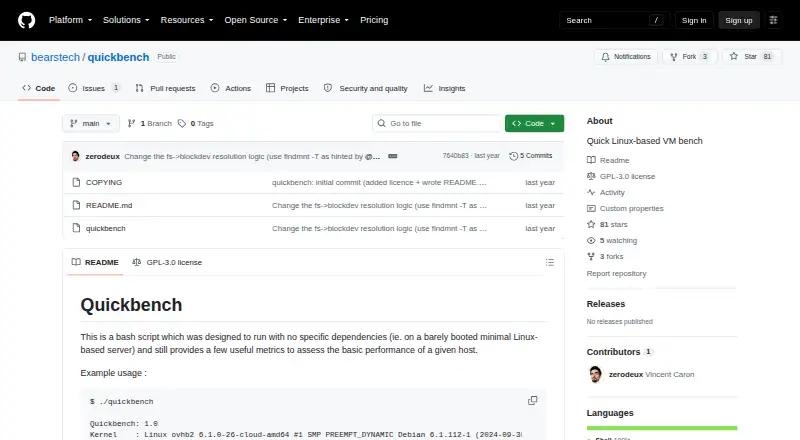
What Quickbench is
Quickbench is a free Bash script for measuring basic performance on Linux-based hosts. It reports CPU configuration and runs busy-loop benchmarks at different job counts. It also reports Linux-allocatable memory and runs a basic bandwidth test, which may reflect L1 or L2 cache performance. For storage, Quickbench uses parallel transfers with 4k and 1M blocks to report bandwidth and I/O rates. These tests run on the filesystem in the current working directory; to check another device, mount its filesystem there and run the script from that mount point. Quickbench is designed to run without specific dependencies on a minimal Linux server. It takes one parameter: the maximum duration in seconds for each benchmark loop. The project recommends at least 30 seconds for statistically meaningful results and warns that shorter runs may be unreliable. CPU loop results are not calibrated, so host comparisons call for matching Quickbench, kernel, Bash, and dd versions. The project describes its storage test as non-thorough and says it cannot measure I/O completion latency. Quickbench is licensed under GPL-3.0.
Good
- Free Bash script for Linux hosts.
- Designed for minimal servers without specific dependencies.
- Reports CPU, memory, and storage measurements.
- Storage checks use parallel transfers with two block sizes.
Watch out
- Storage testing is described as non-thorough.
- It cannot measure I/O completion latency.
- CPU results are not calibrated for comparisons.
- Runs under 10 seconds may be unreliable.
Who it suits
Quickbench suits people who want a basic performance check on a Linux host or virtual machine. It may be useful when a simple script is preferred over a dependency-heavy benchmark setup.
Verdict
Quickbench offers a straightforward set of CPU, memory, and storage checks for Linux hosts. Treat its measurements as basic indicators rather than thorough storage or calibrated CPU results.
Plans and prices
From Quickbench's own pricing page, checked 7 Oct 2026.
| Plan | Price | What it gives you |
|---|---|---|
| Quickbench | Free | Bash script · Linux-based server · no specific dependencies |
The facts
Each one read from Quickbench's own pages, with the date it was checked.
What it does
- Benchmark limits
- The project describes its storage benchmark as non-thorough and says it cannot measure I/O completion latency.checked 7 Oct 2026
- Benchmark location
- The storage benchmark runs on the filesystem in the current working directory.checked 7 Oct 2026
- Comparability
- The README says CPU loop measurements are not calibrated and recommends matching Quickbench, kernel, Bash, and dd versions when comparing hosts.checked 7 Oct 2026
- CPU benchmark
- It runs a CPU busy-loop with configurable parallel jobs and reports loop rates.checked 7 Oct 2026
- CPU measurements
- It reports CPU configuration and runs a busy-loop benchmark at different job counts.checked 7 Oct 2026
- Dependencies
- The script is designed to run without specific dependencies on a minimal Linux server.checked 7 Oct 2026
- Intended users
- The README describes Quickbench as a quick Linux-based VM benchmark for assessing host performance.checked 7 Oct 2026
- License
- The repository identifies the project license as GPL-3.0.checked 7 Oct 2026
- Limitations
- Quickbench says it cannot currently measure storage I/O completion latency and describes its storage test as not thorough.checked 7 Oct 2026
- Memory measurements
- It reports Linux allocatable memory and runs a simple memory bandwidth test that may reflect L1 or L2 cache performance.checked 7 Oct 2026
- Memory metrics
- It reports Linux-allocatable memory and a simple memory bandwidth measurement that may reflect L1/L2 cache performance.checked 7 Oct 2026
- Parameter
- The script accepts one parameter: the maximum duration in seconds for each benchmark loop.checked 7 Oct 2026
- Purpose
- Quickbench is a Bash script that measures basic performance on Linux-based hosts.checked 7 Oct 2026
- Recommended duration
- The README advises using at least 30 seconds for statistically meaningful results and says values below 10 seconds may be unreliable.checked 7 Oct 2026
- Run duration
- Quickbench accepts one parameter, the loop delay in seconds, and recommends at least 30 seconds for statistically meaningful results.checked 7 Oct 2026
- Storage measurements
- It benchmarks storage with parallel dd transfers using 4k and 1M blocks, reporting bandwidth and I/O rates.checked 7 Oct 2026
- Storage metrics
- It measures storage read and write throughput using 4k and 1M blocks with multiple parallel jobs.checked 7 Oct 2026
- Storage scope
- Storage benchmarks run on the filesystem in the current working directory; to benchmark another device, the user must mount a filesystem there and change to its mount point.checked 7 Oct 2026
The company
- Maker location
- The maker's GitHub organization profile lists Paris, France.checked 7 Oct 2026
Alternatives to Quickbench
- 1

GitHub CodeQL
Free planWebExtensionLinuxmacOS7.5From $30 a month - 2
Parkdale
Free planAndroidmacOSWindows7.2Free plan - 3
CrystalDiskMark
Free planWindows6.9$9.99 one-time - 4
fio
Free planLinuxmacOSWindows6.6Free plan - 5

AJA System Test
Free planmacOSWindows6.5Free plan - 6
DiskSpd
Free planLinuxmacOSWindows6.5Free plan