DiskSpd
DiskSpd is a free storage load generator and performance test tool from Microsoft engineering teams.
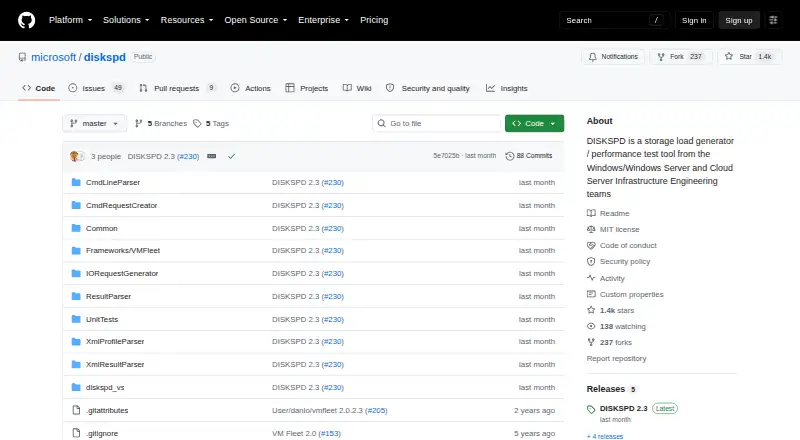
What DiskSpd is
DiskSpd is a free storage load generator and performance test tool from Microsoft engineering teams. It is designed for measuring storage behavior through random and sequential I/O tests, including IOPS and latency measurements. Its 2.3 release adds an IoRing path with registered buffers and configurable submission batching, along with BypassIO options for partial bypass or required full bypass. Processor controls include topology-aware affinity, physical-core assignment, and P-core/E-core ordering. Results can include processor names and cache topology in text or XML, while XML profiles and results cover the newer I/O, affinity, buffer, and completion settings. The release includes amd64 and arm64 binaries, available as precompiled ZIP files alongside source code. The minimum supported operating system is Windows 10 version 1803; IoRing and BypassIO require Windows 11 or later, and BypassIO also requires NTFS. The repository also includes VM Fleet, a framework for exploring storage capabilities in Windows Server Hyper-Converged environments with Storage Spaces Direct. The project uses the MIT License.
Good
- Free to use under the MIT License
- Measures random and sequential I/O, IOPS, and latency
- Reports processor names and cache topology
- Offers precompiled amd64 and arm64 binaries
Watch out
- Minimum supported OS is Windows 10 version 1803
- IoRing and BypassIO require Windows 11 or later
- BypassIO also requires NTFS
Who it suits
DiskSpd suits users who need to generate storage workloads and examine performance measurements. Its newer I/O modes and processor controls may be relevant to people working with supported Windows systems.
Verdict
DiskSpd provides storage workload generation with configurable I/O and reporting options. Check operating-system and filesystem requirements before relying on its newer modes.
Plans and prices
From DiskSpd's own pricing page, checked 28 Sep 2001.
| Plan | Price | What it gives you |
|---|---|---|
| Free | Free | Windows 10 version 1803 or later · IoRing and BypassIO require Windows 11 or later · BypassIO also requires NTFS |
The facts
Each one read from DiskSpd's own pages, with the date it was checked.
What it does
- Builds
- The 2.3 binary release contains amd64 and arm64 builds.checked 28 Sep 2001
- Downloads
- The releases page provides precompiled ZIP binaries and source code.checked 28 Sep 2001
- I/O modes
- DiskSpd 2.3 adds BypassIO modes for partial bypass and required full bypass.checked 28 Sep 2001
- Latest release
- DiskSpd 2.3 adds an IoRing I/O path with registered buffers and configurable submission batching.checked 28 Sep 2001
- License
- The repository uses the MIT License, which grants permission to use, copy, modify, distribute, sublicense, and sell copies of the software subject to its conditions.checked 28 Sep 2001
- Processor controls
- DiskSpd 2.3 adds topology-aware affinity controls, including physical-core assignment and P-core/E-core ordering.checked 28 Sep 2001
- Profiles
- XML profiles and results support the new I/O, affinity, buffer, and completion settings.checked 28 Sep 2001
- Purpose
- DiskSpd is a storage load generator and performance test tool from Microsoft engineering teams.checked 28 Sep 2001
- Related framework
- The repository includes VM Fleet, a framework for exploring storage capabilities in Windows Server Hyper-Converged environments with Storage Spaces Direct.checked 28 Sep 2001
- Reporting
- Results can report processor names and cache topology in text and XML formats.checked 28 Sep 2001
- Requirements
- The minimum supported operating system is Windows 10 version 1803; IoRing and BypassIO require Windows 11 or later, and BypassIO also requires NTFS.checked 28 Sep 2001
- Security reporting
- Microsoft asks researchers to report security vulnerabilities through the Microsoft Security Response Center rather than public GitHub issues.checked 28 Sep 2001
- Support
- The repository directs users to GitHub Issues to report DiskSpd problems.checked 28 Sep 2001
The company
- Founded
- 1975checked 28 Sep 2001
- Headquarters
- Redmond, Washington, USAchecked 28 Sep 2001
Money
- Free plan
- Yeschecked 20 Sep 2001
The full review of DiskSpd
Overview
DiskSpd is Microsoft’s storage workload generator for measuring performance under configurable I/O conditions. It best suits technical users who need command-line testing, repeatable profiles or detailed processor and storage reporting. Its broad range of workload controls is useful, but newer I/O paths have specific operating-system and filesystem requirements.
Key features
DiskSpd supports random and sequential I/O tests, with IOPS and latency measurement. That makes it suitable for examining both throughput-oriented workloads and responsiveness, rather than relying on a single headline score. Its command-line interface and XML profiles favor users comfortable configuring tests over those seeking a guided desktop benchmark.
Version 2.3 adds an IoRing path with registered buffers and configurable submission batching, plus BypassIO modes for partial bypass or required full bypass. These options provide more ways to shape a workload, but they are not universally usable: IoRing and BypassIO require Windows 11 or later, and BypassIO also requires NTFS.
Processor controls include topology-aware affinity, physical-core assignment and P-core/E-core ordering. Results can include processor names and cache topology in text or XML, while XML profiles and results accommodate the newer I/O, affinity, buffer and completion settings. This depth is valuable for controlled technical comparisons, though the configuration overhead is unnecessary for a quick, uncomplicated disk check.
The 2.3 binary release includes amd64 and arm64 builds. Releases provide precompiled ZIP binaries as well as source code. The repository also includes VM Fleet, a framework for exploring storage capabilities in Windows Server Hyper-Converged environments with Storage Spaces Direct; that is a separate, specialized use rather than a general-purpose benchmark feature.
Pricing
Free — free. The free plan includes DiskSpd, with Windows 10 version 1803 or later as the minimum supported operating system. IoRing and BypassIO require Windows 11 or later, and BypassIO additionally requires NTFS. There are no paid tiers or seat and quota distinctions to weigh, so the decision is about technical fit rather than plan limits.
The repository uses the MIT License, permitting use, modification and distribution subject to its conditions. GitHub Issues is the channel for reporting DiskSpd problems; security vulnerabilities should instead go to the Microsoft Security Response Center, not public GitHub issues.
Platforms
DiskSpd is offered for Windows, Linux and macOS, while its stated minimum operating-system requirement and newer-mode requirements apply to Windows. The 2.3 release has amd64 and arm64 binaries. Check the requirements for the intended platform and mode before depending on a particular test path.
Who it's for
DiskSpd is a strong fit for administrators, engineers and technically confident users who want configurable storage workloads, command-line operation, XML-based repeatability or processor-topology-aware testing. Its reporting and affinity controls serve investigations where workload conditions matter. It is a weaker choice for casual users who want a simple graphical score, or for anyone whose target system cannot meet the requirements of the desired I/O mode.
Pros and cons
- Pros: Random and sequential tests with IOPS and latency measurement cover distinct storage-performance questions.
- Pros: XML profiles and text/XML reporting help preserve detailed settings and results across repeat runs.
- Pros: The free MIT-licensed tool has amd64 and arm64 release builds.
- Cons: IoRing and BypassIO are limited to Windows 11 or later, and BypassIO also needs NTFS.
- Cons: Command-line and profile-driven configuration is less suited to a quick, guided benchmark.
Alternatives
For a broader set of disk benchmark options, browse Disk Benchmark Software. Choose fio instead if its free GNU GPL version 2 software and Linux, macOS and Windows availability better match your needs. Filebench is a free Linux option. Modern FS Benchmark is a free choice for Linux or self-hosted use.
Linux users seeking an open-source disk benchmark can consider KDiskMark. For a Windows freeware option with a 261 KB download, consider AS SSD Benchmark. Parkdale is free to download and use on Android, macOS and Windows. D-Bench is a free Windows option supporting Windows 8/8.1/10/11 or Vista/7. Storage Benchmark Kit is free and supports Windows, macOS and Linux.
Verdict
Choose DiskSpd if you need a free, configurable storage workload tool with command-line control, XML profiles and detailed I/O and processor options. Its chief advantage is the control it gives technical users over test conditions; its chief drawback is that the more specialized modes depend on recent Windows versions and, for BypassIO, NTFS. For a simple guided benchmark or a platform-specific alternative, compare the options above.
Alternatives to DiskSpd
- 1
Parkdale
Free planAndroidmacOSWindows7.2Free plan - 2
CrystalDiskMark
Free planWindows6.9$9.99, paid once - 3
fio
Free planLinuxmacOSWindows6.6Free plan - 4

AJA System Test
Free planmacOSWindows6.4Free plan - 5

ATTO Disk Benchmark
Free planmacOSWindows6.3Free plan - 6
HD Tune Pro
Windows6.3From $29.95 a month