Filebench
Filebench is a free Linux tool for benchmarking file systems and storage by generating workloads.
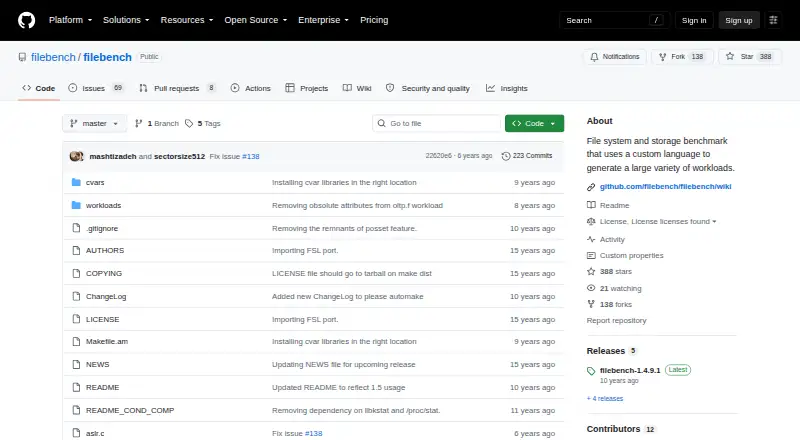
What Filebench is
Filebench is a free Linux tool for benchmarking file systems and storage by generating workloads. It supports micro- and macro-benchmarking, including random and sequential I/O tests, IOPS measurement, and latency measurement. Users can describe application I/O behavior with its Workload Model Language (WML), defining filesets, processes, threads, and flow operations. Built-in workload personalities cover mail, web, file, and database servers, and named examples include webserver, fileserver, and mailserver workloads. Shipped workloads may not be sized for a particular system, so the documentation recommends copying and adjusting them. Filebench has a command-line interface. The README describes compiling and installing it with configure, make, and sudo make install, and notes that yacc and lex are required. The project directs questions, bug reports, and feature requests to GitHub Issues. Its repository license is the Common Development and Distribution License, Version 1.0. The listed plan is free, with no usage limits stated.
Good
- Supports micro- and macro-benchmarking.
- Measures IOPS and latency.
- WML defines filesets, processes, threads, and flow operations.
- Includes mail, web, file, and database workload personalities.
Watch out
- Runs on Linux only.
- Installation requires yacc and lex.
- Shipped workloads may need resizing for a particular system.
Who it suits
Filebench suits Linux users who need to generate storage workloads or measure I/O behavior. It may be useful to users who want to define their own workload patterns or adapt the supplied examples.
Verdict
Filebench offers configurable workloads and several storage measurements for Linux benchmarking. Expect to adapt some supplied workloads and meet the stated build requirements during installation.
Plans and prices
From Filebench's own pricing page, checked 3 Oct 2026.
| Plan | Price | What it gives you |
|---|---|---|
| Filebench | Free | No price or usage limits stated |
The facts
Each one read from Filebench's own pages, with the date it was checked.
What it does
- Benchmark types
- The README says Filebench supports both micro- and macro-benchmarking.checked 3 Oct 2026
- Built-in workloads
- The project includes workload personalities such as mail, web, file, and database server workloads.checked 3 Oct 2026
- Custom workloads
- Users can describe application I/O behavior with Filebench’s Workload Model Language (WML).checked 3 Oct 2026
- Installation
- The README describes compiling and installing Filebench with configure, make, and sudo make install, with yacc and lex required.checked 3 Oct 2026
- License
- The repository’s LICENSE file identifies the Common Development and Distribution License (CDDL), Version 1.0.checked 3 Oct 2026
- Predefined examples
- The documentation names webserver, fileserver, and mailserver as predefined workloads.checked 3 Oct 2026
- Purpose
- Filebench is a file system and storage benchmark that generates a variety of workloads.checked 3 Oct 2026
- Support
- The project directs questions, bug reports, and feature requests to GitHub Issues.checked 3 Oct 2026
- Workload sizing
- The documentation cautions that shipped workloads may not be sized for a particular system and recommends copying and adjusting them.checked 3 Oct 2026
- Workload structure
- Filebench workloads can define filesets, processes, threads, and flow operations.checked 3 Oct 2026
Money
- Free plan
- Yeschecked 20 Sep 2026
Alternatives to Filebench
- 1

GitHub CodeQL
Free planWebExtensionLinuxmacOS7.5From $30 a month - 2
Parkdale
Free planAndroidmacOSWindows7.2Free plan - 3
CrystalDiskMark
Free planWindows6.9$9.99 one-time - 4
fio
Free planLinuxmacOSWindows6.6Free plan - 5

AJA System Test
Free planmacOSWindows6.5Free plan - 6
DiskSpd
Free planLinuxmacOSWindows6.5Free plan