QRoll
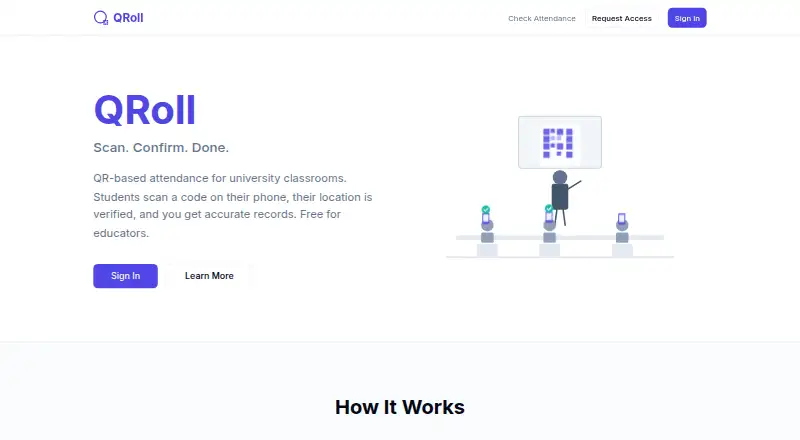
QRoll is a web-based attendance system for university classrooms that records check-ins with QR codes and location verification.
What QRoll is
QRoll is a web-based attendance system for university classrooms that records check-ins with QR codes and location verification. Session codes can change every 30 seconds, and professors can set an allowed location radius for each course. It supports classroom and online sessions; remote students scan a code displayed on a shared screen. Professors can upload rosters from CSV and export attendance in Excel or CSV format. The system flags students below 75% or 50% attendance, while students can look up their own attendance with a course and student ID without logging in. Professors can add teaching assistants and group course sections for combined views and exports. QRoll is free, but access is invite-only and a request does not guarantee approval. The service may limit supported professors, institutions, classes, users, sessions, or attendance records. It does not guarantee security or that location checks and anti-sharing features will always work correctly. It was built by Mayank Chadha, Ph.D. in 2026 while teaching at UC San Diego.
Good
- QR codes can rotate every 30 seconds
- Supports classroom and online sessions
- Exports attendance to Excel or CSV
- Flags attendance below 75% or 50%
- Students can look up attendance without logging in
Watch out
- Invite requests do not guarantee approval
- No mobile app is listed
- Service capacity may be restricted
- Security and verification are not guaranteed
Who it suits
QRoll suits university professors who want QR-based classroom or online attendance, roster imports, and exports. Students can use it to check their own attendance without logging in, but service access requires approval.
Verdict
QRoll offers a free web-based approach to attendance capture, course organization, and reporting. Its invite-only access and stated limits on service capacity and verification are important considerations.
Plans and prices
From QRoll's own pricing page, checked 7 Oct 2001.
| Plan | Price | What it gives you |
|---|---|---|
| Free | Free | Limited access · approved users only · access at QRoll’s discretion |
The facts
Each one read from QRoll's own pages, with the date it was checked.
What it does
- Access
- QRoll is invite-only, and an access request does not guarantee approval.checked 7 Oct 2001
- Attendance alerts
- QRoll automatically flags students below 75% or 50% attendance.checked 7 Oct 2001
- Availability limits
- QRoll may restrict the number of professors, institutions, classes, users, sessions, or attendance records it supports.checked 7 Oct 2001
- Course management
- Professors can add teaching assistants and group course sections for combined views and exports.checked 7 Oct 2001
- Location checks
- Professors can set an allowed location radius per course.checked 7 Oct 2001
- Purpose
- QRoll tracks attendance for university classrooms using QR-based check-ins and location verification.checked 7 Oct 2001
- Remote sessions
- QRoll supports classroom and online sessions, with remote students scanning a QR code from a shared screen.checked 7 Oct 2001
- Roster and reports
- Professors can upload rosters from CSV and export attendance as Excel or CSV.checked 7 Oct 2001
- Rotating QR codes
- Session QR codes can change every 30 seconds.checked 7 Oct 2001
- Security and verification limits
- QRoll does not guarantee that the service is secure or that location checks and anti-sharing features will always work correctly.checked 7 Oct 2001
- Student lookup
- Students can look up their own attendance using their course and student ID without logging in.checked 7 Oct 2001
- Support
- QRoll lists [email protected] for questions or feedback.checked 7 Oct 2001
The company
- Founded
- 2026checked 28 Sep 2001
- Maker
- QRoll was built by Mayank Chadha, Ph.D. in 2026 while teaching at UC San Diego.checked 7 Oct 2001