
Qpoint
Qpoint is software for monitoring AI agents and applying controls where they operate.
What Qpoint is
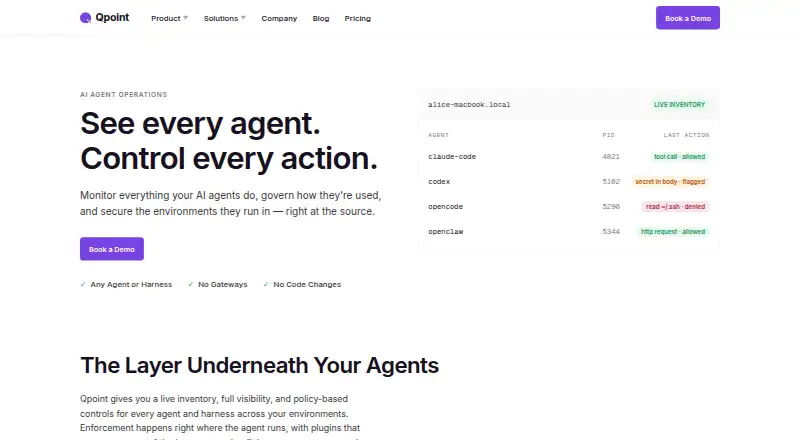
Qpoint is software for monitoring AI agents and applying controls where they operate. It records file activity, tool calls, outbound network requests and process execution, associating that activity with agents and sessions. Teams can set policies to block secret reads, reject unapproved endpoints, redact outbound content and deny unapproved tool calls. Qpoint describes its endpoint deployment as a single binary, without gateways, sidecars or SDK integration. It can also run in containers, virtual machines, clusters and CI runners, and Kubernetes support is listed. The endpoint solution covers macOS, Windows and Linux; Jamf and Intune are named for rollout. Events can be exported to SIEM and observability stacks, with Splunk, Datadog and Elastic named. The free Community plan supports up to 25 endpoints and includes agent discovery and monitoring with attribution, built-in policy plugins and community support. Team supports up to 500 endpoints and adds a shared workspace, custom policy plugins, exports and usage and cost reports. Enterprise offers unlimited endpoints, compliance reports, SSO and role-based access control. Qpoint states that it has achieved SOC 2 Type II compliance.
Good
- Attributes file, tool, network and process activity to agents and sessions.
- Policies can block secret reads and unapproved tool calls.
- Runs as a single binary without gateways, sidecars or SDK integration.
- Can export events to Splunk, Datadog and Elastic.
- Community plan covers up to 25 endpoints at no charge.
Watch out
- Community is limited to 25 endpoints.
- Team is limited to 500 endpoints.
Who it suits
Community is positioned for individuals and small teams that need agent discovery, monitoring and built-in policy enforcement across up to 25 endpoints. Team is aimed at IT operations and security teams, while Enterprise is positioned for organizations needing unlimited endpoints or enterprise access controls.
Verdict
Choose Qpoint if you need to monitor AI agent activity and enforce policies where agents run, with a free Community plan for up to 25 endpoints. Look elsewhere if you need more than 25 endpoints without moving beyond Community, or need listed pricing for Team or Enterprise before evaluating them.
Plans and prices
From Qpoint's own pricing page, checked 3 Oct 2026.
| Plan | Price | What it gives you |
|---|---|---|
| Community | Free | Up to 25 endpoints · Agent discovery and monitoring with attribution · Built-in policy plugins and source enforcement · Community support |
| Enterprise | Priced on request | Unlimited endpoints · Compliance reports · Embed Qpoint in products · SSO and RBAC · 24/7 support with onboarding |
| Team | Priced on request | Up to 500 endpoints · Shared team workspace · Custom policy plugins · SIEM and observability export · Usage and cost reports · Email and chat support |
The facts
Each one read from Qpoint's own pages, with the date it was checked.
What it does
- Agent activity
- It captures agent file activity, tool calls, outbound network requests, and process execution with agent and session attribution.checked 3 Oct 2026
- Deployment
- Qpoint describes its deployment as a single binary that runs directly on endpoints without gateways, sidecars, or SDK integration.checked 3 Oct 2026
- Enterprise access
- The Enterprise plan includes SSO and role-based access control.checked 3 Oct 2026
- Hosted environments
- The site says Qpoint can run in containers, virtual machines, clusters, and CI runners.checked 3 Oct 2026
- Integrations
- Qpoint says events can be exported to existing SIEM and observability stacks; its Monitor page names Splunk, Datadog, and Elastic.checked 3 Oct 2026
- Policy controls
- Policies can block secret reads, refuse unapproved endpoints, redact outbound content, and deny unapproved tool calls.checked 3 Oct 2026
- Product
- Qpoint monitors AI agents, governs how they are used, and enforces policies where they run.checked 3 Oct 2026
- Security compliance
- Qpoint states that it achieved SOC 2 Type II compliance.checked 3 Oct 2026
- Support
- The plans list community support for Community, email and chat support for Team, and 24/7 support with onboarding for Enterprise.checked 3 Oct 2026
- Supported endpoint systems
- The endpoint solution lists macOS, Windows, and Linux, with Jamf and Intune named for rollout.checked 3 Oct 2026
The company
- Company background
- Qpoint says it was founded by veterans of DigitalOcean, NS1, and HashiCorp.checked 3 Oct 2026
- Intended teams
- The pricing page positions Community for individuals and small teams, Team for IT operations and security teams, and Enterprise for organizations.checked 3 Oct 2026
The full review of Qpoint
Qpoint is built for monitoring AI agents and controlling their behavior on the systems where they execute. It fits security and IT teams responsible for agent fleets, while individuals and small groups can start without paying. The central advantage is combining attributed activity records with controls that can stop risky actions before they leave an endpoint.
Overview
Qpoint records file activity, tool calls, outbound network requests, and process execution, associating each event with an agent and session. That attribution gives incident reviews and operational investigations useful context instead of a generic stream of machine events. Its policy engine can block attempts to read secrets, reject unapproved endpoints, redact outbound content, and deny tool calls that have not been approved. Those safeguards make Qpoint more appropriate for governing agent use than for teams seeking observation alone.
Deployment uses a single binary running directly on endpoints, with no gateway, sidecar, or SDK integration. Qpoint can also run in containers, virtual machines, clusters, and CI runners, covering hosted workloads as well as employee machines. Events can be exported to existing SIEM and observability systems, with Splunk, Datadog, and Elastic named as integrations.
Key features
- Agent and session attribution: File, tool, network, and process events are tied back to the responsible agent and session, which helps distinguish legitimate automation from an individual problematic run.
- Preventive policy controls: Blocking secret reads and unapproved tool calls addresses high-impact failure modes directly. Endpoint refusal and outbound redaction add control over where data goes and what it contains.
- Endpoint-first deployment: A standalone binary avoids adding a gateway, sidecar, or application SDK. That reduces integration dependencies, while support for containers, VMs, clusters, and CI runners broadens where it can be used.
- Operational exports: SIEM and observability export lets teams feed Qpoint events into established workflows; Splunk, Datadog, and Elastic are specifically supported.
- Hybrid infrastructure coverage: Qpoint includes network visibility, application tracing, and Kubernetes support. The endpoint solution covers macOS, Windows, and Linux, with Jamf and Intune named for rollout.
- Security assurance: Qpoint states that it has achieved SOC 2 Type II compliance, a relevant consideration for organizations assessing controls around agent activity.
Pricing
Qpoint uses a freemium structure. The Community plan costs free and supports up to 25 endpoints. It includes agent discovery and monitoring with attribution, built-in policy plugins and source enforcement, and community support. This is a sensible starting point for an individual or small team that can stay within the endpoint cap, but the cap becomes a hard boundary for a growing fleet.
Team has custom pricing and supports up to 500 endpoints. It adds a shared team workspace, custom policy plugins, SIEM and observability export, usage and cost reports, and email and chat support. IT operations and security teams that need collaborative administration and reporting are the intended audience; moving up is necessary when Community's 25-endpoint limit or built-in policy scope no longer fits.
Enterprise also uses custom pricing and removes the endpoint ceiling with unlimited endpoints. It adds compliance reports, the ability to embed Qpoint in products, SSO and role-based access control, plus 24/7 support with onboarding. Those additions target organizations with formal governance, identity requirements, or a product-embedding use case. Buyers who need a published price before evaluation should account for the custom-quote model on both paid tiers.
Platforms
Qpoint is available across Linux, macOS, Windows, and the web. Linux-based deployments require kernel 5.10 or newer and support x86_64 and arm64. Kubernetes is supported, and the hybrid deployment model accommodates endpoint and hosted environments. Jamf and Intune provide named rollout paths for macOS and Windows fleets.
Who it's for
Community suits individuals and small teams monitoring up to 25 endpoints. Team is the practical fit for IT operations and security groups managing a larger, shared deployment and needing exports, custom policies, and usage reporting. Enterprise is aimed at organizations that require unlimited scale, compliance reporting, SSO, RBAC, onboarding, and 24/7 support. Qpoint is less suitable when agent monitoring is not needed or when a deployment must remain within a free tier above 25 endpoints.
Pros and cons
Pros
- Controls as well as visibility: Qpoint can prevent secret access, unapproved destinations, and unauthorized tools instead of merely recording events.
- Broad execution coverage: The same approach extends from desktops to containers, clusters, virtual machines, and CI runners.
- Low-friction deployment: A single endpoint binary avoids gateway, sidecar, and SDK dependencies.
- Useful free entry point: Community includes attributed discovery, monitoring, and policy features at no cost for up to 25 endpoints.
Cons
- Community is capped at 25 endpoints: Larger deployments must move to a custom-priced tier.
- Paid-tier costs require a quote: Team and Enterprise have no published price, making early budget comparison harder.
- Advanced governance is reserved for Enterprise: SSO, RBAC, compliance reports, unlimited endpoints, and 24/7 onboarding support are not part of Community or Team.
Alternatives
For a broader catalog of kernel and infrastructure observability choices, see the eBPF Observability Tools list. Kubeshark is a freemium option with a free Community tier for up to three nodes or 60 pods and API-focused platform coverage. DeepFlow is a free, open-source-oriented choice covering Linux servers and selected Kubernetes, cloud, and container environments.
Coroot offers a free self-hosted Community Edition under Apache 2.0 alongside a paid Standard plan. Inspektor Gadget is a free open-source toolkit for Linux 5.10+ systems with BTF support. Odigos provides free Apache 2.0 OpenTelemetry tracing with a community-supported Open Source plan.
bpftrace is a free Linux tracing tool for compatible kernels with BPF support. Caretta is a free open-source Kubernetes tool. Grafana k6 is a Linux load-testing option whose free tier is limited to 500 virtual user hours per month.
Verdict
Choose Qpoint when you need attributed AI-agent monitoring paired with enforceable controls across endpoints and hosted workloads, especially if 25 endpoints cover your initial Community deployment. Its single-binary installation, policy enforcement, and SIEM exports give security teams a coherent way to govern agent behavior. Look elsewhere if you need a larger free deployment, a published price for paid tiers, or a tool focused on general infrastructure tracing rather than agent-specific policy control.
Getting started
- Visit the Qpoint website.
- Choose Community for up to 25 endpoints, Team for up to 500, or Enterprise for unlimited endpoints.
- Deploy the single binary on an endpoint, or run Qpoint in a container, virtual machine, cluster or CI runner.
- For endpoint rollout, use Jamf or Intune if appropriate.
- Export events to an existing SIEM or observability stack if needed.
Limits worth knowing
The free Community plan supports up to 25 endpoints. The Team plan supports up to 500; Enterprise lists unlimited endpoints.
Questions
Is there a free plan?
Yes. Community is listed as free and supports up to 25 endpoints.
Which platforms does Qpoint support?
The listed platforms are Linux, macOS, web and Windows. The endpoint solution lists macOS, Windows and Linux.
Can Qpoint integrate with SIEM or observability tools?
Events can be exported to existing SIEM and observability stacks. Splunk, Datadog and Elastic are named.
What does Enterprise include?
Enterprise includes unlimited endpoints, compliance reports, embedding Qpoint in products, SSO, role-based access control, 24/7 support and onboarding.
Does Qpoint state a security compliance status?
Qpoint states that it achieved SOC 2 Type II compliance.
Alternatives to Qpoint
- 1

Enkrypt AI Guardrails
Free planWebAPISelf-hosted6.8From $1,608 a year - 2

GuardionAI
WebAPILinuxmacOS6.8 - 3

Azure AI Speech
Free planWebAPISelf-hosted6.7Free plan - 4
Silker AI Mobile Security
AndroidiOSWeb6.6From $19.50 a month - 5
Google Cloud Secret Manager
Free planWeb6.5From $0.02 a month - 6
VotalAI
WebAPISelf-hosted6.1