
DeepFlow
DeepFlow is an observability product for complex cloud infrastructure and cloud-native applications.
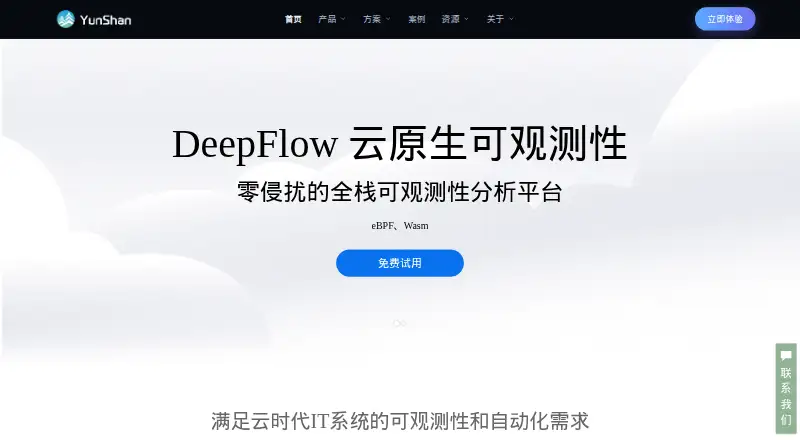
What DeepFlow is
DeepFlow is an observability product for complex cloud infrastructure and cloud-native applications. It uses eBPF to collect application performance metrics, distributed traces, and continuous profiling data, and provides a service map, tracing, and profiling. Its built-in protocol parsing covers HTTP, HTTPS, Dubbo, gRPC, MySQL, PostgreSQL, Redis, MongoDB, Kafka, MQTT, and DNS. DeepFlow can act as a storage backend for Prometheus, OpenTelemetry, SkyWalking, and Pyroscope, and provides SQL, PromQL, and OTLP interfaces. AutoTagging can connect observability data to cloud and Kubernetes resources, tags, and CMDB business tags. The Community Edition is open source under the Apache 2.0 License and costs nothing. Deployment instructions cover Kubernetes and Docker Compose for an all-in-one installation. The Enterprise Edition adds encrypted agent-server transmission, multi-tenancy, data permission isolation, and after-sales support. The Community Edition lacks alert management, report management, and custom dashboard management.
Good
- Open-source Community Edition under Apache 2.0
- Collects metrics, traces, and profiling data
- Supports many common protocols
- Offers SQL, PromQL, and OTLP interfaces
Watch out
- Community Edition lacks alert management
- Community Edition lacks report management
- Community Edition lacks custom dashboard management
Who it suits
It suits teams monitoring complex cloud or cloud-native environments that need tracing, profiling, and broad protocol parsing. Teams needing alert, report, or custom dashboard management should note these are not in the Community Edition.
Verdict
DeepFlow combines infrastructure observability, protocol parsing, and integration interfaces in an open-source Community Edition. Its documented Community Edition limits matter if alerting, reports, or custom dashboards are required.
Plans and prices
From DeepFlow's own pricing page, checked 30 Sep 2026.
| Plan | Price | What it gives you |
|---|---|---|
| Community Edition | Free | Open-source edition; supports Linux servers and selected Kubernetes, cloud, and container environments |
| Cloud Edition | Priced on request | Fully managed platform; described as in the testing trial phase |
| Enterprise Edition | Priced on request | Enterprise features and services; pricing not stated |
The facts
Each one read from DeepFlow's own pages, with the date it was checked.
What it does
- Collection
- It uses eBPF for zero-intrusion collection of application performance metrics, distributed traces, and continuous profiling data.checked 30 Sep 2026
- Community license
- The core modules are open-sourced under the Apache 2.0 License.checked 30 Sep 2026
- Core features
- Its core capabilities are a universal service map, distributed tracing, and continuous profiling.checked 30 Sep 2026
- Deployment
- The documentation provides Kubernetes and Docker Compose deployment methods for an all-in-one installation.checked 30 Sep 2026
- Enterprise security
- The Enterprise Edition supports encrypted data transmission between agent and server, multi-tenancy, and data permission isolation.checked 30 Sep 2026
- Enterprise support
- Enterprise after-sales support includes fault troubleshooting, performance tuning, version upgrades, and implementation best practices.checked 30 Sep 2026
- Integrations
- DeepFlow can serve as a storage backend for Prometheus, OpenTelemetry, SkyWalking, and Pyroscope, and provides SQL, PromQL, and OTLP interfaces.checked 30 Sep 2026
- Notable limits
- The Community Edition does not include Enterprise features such as alert management, report management, or custom dashboard management.checked 30 Sep 2026
- Protocol support
- Built-in protocol parsing includes HTTP, HTTPS, Dubbo, gRPC, MySQL, PostgreSQL, Redis, MongoDB, Kafka, MQTT, and DNS.checked 30 Sep 2026
- Purpose
- DeepFlow is an observability product for complex cloud infrastructure and cloud-native applications.checked 30 Sep 2026
- Tagging
- AutoTagging can associate observability data with cloud resources, Kubernetes resources and tags, and CMDB business tags.checked 30 Sep 2026
The company
- Headquarters
- The company lists its Beijing headquarters at Room D-1111, U-Center, No. 28 Chengfu Road, Haidian District, Beijing, China.checked 30 Sep 2026
- Maker and founding
- The maker is Yunshan Networks (Beijing Yunshan Century Network Technology Co., Ltd.), founded in December 2011.checked 30 Sep 2026
The full review of DeepFlow
DeepFlow is an observability platform for complex cloud infrastructure and cloud-native applications. It is best suited to teams that want eBPF-based collection alongside tracing, profiling and broad protocol parsing. The Community Edition is free and open source, but teams that need managed alerting, reports or custom dashboards should look at Enterprise instead.
Overview
DeepFlow brings together a universal service map, distributed tracing and continuous profiling, collecting application performance metrics and other signals through eBPF. That breadth makes it a fit for teams seeking a shared view across infrastructure and applications rather than a tool centered on one signal alone.
Its core modules use the Apache 2.0 License, and it supports hybrid deployment. Kubernetes and Docker Compose are documented options for an all-in-one installation. The maker, Yunshan Networks, was founded in December 2011.
For more options in this category, browse eBPF Observability Tools.
Key features
Service relationships and performance signals
The universal service map, distributed tracing and continuous profiling cover complementary jobs: understanding service relationships, following requests, and examining performance over time. This combination is useful when teams need infrastructure and application signals together; readers seeking only a narrow tracing or debugging tool may not need the full scope.
Protocol parsing and integrations
Built-in parsing covers HTTP, HTTPS, Dubbo, gRPC, MySQL, PostgreSQL, Redis, MongoDB, Kafka, MQTT and DNS. That range can help teams inspect varied service traffic without limiting the product to a single protocol family. DeepFlow can also act as a storage backend for Prometheus, OpenTelemetry, SkyWalking and Pyroscope, with SQL, PromQL and OTLP interfaces.
Resource-aware tagging
AutoTagging associates observability data with cloud and Kubernetes resources, Kubernetes tags and CMDB business tags. This can give teams organizational context for their telemetry, especially where infrastructure and business ownership need to be connected.
Enterprise controls and support
Enterprise adds encrypted transmission between agent and server, multi-tenancy and data permission isolation. Its after-sales support covers troubleshooting, performance tuning, upgrades and implementation practices. Those additions matter for organizations with isolation or operational support requirements, but the Community Edition lacks alert management, report management and custom dashboard management.
Pricing
The Community Edition costs nothing. It is the open-source option for Linux servers and selected Kubernetes, cloud and container environments, and suits teams able to operate the deployment themselves. Its exclusions are consequential: teams that depend on managed alerts, reports or custom dashboards will need Enterprise.
The Cloud Edition is a fully managed platform described as being in the testing trial phase; its price is custom pricing. It may suit teams looking for a managed deployment rather than running the all-in-one installation themselves.
The Enterprise Edition has custom pricing and includes enterprise features and services. It is the relevant choice for organizations requiring the additional security controls, data isolation or after-sales support. No seat or usage caps are stated for these plans.
Platforms
DeepFlow supports Linux, Windows and Android, with API, web and self-hosted platforms also listed. Kubernetes support, network visibility, application tracing and kernel profiling are supported. The Community Edition's stated environment support is Linux servers and selected Kubernetes, cloud and container environments, so its free plan is not a blanket promise of equal coverage across every listed platform.
Who it's for
DeepFlow is a strong fit for infrastructure and platform teams that want service mapping, tracing, profiling and protocol visibility in one open-source system, particularly where Kubernetes or hybrid deployment is relevant. It is less suitable for teams that need alerting, reporting or dashboard customization without moving to Enterprise, or that want a fully managed service beyond the Cloud Edition's testing-trial phase.
Pros and cons
- Pros: The combination of service mapping, distributed tracing and continuous profiling spans several observability needs in one product.
- Pros: Protocol parsing and storage-backend integrations cover a broad set of common services and telemetry systems.
- Pros: Apache 2.0 core modules and documented Kubernetes and Docker Compose deployment give teams open-source and self-hosted options.
- Cons: Community lacks alert management, report management and custom dashboard management, limiting its fit for teams that rely on those workflows.
- Cons: Enterprise capabilities and support require custom pricing, so organizations needing them cannot use the free edition as a complete substitute.
Alternatives
Kubeshark is worth considering for teams looking for a community plan capped at 3 nodes or 60 pods, with unlimited API call capacity and community support.
Qpoint offers a free Community plan for up to 25 endpoints, including agent discovery and monitoring with attribution, built-in policy plugins and source enforcement.
Coroot is another self-hosted, Apache 2.0 community option for teams looking for core features under a freemium model.
Inspektor Gadget is a free open-source tools and framework option for Linux 5.10 or later with BTF support required for project gadgets.
Odigos offers an open-source Apache 2.0 plan centered on core OpenTelemetry tracing for teams that want that narrower focus.
bpftrace is a free Linux tracing tool for users with a compatible kernel and BPF support.
Grafana k6 is a Linux option for teams focused on load testing, with its free plan limited to 500 virtual user hours per month.
groundcover offers a free-forever plan with 12-hour data retention, Slack Community and BYOC for teams prioritizing those terms.
Verdict
Choose DeepFlow if your team wants an open-source observability platform combining eBPF collection, service mapping, tracing, profiling and protocol parsing. Its breadth and integration interfaces are the main reasons to choose it; the main reason to look elsewhere is the Community Edition's lack of alerting, reports and custom dashboards when those are essential.
Getting started
- Visit the DeepFlow website.
- Choose the Community Edition, Cloud Edition, or Enterprise Edition.
- For an all-in-one installation, follow the Kubernetes or Docker Compose deployment method.
- Use the listed Linux, Windows, Android, API, self-hosted, or web platforms as applicable.
Limits worth knowing
The Community Edition does not include alert management, report management, or custom dashboard management. The Cloud Edition is described as being in the testing trial phase.
Questions
Is DeepFlow free?
The Community Edition costs nothing and is open source under the Apache 2.0 License.
What deployment options are described?
The documentation provides Kubernetes and Docker Compose methods for an all-in-one installation. DeepFlow also lists hybrid deployment.
Which tools can use DeepFlow as a storage backend?
DeepFlow can serve as a storage backend for Prometheus, OpenTelemetry, SkyWalking, and Pyroscope.
What does the Enterprise Edition add?
It supports encrypted data transmission between agent and server, multi-tenancy, and data permission isolation. Enterprise after-sales support covers troubleshooting, performance tuning, version upgrades, and implementation best practices.
Which platforms does DeepFlow list?
Its listed platforms are Android, API, Linux, self-hosted, web, and Windows.
Alternatives to DeepFlow
- 1
Coroot
Free planOpen sourceWebAPILinuxSelf-hosted8.2From $1 a month - 2
Kubeshark
Free planOpen sourceWebAPILinuxmacOS8.1From $0.40 a month - 3
Metoro Kubernetes Profiling
Free planWebAPILinuxSelf-hosted7.5From $20 a month - 4

groundcover
Free planWebLinuxSelf-hosted7.1From $30 a month - 5
Pyroscope
Free planWebLinuxmacOSWindows6.7From $19 a month - 6

Parca
Free planWebAPILinuxSelf-hosted6.6Free plan