pyJedAI
pyJedAI is a free, open-source Python framework for building workflows that identify and link records or entities across datasets.
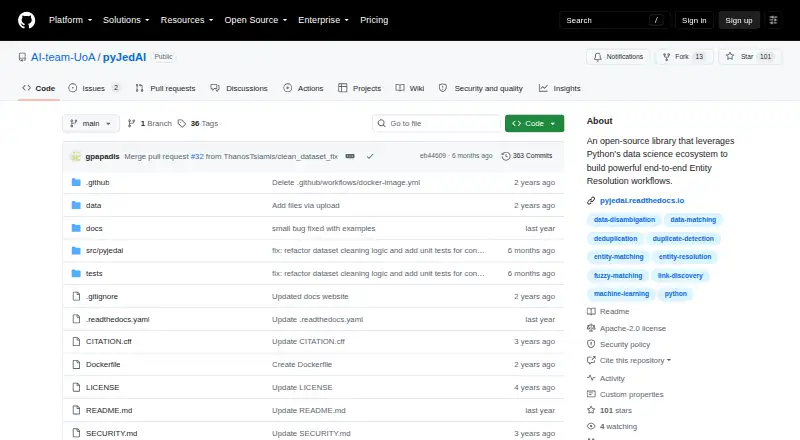
What pyJedAI is
pyJedAI is a free, open-source Python framework for building workflows that identify and link records or entities across datasets. It targets record linkage, entity resolution, and link discovery, and processes structured and semi-structured data. The framework offers multiple algorithms and supervised and unsupervised machine-learning techniques. Its blocking and matching methods can use deep learning and NLP without requiring users to supply labeled instances. Installation is available through pip, a Git checkout, or Docker. The project README says pyJedAI has been tested on Windows and Linux, and lists Python 3.8 or later as a requirement; Windows also requires Microsoft Visual C++ 14.0. Integrations include NLTK, pandas, transformers, sentence-transformers, and FAISS CPU. The framework is released under the Apache-2.0 license. Its stated audience includes expert and novice users, while package metadata also lists developers and science or research audiences. For Java users, the project points to JedAI, which includes a web application for interactively creating entity-resolution workflows.
Good
- Free and open source
- Supports structured and semi-structured data
- Includes supervised and unsupervised methods
- Offers pip, Git, and Docker installation
- No labeled instances required for stated blocking and matching methods
Watch out
- Requires Python 3.8 or later
- Windows requires Microsoft Visual C++ 14.0
- README lists Windows and Linux testing
Who it suits
pyJedAI suits developers and research users building entity-resolution workflows in Python, from beginners to experts. It targets teams working with structured or semi-structured records and entity-linking problems.
Verdict
pyJedAI provides a broad set of methods for entity resolution and related record-linking workflows. Check the Python and Windows prerequisites and package integrations against your environment.
Plans and prices
From pyJedAI's own pricing page, checked 4 Oct 2026.
| Plan | Price | What it gives you |
|---|---|---|
| pyJedAI (open-source library) | Free | No paid plans or usage limits stated |
The facts
Each one read from pyJedAI's own pages, with the date it was checked.
What it does
- Algorithms
- It offers multiple algorithms and supervised and unsupervised machine learning techniques.checked 4 Oct 2026
- Audience
- The project describes pyJedAI as intended for expert and novice users, and its package metadata lists developers and science/research audiences.checked 4 Oct 2026
- Data types
- It can process structured and semi-structured data.checked 4 Oct 2026
- Install
- The project provides installation through pip, Git checkout, or Docker.checked 4 Oct 2026
- Integrations
- The project uses Python data-science and machine-learning packages, including NLTK, pandas, transformers, sentence-transformers, and FAISS CPU.checked 4 Oct 2026
- Learning methods
- The project says its blocking and matching methods can use deep learning and NLP techniques without requiring labeled instances from the user.checked 4 Oct 2026
- License
- pyJedAI is released under the Apache-2.0 license.checked 4 Oct 2026
- Operating systems
- The README says pyJedAI has been tested on Windows and Linux.checked 4 Oct 2026
- Problem types
- The framework targets record linkage, entity resolution, and link discovery problems.checked 4 Oct 2026
- Purpose
- pyJedAI is an open-source Python framework for building end-to-end entity resolution workflows.checked 4 Oct 2026
- Requirements
- The README lists Python 3.8 or later and says Windows requires Microsoft Visual C++ 14.0.checked 4 Oct 2026
- Security policy
- The security policy lists version 0.0.x as supported with security updates and directs users to open an issue to report a bug.checked 4 Oct 2026
- Support
- The project recommends GitHub Discussions for general questions and discussions and GitHub Issues for bugs.checked 4 Oct 2026
Where it runs
- Related web app
- The README points Java users to JedAI, which includes a web application for interactive creation of entity-resolution workflows.checked 4 Oct 2026
The full review of pyJedAI
pyJedAI is an open-source Python framework for constructing end-to-end entity-resolution workflows. It fits developers, analysts, and research teams who want algorithmic control in code, including users new to the field but comfortable managing a Python environment. The strongest case is its broad mix of record-linkage methods at no license cost; the trade-off is that it is a library rather than an interactive, turnkey application.
Overview
pyJedAI targets record linkage, entity resolution, and link discovery across structured and semi-structured data. You assemble workflows inside a Python project, so it suits teams that need to adapt processing and matching logic or integrate results into their own systems. It is a weaker choice for a nontechnical user who expects a graphical workflow designer or a hosted service.
The project describes itself as suitable for expert and novice users, while its package metadata specifically includes developers and science and research audiences. Java users looking for an interactive web application are directed to JedAI, a related project that provides that style of workflow creation rather than pyJedAI's Python-library approach.
Key features
Multiple algorithms cover the core stages of an entity-resolution workflow, with both supervised and unsupervised machine-learning techniques. That range lets a team choose between methods that use labeled examples and methods that do not. In particular, the blocking and matching approaches can use deep-learning and natural-language-processing techniques without requiring the user to provide labeled instances, a practical advantage when creating a training set is difficult.
Support for structured and semi-structured data broadens the kinds of records you can bring into one process. pyJedAI relies on established Python data-science and machine-learning packages, including NLTK, pandas, transformers, sentence-transformers, and FAISS CPU. Those integrations are useful for teams already working in that ecosystem, but they also mean dependency compatibility belongs in your project planning.
Installation is offered through pip, a Git checkout, or Docker. The choice is helpful for both conventional Python development and containerized deployment, while the need to manage a software environment reinforces that this is a developer tool rather than a hosted product. Apache-2.0 licensing permits use as a free open-source component.
Pricing
pyJedAI (open-source library): free. The library is open source, with no paid plans or stated usage limits. There is no separate commercial tier to unlock additional capacity, so the main consideration is the engineering work required to install, integrate, and operate it.
Platforms
pyJedAI is available for Linux, Windows, and self-hosted environments. The project says it has been tested on Windows and Linux. Python 3.8 or later is required, and Windows installations require Microsoft Visual C++ 14.0. Those prerequisites should be checked before selecting it for an existing workstation or deployment image.
The project uses Python packages such as pandas, NLTK, transformers, sentence-transformers, and FAISS CPU. Support questions are directed to GitHub Discussions, while bugs should be reported through GitHub Issues. Its security policy lists the 0.0.x line as supported with security updates and asks users to open an issue to report a bug.
Who it's for
Choose pyJedAI when you need a programmable framework for matching records, resolving identities, or discovering links and your team can work with Python dependencies. It is particularly relevant to developers and research groups comparing supervised and unsupervised techniques or experimenting with NLP and deep-learning-assisted matching without labeled instances.
Look elsewhere if your priority is a browser-based workflow builder, a managed data service, or a vendor-operated support model. pyJedAI gives you the source and integration points, not a packaged operational interface.
Pros and cons
Pros
- Broad method selection: multiple algorithms and supervised and unsupervised learning support different resolution strategies.
- Useful when labels are scarce: blocking and matching can use deep learning and NLP without user-supplied labeled instances.
- Flexible deployment: pip, Git, and Docker installation work across Linux, Windows, and self-hosted setups.
- No license charge: the Apache-2.0 open-source library has no paid plans or stated usage caps.
Cons
- Requires a managed Python stack: Python 3.8+, Windows Visual C++ 14.0, and several data-science dependencies add setup responsibility.
- Not a graphical application: workflows are built in code, so it is less suitable for users seeking interactive, no-code construction.
- Self-operated support path: questions and bug reports go through GitHub Discussions and Issues rather than a commercial service desk.
Alternatives
InterSystems IRIS is the better fit when you want a paid platform with API, web, and self-hosted options, plus a free Community Edition and trial. Its free edition is not the same open Python-library model as pyJedAI.
Splink is a close free alternative for teams wanting an open-source Python package installable through pip or conda across Linux, macOS, Windows, and self-hosted environments.
Hightouch suits teams that prefer a web and API service with a freemium plan, including two active syncs per month and up to 100,000,000 operations per month on its free tier.
Open Client Registry (OpenCR) is another free option spanning API, web, desktop operating systems, and self-hosted deployment.
Zingg is worth considering for batch probabilistic matching at millions-of-record scale through its open-source Community plan, with an enterprise tier for broader batch and real-time needs.
AWS Entity Resolution is a paid, web and API data service; its provider-matching plan charges per 1,000 records and requires a provider license or subscription.
NVECTA is a paid alternative offered across Android, iOS, web, and API platforms.
Treasure AI Composable CDP is a paid Android, iOS, web, and API option with custom pricing and warehouse credits applying to query execution.
Verdict
pyJedAI is a strong choice for developers and research teams that want a free, Apache-2.0 Python foundation with many entity-resolution methods and label-free deep-learning or NLP options. Choose it for control and extensibility; look to a hosted or graphical alternative when your priority is managed operation, visual workflow design, or vendor support.
Alternatives to pyJedAI
- 1

Hightouch
Free planAndroidiOSWebAPI8.2From $350 a month - 2

Zingg
Free planOpen sourceAPILinuxmacOSSelf-hosted7.4Free plan - 3
Splink
Free planOpen sourceAPILinuxmacOSSelf-hosted7.3Free plan - 4
Senzing Entity Resolution
WebAPILinuxmacOS6.7From $58,560 a year - 5
NVECTA
AndroidiOSWebAPI6.2 - 6

AWS Entity Resolution
Free planWebAPI6.1Free plan