Pulse HR
Pulse HR is a free, open-source workspace for individual contributors, focused on status, growth, recognition and wellbeing.
What Pulse HR is
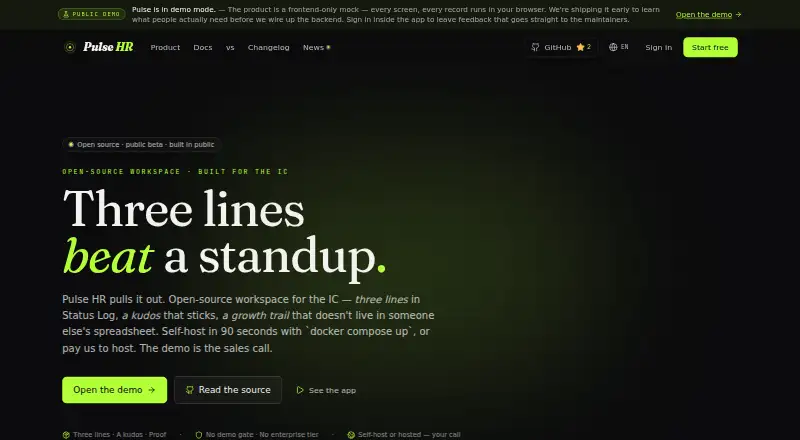
Pulse HR is a free, open-source workspace for individual contributors, focused on status, growth, recognition and wellbeing. Its surfaces include Status Log, Growth, Kudos, Moments, Workload check-in, Leave journal, Pulse and People Insights. Status Log supports written async standups with a three-line-per-person team feed and a manager-safe sentiment recap. Growth brings achievements, challenges and skill paths together, while Kudos enables peer recognition with reasons and leaderboards that reset weekly, monthly and yearly. Workload check-ins show managers an eight-week trend instead of individual answers; anonymous weekly Pulse mood summaries appear only when at least three people respond. The product is intended to run alongside an HRIS and does not cover payroll, time tracking, recruiting, project allocation or document e-signature. It can be self-hosted with Docker or Kubernetes and is available as a PWA on macOS, Windows, iOS and Android, with some views and drafts usable offline. The public demo is a frontend-only mock, and its backend is not wired up yet.
Good
- Free and open source.
- Supports written async standups and peer recognition.
- Self-hosting supports Docker and Kubernetes.
- Recent views and drafts work offline.
Watch out
- Public demo backend is not wired up.
- Does not cover payroll or time tracking.
- Leave journal has no approval workflow.
- Anonymous weekly mood heatmap needs three responses.
Who it suits
Pulse HR suits individual contributors and teams looking for async status updates, recognition and wellbeing features. It may also suit people who want to self-host and run a workspace alongside an HRIS.
Verdict
Pulse HR offers focused status, recognition, growth and wellbeing features, with self-hosting and offline PWA support. It is not a replacement for an HRIS covering the listed excluded functions, and its public demo is only a frontend mock.
The facts
Each one read from Pulse HR's own pages, with the date it was checked.
What it does
- API
- The site describes a REST API, resource-event webhooks, TypeScript, Python and Go SDKs, and a standard-tier limit of 1,000 requests per minute.checked 8 Oct 2026
- Audience
- The maker highlights individual contributors, teams seeking an alternative to daily standups, and people who want to self-host.checked 8 Oct 2026
- Demo status
- The public demo is a frontend-only mock, and its records run in the browser; the page says feedback is the only part that talks to a real backend.checked 8 Oct 2026
- Features
- Its listed surfaces include Status Log, Growth, Kudos, Moments, Workload check-in, Leave journal, Pulse and People Insights.checked 8 Oct 2026
- Integrations and API
- The maker describes a REST API, resource-event webhooks, and maintained TypeScript, Python, and Go SDKs; its site says an MCP server is planned for a later release.checked 8 Oct 2026
- Maintainers
- The site names Davide Ghiotto and Niccolò Naso as maintainers.checked 8 Oct 2026
- Privacy and certifications
- The security page states GDPR compliance by design, EU data residency options in Frankfurt and Dublin, SOC 2 Type II in progress, and ISO 27001 on the roadmap.checked 8 Oct 2026
- Privacy threshold
- The anonymous weekly Pulse mood heatmap appears only when at least three people respond.checked 8 Oct 2026
- Product
- Pulse HR describes itself as an open-source workspace for individual contributors focused on status, growth, recognition and wellbeing.checked 8 Oct 2026
- Product limits
- Pulse says it does not cover payroll, time tracking, recruiting, project allocation or document e-signature, and is intended to run alongside an HRIS.checked 8 Oct 2026
- Product scope
- Pulse HR says it is intended to run alongside an HRIS and does not handle payroll, time tracking, recruiting, project allocation, or document e-signature.checked 8 Oct 2026
- Product status
- The public demo is a frontend-only mock; its records stay in the browser, and the maker says the backend is not wired up yet.checked 8 Oct 2026
- Purpose
- Pulse HR describes itself as an open-source workspace for individual contributors, focused on status, recognition, growth, and wellbeing.checked 8 Oct 2026
- Recognition
- Kudos supports peer recognition with reasons, teammate coins and leaderboards that reset weekly, monthly and yearly.checked 8 Oct 2026
- Security and compliance
- The security page describes GDPR compliance, Frankfurt and Dublin data residency, AES-256 encryption at rest, TLS 1.3 in transit, and says SOC 2 Type II is in progress and ISO 27001 is on the roadmap.checked 8 Oct 2026
- Security controls
- The security page lists AES-256 encryption at rest, TLS 1.3 in transit, SAML 2.0 or OIDC SSO, SCIM provisioning and append-only audit logs.checked 8 Oct 2026
- Self-hosting
- The site says the open-source product can be self-hosted, and lists Docker or Kubernetes deployments with Helm and Terraform support.checked 8 Oct 2026
- Status Log
- Status Log supports written async standups with a three-line-per-person team feed and a manager-safe sentiment recap.checked 8 Oct 2026
- Support
- The security page gives a 24/7 on-call rotation and says its P0 SLA is 15 minutes to acknowledge and two hours to provide a workaround.checked 8 Oct 2026
- Workload and leave limits
- Workload check-ins show managers an eight-week trend rather than individual answers, and the Leave journal has no approval workflow.checked 8 Oct 2026
The company
- Company
- The site names Davide Ghiotto and Niccolò Naso as maintainers and describes them as two developers building Pulse in public.checked 8 Oct 2026
Where it runs
- Growth and kudos
- Growth brings achievements, challenges, skill paths, and kudos together, while Kudos supports peer recognition with reasons and leaderboards.checked 8 Oct 2026
- Offline and platforms
- The site says the product installs as a PWA on macOS, Windows, iOS and Android, with recent views and status and kudos drafts available offline.checked 8 Oct 2026
- Platforms
- The maker says Pulse installs as a PWA on macOS, Windows, iOS, and Android, with selected views and drafts available offline.checked 8 Oct 2026
The full review of Pulse HR
Pulse HR is an open-source engagement workspace for teams that want asynchronous status updates, recognition, development and wellbeing tools. It suits individual contributors, teams moving away from daily standups, and organizations that want to self-host. The trade-off is clear: it adds a focused people layer to an HRIS rather than replacing core HR operations.
Overview
Pulse HR gathers status, growth, recognition, workload, leave and mood features in one workspace. Status Log is built around written async standups, while Growth and Kudos connect development activity with peer appreciation. That combination can make team progress and morale more visible without another live meeting.
The public demo should be treated as a product preview, not a live-service evaluation. It is a frontend-only mock whose records stay in the browser; feedback is the only area described as connected to a real backend. The maker says the backend is not wired up yet, so the demo cannot demonstrate production data handling or live collaboration.
Key features
Status Log provides a three-line-per-person team feed and a manager-safe sentiment recap. The tight format encourages concise updates and can replace routine daily standups for teams comfortable with asynchronous communication, but it is not a project-allocation system.
Growth combines achievements, challenges, skill paths and kudos. Kudos supports peer recognition with a reason and teammate coins, then adds weekly, monthly and yearly leaderboards. That recurring visibility can reinforce appreciation, although competitive rankings will not suit every workplace culture.
Workload check-ins show managers an eight-week trend rather than individual answers. This is a useful privacy-conscious view of patterns, but it prevents managers from examining a particular response. The Leave journal records leave without an approval workflow, so it cannot replace a formal absence-management process.
Pulse surveys produce an anonymous weekly mood heatmap only after at least three people respond. The threshold protects small groups from being represented by a single identifiable response, while also meaning smaller teams may see no heatmap. People Insights rounds out the listed surfaces with analytics for teams that need more than a simple survey feed.
For integration work, Pulse describes a REST API, resource-event webhooks and maintained TypeScript, Python and Go SDKs. The standard tier is limited to 1,000 requests per minute. An MCP server is planned for a later release, so it should not be treated as a current integration option.
Self-hosting is a major differentiator. Deployments are described for Docker or Kubernetes, with Helm and Terraform support. The PWA installs on macOS, Windows, iOS and Android, and supports recent views plus offline drafts for status and kudos. That makes intermittent connectivity less disruptive while preserving a web-based workflow.
Security controls include AES-256 encryption at rest, TLS 1.3 in transit, SAML 2.0 or OIDC SSO, SCIM provisioning and append-only audit logs. The security page describes GDPR compliance by design and EU residency options in Frankfurt and Dublin. SOC 2 Type II is in progress and ISO 27001 is on the roadmap. A 24/7 on-call rotation is paired with a P0 target of 15 minutes to acknowledge and two hours to provide a workaround.
Pricing
Pulse HR is free and open source, with no paid plan or published seat charge. That is particularly attractive to teams able to operate a self-hosted deployment and adapt their own infrastructure. The cost decision shifts from licensing to hosting and administration, while organizations wanting a managed commercial contract may prefer a paid alternative.
Platforms
Pulse HR supports Android, iOS, macOS, Windows and web access, alongside API and self-hosted deployments. Its PWA model and offline recent views and drafts make it practical across desktop and mobile devices, while Docker and Kubernetes options suit teams managing their own environment.
Who it's for
Choose Pulse HR if your team wants async standups, structured peer recognition, lightweight growth tracking and anonymous mood signals in an open-source package. It is especially well matched to individual contributors and organizations that value self-hosting or EU data-residency choices.
Do not choose it as your only HR system. Payroll, time tracking, recruiting, project allocation and document e-signature are explicitly outside its scope, and leave lacks approvals. It is designed to run beside an HRIS.
Pros and cons
Pros
- Open-source and self-hostable: Docker, Kubernetes, Helm and Terraform support give infrastructure teams control over deployment.
- Useful async workflow: Three-line status updates and sentiment recaps can reduce dependence on daily meetings.
- Privacy-aware feedback: Eight-week workload trends and the three-response mood threshold limit exposure of individual answers.
- Broad integration surface: REST, webhooks and three SDKs support custom workflows, within the 1,000-requests-per-minute standard-tier limit.
- Offline-capable PWA: Recent views and status or kudos drafts remain usable across supported desktop and mobile platforms.
Cons
- Not core HR: Missing payroll, time tracking, recruiting, allocation and e-signature require companion systems.
- Leave is record-only: There is no approval workflow.
- Demo limitations: Browser-only records and an unwired backend make the public demo a weak indicator of production readiness.
- Competitive recognition may divide teams: Resetting leaderboards are motivating for some cultures and distracting for others.
Alternatives
For a broader shortlist, see Employee Engagement Software.
Kudosky is a better fit for a small team wanting a freemium product with a free tier for up to 10 users and broad desktop, mobile and API platforms. Teamphoria suits teams seeking a paid engagement plan at $3 a month billed monthly, including peer and manager recognition, surveys and mood tracking.
FeedbackPulse offers a free-forever tier for up to 10 employees with five active or scheduled surveys and basic dashboards. HeartCount is compelling when unlimited surveys for up to 25 employees are the priority, with a 2.50 USD-per-employee monthly Business plan for larger deployments. Happy Mood Score includes all features for up to 20 employees free, then charges a flat $19 a month for 21 or more employees.
Perceptyx, Gallup Access and Motivosity are paid options with custom or consultation-based pricing; choose them when a commercial engagement platform is preferable to an open-source, self-managed deployment.
Verdict
Pulse HR is a strong choice for teams that want a free, open-source companion to an HRIS, especially when async status, peer recognition and self-hosting matter. Look elsewhere if you need payroll, approvals, recruiting or other core HR workflows, or if an unwired frontend demo and self-managed operations are unacceptable.
Alternatives to Pulse HR
- 1
Teamphoria
Free planAndroidiOSWeb8.1From $3 a month - 2

Kudosky
Free planAndroidiOSWebAPI7.4Free plan - 3

Culture Amp
AndroidiOSWebAPI7.1 - 4

FeedbackPulse
Free planWeb6.8From $4 a month - 5

Quantum Workplace
AndroidiOSWeb6.8 - 6

Tap My Back
AndroidiOSWebAPI6.8From $2 a month