Protogrid
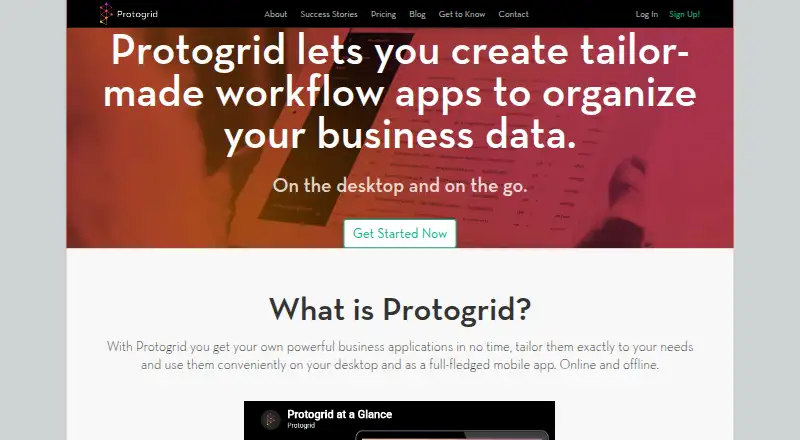
Protogrid is a low-code platform for building business database and workflow applications tailored to an organization’s needs.
What Protogrid is
Protogrid is a low-code platform for building business database and workflow applications tailored to an organization’s needs. Its database system automatically creates views and arranges data when an application is made. Applications can operate offline, keep relevant information locally, and synchronize when connectivity returns. Each application includes multilingual support, with options to add or edit translations. Data and workflow tools include relational models, attachments, PDF output, JavaScript extensions, automated calculations, and a workflow engine. External systems can read and write application data through a JSON API; listed integrations also include OpenID Connect and Active Directory. Read and write permissions can be set separately for each app, Proto, and Card. Protogrid also lists risk-based authorization, step-up authentication, automatic backups, and card mutation history. The maker says hosting is by Hetzner in Germany. Protogrid is free for up to two users with any number of applications. Evaluation is limited to 12 months and does not assure availability; Enterprise is listed at $100 a month per environment, plus user charges.
Good
- Applications can work offline and synchronize later.
- Applications include multilingual support.
- JSON API supports reading and writing application data.
- Read and write access can be configured at multiple levels.
- Free use covers up to two users.
Watch out
- Evaluation is limited to 12 months.
- Evaluation does not assure availability.
- Enterprise costs $100 a month per environment, plus user charges.
- Government plan pricing is available upon request.
Who it suits
Protogrid may suit organizations building custom data and workflow applications, particularly when offline operation, multilingual support, or individually configured access is useful. It supports cloud and on-premises Enterprise deployment.
Verdict
Protogrid combines low-code application creation with offline use, workflow features, and granular access settings. Its free offering is limited to two users, while Evaluation has a 12-month limit and does not assure availability.
Plans and prices
From Protogrid's own pricing page, checked 3 Oct 2026.
| Plan | Price | What it gives you |
|---|---|---|
| Evaluation | Free | 12-month maximum · unlimited users · cloud · fair-use traffic and storage · USD 0.00 per month and environment; USD 0.00 per month and environment user; USD 0.00 per month and app user |
| Enterprise | $100 a month | Unlimited operation · unlimited users · cloud or on-premises · 98% availability for cloud · fair-use traffic and storage · USD 100.00 per month and environment; USD 1.00 per month and environment user; USD 10.00 per month and app user |
| Government | Priced on request | Unlimited operation · user count and prices upon request · Swiss cloud or on-premises · phone, email, or on-site support · Details upon request |
The facts
Each one read from Protogrid's own pages, with the date it was checked.
What it does
- Access controls
- Read and write access can be configured individually for each app, Proto, and Card; the platform also lists risk-based authorization and step-up authentication.checked 3 Oct 2026
- Automatic setup
- Its database system automatically creates views and arranges data when users create an application.checked 3 Oct 2026
- Data and workflow features
- Features include relational data models, attachments, PDF output, JavaScript extensions, a workflow engine, and automated calculations.checked 3 Oct 2026
- Data protection
- The maker says Protogrid is hosted by Hetzner in Germany and describes automatic backups and mutation history for cards.checked 3 Oct 2026
- Evaluation limits
- Evaluation operation is limited to 12 months, and the Evaluation plan does not assure availability.checked 3 Oct 2026
- Integrations
- The platform provides a JSON API for external systems to read and write application data and lists OpenID Connect and Active Directory integration.checked 3 Oct 2026
- Languages
- Every Protogrid application includes multilingual support, and users can add or edit translations.checked 3 Oct 2026
- Offline use
- Apps work offline, save relevant data locally, and synchronize automatically after an internet connection returns.checked 3 Oct 2026
- Product
- Protogrid is a low-code platform for creating tailor-made business database and workflow applications.checked 3 Oct 2026
- Support
- Protogrid lists phone or email support for Evaluation and Enterprise, and phone, email, or on-site support for Government; Enterprise reaction time is up to three working days.checked 3 Oct 2026
The company
- Company
- Protogrid is developed by ATEGRA AG, whose headquarters the maker lists in Zurich, Switzerland; the About page says ATEGRA was founded in 1994.checked 3 Oct 2026
- Founded
- 2012checked 28 Sep 2026
- Headquarters
- Kreuzstrasse 60, Zurich, Switzerlandchecked 28 Sep 2026
Money
- Free use
- Protogrid says it is free for up to two users with any number of applications.checked 3 Oct 2026
Where it runs
- Platforms
- Protogrid supports browser apps, PWAs, and native apps for iOS, Android, Windows, and macOS, with Linux apps available in the Snap Store.checked 3 Oct 2026
The full review of Protogrid
Protogrid is a low-code platform for building business database and workflow applications. It is best suited to teams that need custom data handling across connected devices, including offline use. Its workflow, access-control and deployment options are substantial, but plan limits and pricing structure deserve close attention.
Overview
Protogrid combines a relational data model with tools for shaping applications around business processes. Automatic setup creates views and arranges data as an application is built, while the workflow engine, automated calculations and JavaScript extensions support more tailored behavior. The balance is practical: teams can create purpose-built software without being limited to static forms, though extending applications with JavaScript calls for more technical involvement.
Offline operation is a notable strength for field or mobile work. Applications save relevant data locally and synchronize when the connection returns, reducing dependence on continuous connectivity. Multilingual support is built into every application, with editable translations, which suits teams serving users in multiple languages.
Key features
- Data and documents: Relational data models, attachments and PDF output suit applications that need connected records and document generation.
- Workflow: A workflow engine and automated calculations can support process-driven applications rather than simple data-entry screens.
- Integration: A JSON API allows external systems to read and write application data. OpenID Connect and Active Directory integration are also listed.
- Access controls: Read and write permissions can be set separately for each app, Proto and Card. Risk-based authorization and step-up authentication add further controls for teams with more demanding access requirements.
- Data protection: Protogrid is hosted by Hetzner in Germany, and the maker describes automatic backups and card mutation history.
Pricing
Protogrid offers Evaluation at no cost, with a 12-month maximum, unlimited users, cloud hosting, and fair-use traffic and storage. It is a way to assess the platform without a fee, but it is not a permanent free tier: operation ends at the 12-month limit, and the plan does not assure availability.
Enterprise costs $100 a month, billed at $100 a month per environment, plus $1 a month per environment user and $10 a month per app user. It supports unlimited operation and users, cloud or on-premises deployment, fair-use traffic and storage, and 98% availability for cloud. This is the more suitable paid option for ongoing business use, but the environment and user charges mean the headline price is not the full cost.
Government uses custom pricing, with user count and prices upon request. It offers unlimited operation, Swiss cloud or on-premises deployment, and phone, email or on-site support. It is aimed at organizations that need those deployment and support terms rather than a published, self-serve price.
Protogrid also says it is free for up to two users with any number of applications. That cap makes it useful for a very small team, but not for broader rollout. Support differs by plan: Evaluation and Enterprise include phone or email support; Government also includes on-site support. Enterprise reaction time is up to three working days.
Platforms
Protogrid supports Android, iOS, Linux, macOS and Windows, as well as web, API and self-hosted use. Hybrid deployment is relevant for organizations that want to combine hosted and local infrastructure, while offline synchronization makes the mobile offering more practical where connectivity is intermittent.
Who it's for
Protogrid is a strong fit for teams creating tailored business applications around relational data and workflows, especially when offline access, multilingual interfaces, or precise permissions matter. Its API and identity integrations are useful for connecting applications to existing systems. It is less compelling for a small team that expects to stay free beyond two users, or for an organization that needs guaranteed availability during a no-cost Evaluation period.
Pros and cons
- Pro: Offline work with automatic synchronization supports use beyond reliable internet access.
- Pro: Relational data, workflow automation, calculations, attachments and PDF output cover several parts of a business application in one platform.
- Pro: Per-app, Proto and Card permissions provide finer control than a single broad access setting.
- Con: Free use is capped at two users, and Evaluation is limited to 12 months without assured availability.
- Con: Enterprise billing adds environment, environment-user and app-user charges, making costs dependent on deployment and usage.
Alternatives
Protogrid belongs among Low-Code Development Platforms. Consider Convertigo if you want another freemium low-code platform with a free plan and trial; its listed platforms span mobile, desktop, web, API and self-hosted use. FlutterFlow is an alternative for teams focused on mobile and web, with a free plan capped at two projects, 10 Lite credits, five lifetime AI requests and two API endpoints.
Omnis Studio may suit a reader who values a lifetime-free Community Edition, though deployment is limited by concurrent users and the plan allows five concurrent users. AgilePoint NX is another freemium option, with a Community Edition limited to 25 named users and two applications. Alpha Anywhere is worth considering for a free developer edition that supports web and mobile development, any data source and unlimited apps.
Anvil offers a free-forever plan with unlimited apps, cloud hosting, one developer and 50,000 Data Table rows, making it a distinct option for a single developer. Joget has a free tier for three users, while Draftbit offers a free plan with one sandbox, three projects, two apps per project, one REST API integration per project and 5,000 one-time credits.
Verdict
Choose Protogrid if your team needs custom business applications that combine relational data, workflows, offline operation and granular permissions. Its breadth and deployment flexibility are the case for choosing it; the two-user free cap, time-limited Evaluation, and layered Enterprise billing are the reasons to look elsewhere if you need a simple, predictable route from free trial to long-term use.
Alternatives to Protogrid
- 1

Joget
Free planOpen sourceAndroidiOSWebAPI8.8Free plan - 2

Anvil
Free planOpen sourceAndroidiOSWebAPI8.5From $12 a month - 3

ToolJet
Free planOpen sourceWebAPILinuxSelf-hosted8.3From $23 a month - 4

Windmill
Free planOpen sourceWebAPILinuxSelf-hosted8.3From $120 a month - 5

GeneXus
Free planAndroidiOSWebAPI8.2From $99 a year - 6
Budibase
Free planOpen sourceWebAPILinuxSelf-hosted8.1From $19 a month