project-open
project-open is an open-source application aimed at service-industry organizations, combining project work, portfolio oversight, IT service management and pr…
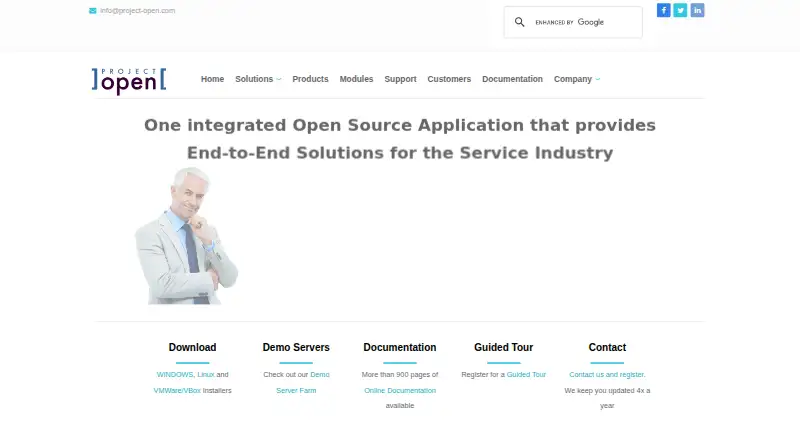
What project-open is
project-open is an open-source application aimed at service-industry organizations, combining project work, portfolio oversight, IT service management and professional services automation. Its project tools cover planning, staffing, tracking, collaboration and accounting. For organizations coordinating several initiatives, it supports cross-project dependencies, project initiation and approval, and resource and capacity management. ITSM modules address incidents, helpdesk, change, configuration, software releases and service-level agreements. PSA capabilities include expenses, invoicing, payments, absence management and time tracking; automation rules and guest access are also listed.
The software is available for Linux, Windows, web, API and self-hosted use, with deployment options including Windows, VMware virtual machines, Docker, native Linux and SaaS. Its SaaS arrangement provides a private server with administrator privileges managed by the project-open team. API components include an OpenACS API Browser and XML-RPC package, with a REST interface module also listed. Integrations and imports include LDAP, Navision/UBL, SAP FI, JIRA and OTRS. The free Community Edition includes freely available modules; paid Professional and Enterprise editions are billed per employee per month and require at least 20 licenses. The maker is project-open, based in Barcelona, Spain; its open-source project began in 2003.
Good
- Project workflows include planning, staffing, tracking and accounting.
- Portfolio tools coordinate dependencies and resource capacity across projects.
- ITSM covers incidents, changes, configuration and service-level agreements.
- PSA includes expenses, invoicing, payments and time tracking.
- Free Community Edition offers freely available modules.
Watch out
- Professional and Enterprise editions require a 20-license minimum.
- Professional includes two support requests per year.
- Enterprise includes six support requests per year.
- The free Windows installer is suited to 5–6 concurrent users.
Who it suits
project-open suits service organizations that need project planning and accounting alongside portfolio coordination, IT service management or professional services workflows. It may also suit teams seeking self-hosted or SaaS deployment and Linux or Windows access.
Verdict
Choose project-open if your service organization needs project management combined with portfolio, ITSM or PSA functions, especially when self-hosting is important. The Community Edition is free, while Professional and Enterprise carry per-employee monthly charges and a 20-license minimum. Teams needing included professional support should compare the support-request allowances of those paid editions.
Plans and prices
From project-open's own pricing page, checked 20 Sep 2001.
| Plan | Price | What it gives you |
|---|---|---|
| Standard | — | 1 GB disk space · 5 GB transfer volume · 5 users included · Unlimited database storage |
| Professional | — | 2 GB disk space · 10 GB transfer volume · 10 users included · Unlimited database storage |
| Platinum | — | 10 GB disk space · 20 GB transfer volume · 20 users included · Unlimited database storage |
| Community Edition | Free | freely available modules · downloadable and self-installable · free of charge |
| Professional Edition | €12 a month | closed-source extensions · professional support · minimum 20 licenses · €12 per internal employee/month |
| Enterprise Edition | €24 a month | enterprise extensions · professional support · minimum 20 licenses · €24 per internal employee/month |
The facts
Each one read from project-open's own pages, with the date it was checked.
What it does
- API
- The product includes an OpenACS API Browser and XML-RPC package, and the installation wiki lists a REST interface module.checked 8 Oct 2001
- Automation rules
- Yeschecked 20 Sep 2001
- Business intelligence
- The BI module provides operational reports, data-warehouse cubes, indicators, charts, Excel/Access reporting and ad-hoc SQL queries.checked 15 Oct 2001
- Collaboration
- Collaboration capabilities include wiki, project file storage, forums, calendar, surveys, idea management, notes, mail integration and full-text search.checked 15 Oct 2001
- Commercial edition limits
- Professional and Enterprise editions include 2 and 6 support requests per year respectively, and each has a 20-license minimum.checked 8 Oct 2001
- Core business areas
- The product combines finance management, project tracking and reporting with professional-services and IT-service operations.checked 15 Oct 2001
- CRM and finance
- CRM handles customer contacts, sales planning, portals, leads and mailings, while finance covers budgets, controlling, billing, earned value, payables and receivables.checked 15 Oct 2001
- Deployment
- The maker offers Windows, VMware virtual machine, Docker and native Linux installation options, and says it can also run the software as SaaS.checked 8 Oct 2001
- Documentation depth
- The online documentation says it contains more than 800 pages, including end-user manuals, configuration guides, data-model material and developer documentation.checked 15 Oct 2001
- Extensibility
- Administrators can install packages, configure workflows and object lifecycles, add dynamic fields, change categories, customize portlets and restrict menus by group.checked 15 Oct 2001
- Guest access
- Yeschecked 20 Sep 2001
- Independent implementation caveat
- Software Finder notes that deploying all modules can require expert configuration.checked 15 Oct 2001
- Independent positioning
- Software Finder characterizes project-open as a modular open-source EPM system combining project management, ITSM, PSA, financials, HR and CRM.checked 15 Oct 2001
- Integrations
- Documented integrations include LDAP/OpenLDAP, Microsoft Project, GanttProject, OpenProj, TaskJuggler, Jira, SugarCRM, Nagios, SAP FI, UBL and exchange-rate services.checked 15 Oct 2001
- IT service management
- ITSM functions include SLA, incident, help-desk, problem, configuration, change and software-release management.checked 15 Oct 2001
- Latest release
- Version 5.2 was released on 2025-05-01 and is stated to be maintained through 2028-12-31.checked 15 Oct 2001
- License details
- Core OpenACS packages use GPL version 2 or later; many project-open packages use the project-open Free License, while enterprise extensions use a commercial license.checked 15 Oct 2001
- Limit: customization learning curve
- A Capterra reviewer said locating the correct source files and execution flow for modifications is difficult and requested clearer developer guidance.checked 15 Oct 2001
- Limit: user interface
- The same G2 review criticized an old-looking, non-responsive interface, too many clicks, a complicated administration area, difficult reporting and no mobile app.checked 15 Oct 2001
The company
- Company
- The maker’s company fact sheet says the open-source project started in 2003 and Project Open Business Solutions S.L. was established in Barcelona in 2012.checked 8 Oct 2001
- Founded and size
- LinkedIn says the project began in 2003, serves more than 3,000 customers in 25 countries and lists a company size of 2–10 employees.checked 15 Oct 2001
- Headquarters
- Barcelona, Spainchecked 28 Sep 2001
- Maker legal name
- The maker identifies itself as Project Open Business Solutions S.L., headquartered in Barcelona, Spain and operating under German management.checked 15 Oct 2001
Money
- Free plan
- Yeschecked 20 Sep 2001
The full review of project-open
project-open is a broad open-source business system for service organizations that need project delivery tied to service operations and professional-services administration. It suits teams willing to host or configure their own platform and coordinate work across many projects. Its functional range is impressive, but the commercial editions require a substantial minimum commitment.
Overview
Project-open combines project planning, staffing, tracking, collaboration and accounting with portfolio coordination, IT service management and professional services automation. That combination can replace a patchwork of project, ticketing and billing tools when those activities share people, data and processes. It is more system than a small team looking only for a lightweight task board needs.
The open-source project started in 2003, and Project Open Business Solutions S.L. was established in Barcelona in 2012. The maker offers a free Community Edition alongside paid Professional and Enterprise editions, plus hosted deployment options.
Key features
Project and portfolio control
Project functions cover planning, staffing, tracking, collaboration and accounting. Portfolio management adds cross-project dependencies, project initiation and approval, and resource and capacity management. These tools are relevant for agencies and service firms that must balance staffing and priorities across a portfolio rather than manage isolated assignments.
ITSM and professional services
ITSM modules handle incidents, helpdesk work, changes, configuration, software releases and service-level agreements. PSA functions extend into expenses, invoicing, payments, absences and time tracking. Together, they connect delivery work with the operational and financial tasks that follow it, although organizations seeking only one of these disciplines may find the scope excessive.
Access, integration and security
Guest access, automation rules and time tracking support mixed project teams and repeatable workflows. Integration and import options include LDAP, Navision/UBL, SAP FI, JIRA and OTRS. An OpenACS API Browser and XML-RPC package are included, and a REST interface module is documented for installations that need programmatic access.
Security measures include page-contract parameter checks, a database interface intended to block SQL injection, XSS filtering and a semi-automatic security checker. These are useful safeguards for a self-managed business application, but deployment responsibility remains with the organization running it.
Pricing
Community Edition
The Community Edition costs free. It includes freely available modules and unlimited users on Linux. The free Windows installer is suited to five to six concurrent users, making Linux the practical choice for larger free deployments. This is the strongest option for organizations with technical capacity that want to avoid per-employee fees.
Professional and Enterprise editions
Professional costs €12 per employee per month, with a minimum of 20 licenses and two support requests per year. Enterprise costs €24 per employee per month, also with a 20-license minimum, and raises the allowance to six support requests per year. Both provide unlimited Linux users. The minimum means even a smaller organization pays for 20 employees, so these editions make most sense when professional support is worth the fixed baseline cost.
Hosted plans
Standard, Professional and Platinum hosting plans have custom pricing. Standard includes 1 GB of disk space, 5 GB of transfer volume, five users and unlimited database storage. Professional provides 2 GB, 10 GB and 10 users; Platinum provides 10 GB, 20 GB and 20 users. Hosted customers receive a private server with full project-open administrator privileges managed by the project-open team.
Platforms
Project-open supports API access, Linux, Windows, web use and self-hosting. Deployment choices include Windows, VMware virtual machine, Docker and native Linux installations, and the software can run as SaaS. That flexibility favors organizations with a preferred infrastructure strategy, while the number of choices may demand more implementation planning than a purely hosted product.
Who it's for
Choose project-open for service organizations coordinating portfolios, staffing, support tickets, contracts, expenses and billing in one environment. It is particularly suited to teams comfortable with Linux or other self-hosted deployment, or to buyers prepared to use the maker-managed SaaS option. Small groups wanting a quick, narrowly focused project app should look elsewhere, and paid-edition buyers must be comfortable with the 20-license floor.
Pros and cons
Pros
- Unusually broad service scope: project, portfolio, ITSM and PSA functions share one system.
- Flexible deployment: self-hosted Linux, Windows, Docker, VMware and SaaS options cover different infrastructure policies.
- Strong free route: the Community Edition has no license charge and unlimited Linux users.
- Useful integration surface: LDAP, SAP FI, Navision/UBL, JIRA and OTRS options can reduce migration work.
Cons
- Paid minimum: Professional and Enterprise both require 20 licenses, which penalizes smaller teams.
- Support allowances are limited: the paid tiers include only two or six support requests per year.
- Operational overhead: self-hosting offers control but places installation and administration demands on the customer.
- Windows free-use ceiling: the free installer is aimed at only five to six concurrent users.
Alternatives
For agency-focused comparisons, see Agency Project Management Software; for a broader shortlist, see Project Management Software.
- TideFlow is a web-based freemium choice for a very small operation: its free plan supports one user, two workspaces and three projects while adding profitability reports, a client portal and file-share links.
- Deltek Maconomy is an enterprise professional-services ERP selected through a demo request rather than a published price.
- Scoro suits buyers wanting a paid, cross-platform service-management product with a free trial; its Time-billing plan is $17 per user per month.
- Synergist is a paid, self-hosted-capable option with a Foundation subscription starting at £300 a month plus onboarding.
- TimeLog offers paid project, time, expense and invoicing tools with a free trial; Starter is €14 per user per month.
- Workamajig targets in-house teams on paid plans for 10 or more users, including a 49.00 USD monthly tier.
- Infor Learning Management System is a paid platform with a free trial for organizations whose priority is learning management.
- Productive is a paid web and desktop option with a three-seat minimum; Essential costs $10 per user per month.
Verdict
Project-open is a strong choice for service organizations that need project and portfolio control connected to ITSM and PSA workflows, especially when self-hosting or open-source access matters. Its free Linux edition lowers the entry barrier, while paid support is available for larger commitments. Look elsewhere if you need a lightweight tracker, a small-team price model or a tightly managed turnkey experience without a 20-license minimum.
Getting started
- Visit https://www.project-open.com/ to review the product and editions.
- Choose Community Edition for the free plan or review Professional and Enterprise terms.
- Select a deployment route: Windows, VMware virtual machine, Docker, native Linux or SaaS.
- Install or arrange the selected deployment; SaaS uses a private server managed by the project-open team.
- Use the product's listed API components or integrations as needed.
Limits worth knowing
The free Community Edition is freely available; its free Windows installer is described as suited to 5–6 concurrent users, while Linux permits unlimited users. Professional and Enterprise are billed per employee per month, require a minimum of 20 licenses, and include two and six support requests per year respectively.
Questions
Is project-open free?
Yes. Community Edition is listed as free and includes freely available modules.
What do the paid editions cost?
Professional Edition is €12 a month per employee, and Enterprise Edition is €24 a month per employee. Both require at least 20 licenses.
Which platforms and deployment options are available?
Platforms include API, Linux, self-hosted, web and Windows. Deployment options include Windows, VMware virtual machine, Docker, native Linux and SaaS.
What does project-open cover?
It combines project management, portfolio management, IT service management and professional services automation, including time tracking.
What integrations are listed?
Listed integrations or import modules include LDAP, Navision/UBL, SAP FI, JIRA import and OTRS import.
Who makes project-open?
The maker is project-open, based in Barcelona, Spain. The open-source project started in 2003.
Alternatives to project-open
- 1

Scoro
AndroidiOSWebAPI7.5From $17 a month - 2
Certinia Professional Services Cloud
AndroidiOSWebAPI7.3From $45 a month - 3
FunctionFox
AndroidiOSWeb7.2From $12.75 a month - 4
TimeLog
AndroidiOSWebmacOS7.1From €14 a month - 5

Deltek Maconomy
AndroidiOSWebAPI7.0 - 6
Keka
AndroidiOSWebAPI6.9