Primer
Primer is payments infrastructure for merchants who want to manage payment services from checkout to payout through one interface and API.
What Primer is
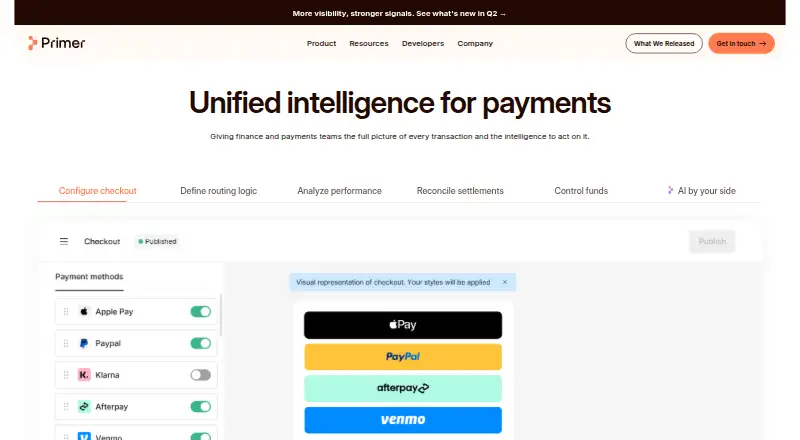
Primer is payments infrastructure for merchants who want to manage payment services from checkout to payout through one interface and API. Businesses can build and operate a payment stack, with configurable checkout experiences that display local and alternative payment methods. Payment performance tools include dynamic routing, Fallbacks, adaptive 3D Secure, and network tokens. For payment operations, Primer provides observability, monitors, reconciliation, a costs overview, and global accounts. Its no-code workflows let businesses activate services and expand into new markets without waiting for engineering work. The integrations directory lists processors and methods such as Adyen, 2C2P, ACH, Affirm, Afterpay, and Airwallex, though Primer says it may not include every provider. Payment channels include cards, digital wallets, bank transfers, account-to-account payments, and buy now pay later. Primer is available on Android, iOS, web, and through an API, with cloud deployment. It was founded in 2020 and describes its audience as merchants in travel, fintech, platforms, retail, and entertainment. Pricing plans are tailored to the business; pricing is available by discussing it with Primer’s team.
Good
- Single interface and API for payment stacks
- Checkout can display local and alternative methods
- Includes routing and reconciliation tools
- Supports several payment channels
- Available on Android, iOS, and web
Watch out
- Pricing is tailored and not listed
- Integration directory may not include every provider
Who it suits
Primer suits merchants seeking a shared interface for payment services, checkout configuration, and payment operations. Its stated customer areas include travel, fintech, platforms, retail, and entertainment.
Verdict
Primer brings checkout configuration, payment optimization, and operational visibility into a cloud-based payments platform. Businesses need to discuss pricing with the company, and its integrations directory may not show every provider.
Plans and prices
From Primer's own pricing page, checked 4 Oct 2026.
| Plan | Price | What it gives you |
|---|---|---|
| Tailored pricing plans | Priced on request | Tailored to your business · ROI calculations · Pricing plans are tailored to your business; discuss pricing and ROI with Primer’s team. |
The facts
Each one read from Primer's own pages, with the date it was checked.
What it does
- Audience
- Primer says it builds payments infrastructure for merchants and highlights travel, fintech, platforms, retail, and entertainment businesses.checked 4 Oct 2026
- Checkout
- Primer offers configurable checkout experiences that can display local and alternative payment methods.checked 4 Oct 2026
- Infrastructure
- Primer says its infrastructure is hosted on Amazon Web Services and monitored 24/7 for threats and anomalies.checked 4 Oct 2026
- Integration caveat
- Primer says its integrations list is updated as the ecosystem grows and may not list every provider.checked 4 Oct 2026
- Integrations
- Primer’s integrations directory lists payment processors and methods including Adyen, 2C2P, ACH, Affirm, Afterpay, and Airwallex.checked 4 Oct 2026
- No-code workflows
- Primer says its no-code platform lets businesses activate services and expand into new markets without waiting on engineering work.checked 4 Oct 2026
- Operations
- Primer offers observability, monitors, reconciliation, costs overview, and global accounts for tracking and managing payments.checked 4 Oct 2026
- Optimization
- Primer lists dynamic routing, Fallbacks, adaptive 3D Secure, and network tokens as tools to improve payment performance.checked 4 Oct 2026
- Payment stack
- Primer provides a single interface and API for businesses to build and manage payment stacks.checked 4 Oct 2026
- Product
- Primer describes itself as AI-powered unified payments infrastructure that helps merchants optimize the payment journey from checkout to payout.checked 4 Oct 2026
- Security
- Primer says it is PCI-1, GDPR, and SOC2 Type-2 compliant and encrypts sensitive data in transit and at rest.checked 4 Oct 2026
- Support
- Primer describes a dedicated merchant support team and links to its support centre and service status page.checked 4 Oct 2026
The company
- Founded
- Primer’s company history says it was founded in 2020 by Gabriel Le Roux and Paul Anthony.checked 4 Oct 2026
The full review of Primer
Primer is cloud-based payments infrastructure for merchants that want one interface and API for configuring and managing a payment stack. It is best suited to businesses with varied payment needs and teams looking to optimize checkout and payment operations. Its broad set of payment tools is compelling, but custom pricing means buyers need to weigh the fit with Primer directly.
Overview
Primer brings payment configuration, checkout, optimization, and operational oversight into a single platform. Merchants can use its interface and API to build and manage their payment stacks, while configurable checkout can present local and alternative payment methods. That breadth suits businesses seeking to coordinate multiple parts of the payment journey rather than adopt a narrow payment tool.
The platform is cloud-hosted on Amazon Web Services, with infrastructure monitored around the clock for threats and anomalies. Primer says it complies with PCI-1, GDPR, and SOC2 Type-2 requirements and encrypts sensitive data both in transit and at rest. It also describes a dedicated merchant support team and provides a support centre and service-status page.
Key features
Checkout and payment performance
Checkout can be configured to show local and alternative payment methods, including cards, digital wallets, bank transfers, account-to-account payments, and buy now pay later. This flexibility can help merchants serve customers across different payment preferences, though the value depends on which providers and methods a business needs.
For payment optimization, Primer offers dynamic routing, fallbacks, adaptive 3D Secure, and network tokens. These tools give teams options for managing payment performance across their stack; the platform does not promise a particular improvement in authorization or conversion rates.
Operations and no-code workflows
Observability, monitors, reconciliation, cost overviews, and global accounts bring payment tracking and management into the same environment. That operational scope may be useful for teams that need visibility beyond checkout, but businesses should confirm that the workflows match their own processes.
Primer’s no-code workflows are intended to let teams activate services and expand into new markets without waiting for engineering work. That can reduce dependence on development for those changes, while the API remains available for businesses building and managing payment stacks programmatically.
Integrations
The integrations directory includes providers and methods such as Adyen, 2C2P, ACH, Affirm, Afterpay, and Airwallex. Primer says it updates the directory as its ecosystem grows and that it may not include every provider, so merchants should verify support for required integrations before committing.
Pricing
Primer is paid, with custom pricing tailored to each business. Its tailored pricing plans are described as based on business needs and ROI calculations, and prospective customers are directed to discuss pricing with Primer’s team. There is no published price to compare against a budget, so businesses should clarify the commercial terms and expected return during that discussion.
The tailored approach may suit merchants whose payment requirements vary substantially, but it gives buyers no standard tier or self-service price point to evaluate. No seat counts, transaction quotas, trial period, or renewal terms are stated.
Platforms
Primer supports Android, iOS, web, and API access, with cloud deployment. The combination covers mobile and browser environments as well as programmatic integration, making it relevant to teams that need more than a standalone web interface.
Who it's for
Primer targets merchants and highlights travel, fintech, platforms, retail, and entertainment businesses. It is most relevant to organizations managing multiple payment channels or looking to coordinate checkout, optimization, and payment operations in one platform. Smaller buyers seeking a transparent fixed price, or teams that need a narrowly scoped tool, may find the custom commercial model and broad platform more than they need.
Pros and cons
- Pros: A single interface and API cover payment-stack management, configurable checkout, optimization tools, and operational visibility.
- Pros: No-code workflows are designed to let teams activate services and expand into markets without waiting on engineering work.
- Pros: Primer describes specific security measures, compliance certifications, 24/7 infrastructure monitoring, and dedicated merchant support.
- Cons: Pricing is custom, so buyers cannot assess a standard price or compare tiers without speaking with the company.
- Cons: The integrations directory may omit providers, making confirmation of required connections an important step before choosing the platform.
Alternatives
Gr4vy is another paid option across Android, API, iOS, and web; its custom pricing is based on business needs, and it offers no free trial. Temenos Wealth Front Office is a paid alternative for buyers considering API, self-hosted, or web platforms. BR-DGE is a paid option available across Android, API, iOS, and web.
VolPay Hub is a paid alternative with API, self-hosted, and web platforms. AccessPay offers a paid platform subscription on a flat annual basis, with price based on estimated annual transaction volumes, users, and required data configurations and submission workflows. ACI Automated Dispute Manager is a paid web-based option without a free plan.
Bottomline Internal Threat Management is a paid web-based enterprise fraud and insider risk management solution. Cash4 is a paid alternative for API and web platforms.
Verdict
Primer is a strong candidate for merchants in travel, fintech, platforms, retail, or entertainment that want to bring checkout configuration, payment optimization, and operational visibility together. Its main reason to choose it is that breadth, including no-code workflows and API access; its main reason to look elsewhere is the custom pricing model, which prevents straightforward budget comparison. Confirm required integrations and commercial terms before deciding.
Alternatives to Primer
- 1

IXOPAY
AndroidiOSWebAPI7.6From $1,000 a month - 2

CellPoint Digital
AndroidiOSWebAPI6.5 - 3

BR-DGE
AndroidiOSWebAPI6.4 - 4

SAP CPQ
Web6.4From $24 a month - 5

PaymentHub
WebAPI6.2From $499 a month - 6
PayYantra
AndroidiOSWebAPI6.2