Poor SQL
Poor SQL is a free tool for reformatting and colorizing T-SQL code according to chosen settings.
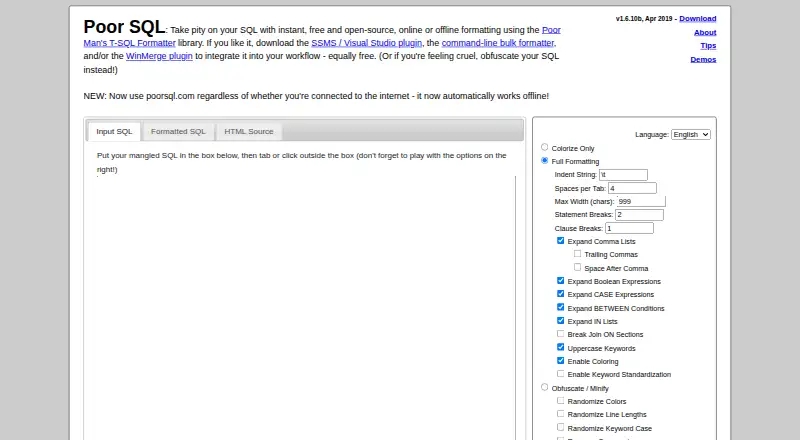
What Poor SQL is
Poor SQL is a free tool for reformatting and colorizing T-SQL code according to chosen settings. It can work offline because formatting runs in the browser, and the site says submitted SQL stays in the browser rather than going to an external service. Users can set indentation, tab spacing, maximum width, and breaks for statements, clauses, comma lists, boolean and CASE expressions, and JOIN ON sections. An obfuscation and minification option can vary colors, line lengths, and keyword case, or substitute keywords. Results are available in input SQL, formatted SQL, and HTML source views. Downloads include plugins for SQL Server Management Studio, Visual Studio, and WinMerge, plus a command-line bulk formatter. The open-source Poor Man's T-SQL Formatter library is AGPL-licensed and works with Microsoft .NET and Mono; its JavaScript library can run in browsers and contexts such as Node.js. The project describes its parsing as coarse rather than full, especially for DDL, so its formatting is not based on complete SQL parsing. Settings are remembered with a cookie; blocking cookies restores defaults on each visit.
Good
- Formatting runs locally and works offline.
- SQL is not sent to an external service.
- Includes plugins for SSMS, Visual Studio, and WinMerge.
- Command-line bulk formatter is available.
- Free to use.
Watch out
- Parsing is coarse, especially for DDL.
- Blocking cookies resets settings each visit.
- Supports T-SQL dialect only.
Who it suits
Poor SQL suits T-SQL users who want configurable formatting, browser-based offline use, or integrations with listed editors and tools. It may also fit developers who want to use its open-source library in .NET, Mono, JavaScript, or Node.js contexts.
Verdict
Poor SQL offers free T-SQL formatting with a wide range of controls and several integration routes. Its stated coarse parsing, particularly for DDL, is worth considering when evaluating its output.
Plans and prices
From Poor SQL's own pricing page, checked 14 Oct 2001.
| Plan | Price | What it gives you |
|---|---|---|
| Free | Free | online formatting · offline formatting · SSMS/Visual Studio plugin · command-line formatter · WinMerge plugin · Free |
The facts
Each one read from Poor SQL's own pages, with the date it was checked.
What it does
- API component
- The project includes a web service alongside its demo WinForms program, add-ins, command-line utility, and plugins.checked 1 Oct 2001
- Changelog event
- Version 1.6.10 in November 2017 added Atom and Visual Studio Code plugins and fixed several formatting and installer issues.checked 14 Oct 2001
- Command line
- A command-line bulk formatter is available for download.checked 1 Oct 2001
- Command-line limitation
- The Node command-line tool does not currently produce syntax-highlighted HTML output.checked 14 Oct 2001
- Command-line package
- The Node command-line formatter installs globally with npm and accepts stdin, files, configurable formatting options, and output files.checked 14 Oct 2001
- Command-line performance
- The Node command-line implementation reports roughly half a second to format one query on the author’s laptop and describes itself as slower than the .NET formatter.checked 14 Oct 2001
- Comment limitation
- The standard formatter can move comments from their original positions in some compound keywords.checked 14 Oct 2001
- Community rating status
- Open Hub shows no user rating yet and invites the first rating.checked 14 Oct 2001
- Cookie behavior
- Formatting preferences are remembered in a cookie; blocking cookies restores default settings on each visit.checked 14 Oct 2001
- Data handling
- The site says SQL submitted for formatting is not sent to any external service and is processed in the browser.checked 1 Oct 2001
- DDL limitation
- DDL parsing is described as very coarse and limited to the minimum needed for ordered declarations.checked 14 Oct 2001
- Dialect support
- The project is focused on Microsoft T-SQL; support for other SQL dialects is possible but none is implemented as a dedicated dialect.checked 14 Oct 2001
- Editor integrations
- Downloads and repositories provide integrations for SSMS, Visual Studio, Notepad++, WinMerge, Atom, and Visual Studio Code.checked 14 Oct 2001
- External institutional mention
- A UCSF VA data-resources document lists Poor SQL as a SQL formatting tool among its SQL resources.checked 14 Oct 2001
- Formatting controls
- Controls include indentation, tab spacing, maximum width, statement and clause breaks, comma-list expansion, boolean and CASE expansion, and JOIN ON breaks.checked 14 Oct 2001
- Independent comparison
- A Korean SQL Server formatter comparison describes Poor SQL as an instant formatter with configurable options and says it targets SQL Server syntax.checked 14 Oct 2001
- Independent mention
- J.D. Hodges lists Poor SQL as a free online alternative for formatting SQL Server queries when SQL Server 2008 lacked a comparable built-in feature.checked 14 Oct 2001
- Installation limitation
- The same comparison reports that using the SSMS 2012 add-in required manually copying an AddIn file into the user’s roaming Addins folder.checked 14 Oct 2001
- Integrations
- Downloads include plugins for SQL Server Management Studio, Visual Studio, and WinMerge.checked 1 Oct 2001
- Library
- The underlying Poor Man’s T-SQL Formatter is a free .NET and JavaScript library with a demo UI, web service, command-line utility, and editor plugins.checked 14 Oct 2001
- Library contexts
- The library works with Microsoft .NET and Mono, and the JavaScript library works in browsers and other contexts such as Node.js.checked 1 Oct 2001
- Licence
- The project is released under the GNU Affero General Public License version 3.checked 14 Oct 2001
- Limit: detail
- The same Curated SQL review says the website is not as detailed as the reviewer wanted, despite being effective for quick formatting.checked 14 Oct 2001
- Local processing
- The website says formatting happens entirely in the browser and SQL is not sent to an external service.checked 14 Oct 2001
The full review of Poor SQL
Poor SQL is a free T-SQL formatter and colorizer for people who want to adjust SQL layout in a browser or through familiar development tools. It suits T-SQL users who value local processing and multiple ways to integrate formatting into a workflow.
Its broad formatting controls and free downloads are useful, but its parsing is deliberately coarse. That makes it a less suitable choice when reliable handling of complex SQL, particularly DDL, is essential.
Overview
Poor SQL pairs a browser-based formatter with plugins, a command-line bulk formatter, and an open-source library. It focuses on T-SQL rather than offering a range of SQL dialects, so it is most relevant to users working in Microsoft SQL Server environments. The library is AGPL-licensed, a consideration for teams evaluating how to incorporate it into their own software.
Formatting runs in the browser, and the site says SQL is not sent to an external service. It also works offline, making it a practical option when users want to format locally or without an internet connection. These qualities do not make it a full parser: the project describes its parsing as coarse, especially for DDL, so users should be cautious about treating its output as authoritative for complex statements.
Key features
Users can set indentation, spaces per tab, maximum width, and where statements and clauses break. Further controls expand comma-separated lists, boolean expressions and CASE expressions, and add breaks in JOIN ON sections. This is a substantial set of layout choices for a free formatter, though custom rules are not supported; teams with a strict shared style may find the built-in controls insufficient.
The browser interface separates input SQL, formatted SQL and HTML source views. An Obfuscate / Minify option can randomize colors, line lengths and keyword case, or substitute keywords. That gives users ways to alter the appearance of code, but the central value remains formatting rather than deep SQL analysis. Automatic fixes are supported.
Downloads include plugins for SQL Server Management Studio, Visual Studio and WinMerge, as well as a command-line bulk formatter. The library works with Microsoft .NET and Mono, while its JavaScript version can be used in browsers and contexts such as Node.js. The project also includes a web service and demo WinForms program. These integration routes make Poor SQL more flexible than a browser-only tool, although it has no CI/CD integration or configuration file.
Formatting preferences are saved in a cookie. Users who block cookies return to the default settings each visit, which can make a preferred layout less convenient to maintain.
Pricing
Poor SQL is free. The Free plan costs nothing and includes online and offline formatting, the SSMS and Visual Studio plugin, the command-line bulk formatter and the WinMerge plugin. There are no paid tiers or seat and usage limits to weigh against those tools in the plan.
Free access makes it easy for individuals and teams to try the available workflow, but the trade-off is not a reduced tier: users get the product's stated feature set, including its coarse parsing and lack of custom rules. The open-source library is AGPL-licensed, so teams incorporating it into software should account for that license.
Platforms
Poor SQL is available on the web and Linux and Windows platforms, and includes an API component. The browser formatter can work offline; downloadable plugins and command-line tools provide alternatives to using the site directly. The underlying .NET and Mono library and browser- and Node.js-compatible JavaScript library offer additional integration contexts.
Who it's for
Poor SQL is a good fit for T-SQL users who want free formatting with control over line breaks and indentation, and for developers who prefer a plugin, bulk command-line tool or reusable library. Its local processing and offline operation are especially useful when keeping formatting within the browser matters.
Look elsewhere if your work depends on accurate parsing of complex DDL, a configurable house style beyond built-in options, or CI/CD integration. Cookie-dependent settings may also be inconvenient for users who block cookies.
Pros and cons
Pros
- Free across several workflows: the plan includes browser formatting, offline use, three named plugins and a command-line bulk formatter.
- Local processing: formatting runs in the browser, and the site says submitted SQL is not sent to an external service.
- Detailed layout controls: users can adjust widths, breaks, indentation and expansion behavior rather than accept a single fixed style.
- Reusable libraries: the .NET/Mono and JavaScript options suit developers who want to incorporate formatting into their own contexts.
Cons
- Coarse parsing: DDL parsing is particularly coarse, limiting confidence when formatting complex SQL.
- No custom rules: teams cannot define additional house-style rules beyond the available controls.
- Cookie-based preferences: blocking cookies resets formatting options to defaults on each visit.
- No CI/CD integration or configuration file: teams seeking those workflow features will need another approach.
Alternatives
Sqruff is another free option for readers comparing SQL tools across web, desktop, extension and self-hosted platforms.
Sleek is a free open-source SQL formatter for users considering a separate formatter project.
SQL Formatter may suit readers seeking a free MIT-licensed formatting library with a browser demo.
sqlfmt is worth considering for a free browser formatter that runs through WebAssembly without installation.
Squawk is a free alternative for readers comparing SQL tools across mobile, desktop, web and self-hosted platforms.
TSQLLint is a free, MIT-licensed option installable with dotnet-tool, Homebrew or NPM; consider it when those installation routes fit better.
JSQLFormatter is another free formatter to compare if you are evaluating alternatives.
pgFormatter is free software under the PostgreSQL Licence and may be a better match for readers looking beyond Poor SQL's T-SQL focus.
Browse the SQL Linters and Formatters list to compare more tools.
Verdict
Choose Poor SQL if you work with T-SQL and want a free formatter that can run locally and fit into browser, plugin or command-line workflows. Its range of layout options and integrations is compelling for everyday formatting; users handling complex DDL or requiring custom rules should look elsewhere.
Getting started
- Open https://poorsql.com/
- Enter T-SQL in the Input SQL view
- Adjust formatting or obfuscation options
- Review Formatted SQL or HTML Source output
- Download a plugin, command-line formatter, or library for supported environments
Questions
Is Poor SQL free?
Yes. The Free plan costs 0.00 USD and includes online and offline formatting, plugins, command-line bulk formatting, and the WinMerge plugin.
Can it work offline?
Yes. Formatting runs locally in the browser, so the site can work without an internet connection.
What SQL dialect does it support?
The supported dialect is T-SQL.
Is Poor SQL open source?
The Poor Man's T-SQL Formatter library is open-source under the AGPL license.
Which integrations are available?
Downloads include plugins for SQL Server Management Studio, Visual Studio, and WinMerge, plus a command-line utility.
Does it provide an API?
The project includes a web service alongside its demo WinForms program, add-ins, command-line utility, and plugins.
Alternatives to Poor SQL
- 1
SQLFormat.org
Free planOpen sourceWebAPIExtensionSelf-hosted7.1Free plan - 2
sqlfmt
Free planWebAPILinuxSelf-hosted6.7Free plan - 3
RegSQL
Free planWeb6.5From $8 a month - 4
SQLCheck
Free planLinuxmacOSWindows6.5Free plan - 5
sqlfmt
Free planWebAPI6.5From $9 a month - 6

SQLFluff
Free planAPILinuxmacOSSelf-hosted6.4Free plan