PluRel
PluRel is an open-source framework for generating synthetic relational and tabular databases, aimed at relational foundation-model research and complex multi…
What PluRel is
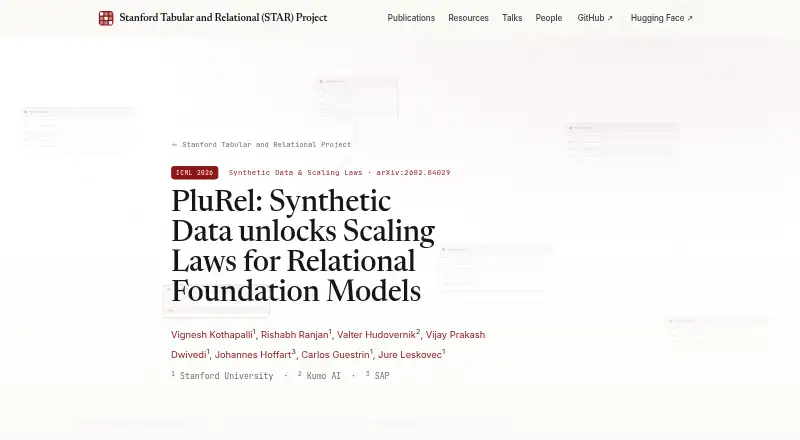
PluRel is an open-source framework for generating synthetic relational and tabular databases, aimed at relational foundation-model research and complex multi-table data work. It models table schemas with directed graphs, relationships with bipartite graphs, and feature distributions through conditional causal mechanisms. Configuration controls table layouts, table and row counts, column counts, and structural causal model parameters. An optional schema_file setting allows generation from an existing SQL schema. Columns can use numeric, categorical, or boolean values, with temporal trends, cycles, and fluctuations. Generated dataset objects can be made compatible with RelBench. A multiprocessing script supports parallel database generation with configurable database and process counts. Installation uses pip install plurel and requires Python 3.12 or later. The public repository lists an MIT license. The project reports that greater synthetic database diversity can improve generalization, while synthetic pretraining alone is insufficient for robust zero-shot transfer and continued pretraining on real data remains important.
Good
- Open-source MIT license
- Configurable relational schemas
- Numeric, categorical, and boolean features
- Temporal pattern generation
- RelBench compatibility
Watch out
- Requires Python 3.12 or later
- Synthetic pretraining alone has transfer limits
- No unstructured data support
Who it suits
PluRel suits researchers and data practitioners working with relational foundation models or synthetic multi-table databases. It is intended for structured relational and time-series data, not unstructured data.
Verdict
PluRel provides configurable synthetic database generation with graph-based schema modeling and parallel processing. Users should plan for real-data continued pretraining when robust transfer is required.
The facts
Each one read from PluRel's own pages, with the date it was checked.
What it does
- Compatibility
- Generated datasets can be made compatible with RelBench.checked 4 Oct 2026
- Configurable output
- Its configuration controls table layouts, table and row counts, column counts, and structural causal model parameters.checked 8 Oct 2026
- Data types and patterns
- Feature generation supports numeric, categorical, and boolean values, with temporal trends, cycles, and fluctuations.checked 4 Oct 2026
- Feature types
- Generated feature columns support numeric, categorical, and boolean types.checked 8 Oct 2026
- Generation stages
- It models database schemas with directed graphs, inter-table primary–foreign key links with bipartite graphs, and feature distributions with conditional causal mechanisms.checked 8 Oct 2026
- Installation
- The library is installed with pip install plurel and requires Python 3.12 or later.checked 8 Oct 2026
- Installation requirement
- The library is installed with pip and requires Python 3.12 or later.checked 4 Oct 2026
- Intended context
- The project targets relational foundation model research and data-driven work with complex multi-table databases.checked 4 Oct 2026
- Intended use
- The project describes PluRel as a framework for research on relational foundation models and synthetic relational database generation.checked 8 Oct 2026
- Large-scale generation
- A multiprocessing script can generate databases in parallel, with the number of databases and processes configurable.checked 4 Oct 2026
- License
- The GitHub repository identifies the project license as MIT.checked 8 Oct 2026
- Parallel generation
- A multiprocessing-based script can generate databases in parallel, with the process count configurable.checked 8 Oct 2026
- Purpose
- PluRel is an open-source library for synthesizing relational and tabular data.checked 8 Oct 2026
- RelBench compatibility
- The project says its generated dataset objects are compatible with RelBench.checked 8 Oct 2026
- Research results
- The project reports that synthetic database diversity and pretraining token count both show power-law scaling in relational foundation model pretraining loss.checked 8 Oct 2026
- Schema input
- It can generate data from an existing SQL schema using the optional schema_file setting.checked 4 Oct 2026
- SQL schemas
- The configuration can optionally use an existing SQL schema as input.checked 8 Oct 2026
- Temporal patterns
- Feature generation can model temporal correlations using trend, cycle, and fluctuation components.checked 8 Oct 2026
- Transfer limitation
- The project states that synthetic pretraining alone is insufficient for robust zero-shot transfer and that continued pretraining on real data is critical for distribution alignment.checked 8 Oct 2026
Alternatives to PluRel
- 1

FakerForge
Free planWebAPILinuxmacOS7.8From $10 a month - 2

Synth Studio
Free planOpen sourceWebAPILinuxmacOS7.5Free plan - 3
Synthehol Dataset
Free planWebAPISelf-hosted7.3From $3,990 a year - 4
SimpleTest
Free planWebAPIExtensionSelf-hosted7.2From $750 a month - 5
SynthEngyne
Free plan7.1Free plan - 6

Tonic Fabricate
Free planWebAPISelf-hosted6.8$29 usage-based