Plaso
Plaso is a Python-based engine for building timelines used in digital forensic analysis.
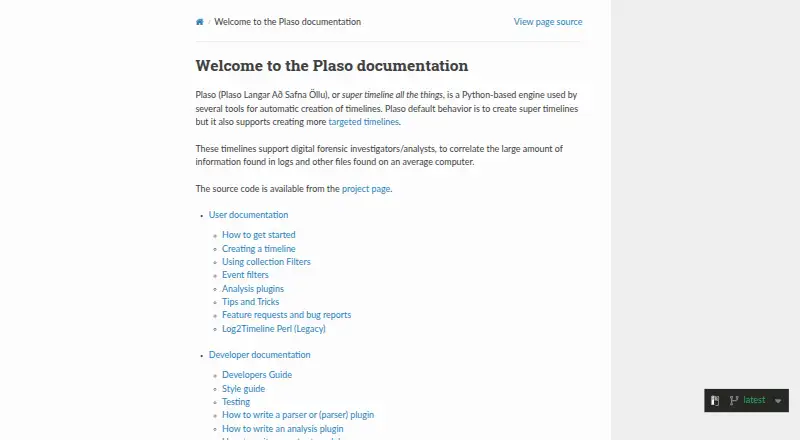
What Plaso is
Plaso is a Python-based engine for building timelines used in digital forensic analysis. Its log2timeline tool collects events from files, directories, storage media images, or devices and saves them in a Plaso storage file. The psort tool can then filter and sort events and run automatic analysis. Other command-line tools include image_export, pinfo, and psteal. Documented inputs include Windows event logs and registry data, browser histories, SQLite databases, text-based logs, and cloud audit logs from AWS CloudTrail, Azure Activity, Google Cloud, and Microsoft 365. With psteal and its dynamic output format, Plaso can produce a CSV timeline from a storage image; listed outputs also include JSON, JSON Lines, KML, TLN, XLSX, OpenSearch, and Timesketch. The framework supports adding parsers, analysis plug-ins, and forensic scripts. Documented plug-ins include VirusTotal, NSRL server, and hash tagging. Plaso is free, with no commercial plan or usage limits stated, and its repository identifies the license as Apache-2.0. It supports Linux, macOS, Windows, Docker, and self-hosted use. The documentation recommends packaged releases for general use and versions no older than six months.
Good
- Collects events from files, devices, and storage images.
- Can filter, sort, and analyze timeline data.
- Documents cloud audit log inputs.
- Supports multiple timeline output formats.
Watch out
- Documentation recommends avoiding releases older than six months.
- Project contributions are best effort.
Who it suits
Plaso suits digital forensic practitioners who need to collect and analyze timelines from files, devices, logs, or storage images. Its parser and plug-in framework may also suit users extending forensic workflows.
Verdict
Plaso provides command-line tools for collecting and analyzing forensic timelines across a range of documented inputs. Follow its release guidance and note that project contributions are best effort.
Plans and prices
From Plaso's own pricing page, checked 15 Oct 2026.
| Plan | Price | What it gives you |
|---|---|---|
| Open-source Plaso package | Free | Python-based forensic timeline engine · self-hosted installation · no paid tiers listed |
| Plaso | Free | No commercial plan or usage limits are stated |
The facts
Each one read from Plaso's own pages, with the date it was checked.
What it does
- Analysis plugins
- Analysis plugins can calculate hashes, apply YARA rules and tag events of interest.checked 15 Oct 2026
- Cloud log formats
- The supported formats page lists AWS CloudTrail, Azure Activity, Google Cloud, and Microsoft 365 audit logs.checked 4 Oct 2026
- Collection
- Collection recursively scans images, directories and files, with support for archives and compressed streams.checked 15 Oct 2026
- Command-line tools
- The project includes image_export, log2timeline, pinfo, psort, and psteal command-line tools.checked 4 Oct 2026
- Core workflow
- log2timeline extracts events into a Plaso storage file, while pinfo and psort inspect or process that file.checked 15 Oct 2026
- Docker
- Official instructions provide a Docker Hub image, Dockerfile build, bind mounts and commands for log2timeline, psort, pinfo and psteal.checked 15 Oct 2026
- Extensibility
- The project supports adding parsers, parser plugins, analysis plugins, output modules, tagging rules and automation scripts.checked 15 Oct 2026
- Independent defect
- Kali reported that Plaso packages in Kali 2024.2 could fail at startup with a missing MacOSLocalTime artifact; Kali marked the issue fixed in version 2024.3.checked 15 Oct 2026
- Independent praise: artifact correlation
- A computer-forensics Reddit commenter praised Plaso for combining MFT, event-log, registry, link-file and browser-history timestamps into one reference timeline.checked 15 Oct 2026
- Independent praise: customization
- The same Reddit discussion highlighted Plaso's customizable output formatting through formatter configuration files.checked 15 Oct 2026
- Integrations
- The documented analysis plug-ins include VirusTotal, NSRL server, and hash tagging.checked 4 Oct 2026
- Latest package
- PyPI records version 20260720 as released on July 21, 2026.checked 15 Oct 2026
- Licence
- PyPI and GitHub identify the project as Apache-2.0 licensed.checked 15 Oct 2026
- License
- The GitHub project page identifies the repository license as Apache-2.0.checked 4 Oct 2026
- Limit: processing speed
- A Reddit practitioner described Plaso as heavyweight and slow, especially when it generates many events that are not needed.checked 15 Oct 2026
- Limit: resource usage
- Official troubleshooting documentation says workers can be killed by out-of-memory conditions and that components may consume excessive memory or leak it.checked 15 Oct 2026
- Limit: setup complexity
- The project recommends packaged releases for ordinary users because development installations can break and require troubleshooting.checked 15 Oct 2026
- Maintainers
- PyPI credits two maintainers, joachimmetz and onager, under the Log2Timeline maintainers group.checked 15 Oct 2026
- Operating systems
- The user guide documents Docker use on Linux, macOS and Windows plus native Fedora, macOS and Ubuntu alternatives.checked 15 Oct 2026
- Output
- Plaso can produce a CSV timeline from a storage image using psteal with the dynamic output format.checked 4 Oct 2026
- Output formats
- Built-in output modules include dynamic delimited text, JSON, JSON Lines, KML, legacy CSV/TLN, raw Python and null output.checked 15 Oct 2026
- Parser development
- Parser documentation provides a complete example covering parser code, registration, event data, tests, timeliner configuration and message formatters.checked 15 Oct 2026
- Parsers
- Plaso uses parsers and parser plugins to extract events from supported forensic formats.checked 15 Oct 2026
The company
- Company identity
- PyPI identifies the maker as the community-run Log2Timeline maintainers group rather than a named commercial corporation.checked 15 Oct 2026
The full review of Plaso
Overview
Plaso is a Python-based toolkit for building and analyzing digital-forensics timelines. It suits investigators working across varied evidence sources who are comfortable with command-line tools. Its broad collection and analysis workflow is the draw; it is not a turnkey graphical casework application.
Key features
Collection and analysis in one workflow. log2timeline extracts events from files, directories, storage-media images, or devices into a Plaso storage file. psort can then filter and sort that material or run automatic analysis. Separating collection from analysis gives investigators a practical way to organize large, mixed evidence sets, though the command-line approach favors users prepared to work directly with tools.
Broad evidence coverage. Documented formats include Windows event logs and Registry data, browser histories, SQLite databases, and text-based logs. Cloud coverage includes AWS CloudTrail, Azure Activity, Google Cloud, and Microsoft 365 audit logs, while supported evidence sources also extend to Android and iOS artifacts. This range is useful when a case crosses devices and services; it may be more toolkit than needed for a narrowly focused investigation.
Flexible tools and output. The command-line suite includes image_export, log2timeline, pinfo, psort, and psteal. Plaso can produce CSV timelines from storage images using psteal with dynamic output, and its export formats include JSON, JSON Lines, KML, TLN, XLSX, OpenSearch, and Timesketch. That choice of outputs helps fit timelines into different downstream workflows.
Extensible analysis. Plaso provides a framework for adding parsers, analysis plug-ins, and scripts. Documented integrations include VirusTotal, an NSRL server, and hash tagging. This is a meaningful advantage for teams that need to tailor processing, but extensibility is most useful when someone can maintain those additions.
Pricing
Plaso is free: its plan costs nothing. No commercial plan or usage limits are stated. That removes a purchase decision for individual practitioners and teams, though the project’s best-effort contribution model means users should not treat it as a paid support contract.
Platforms
Plaso supports Linux, macOS, and Windows, with Docker and self-hosted use also supported. The range makes it adaptable to varied forensic environments rather than locking the workflow to one desktop platform.
Who it's for
Plaso is best for digital-forensics practitioners who need to build timelines from mixed local, mobile, and cloud evidence and want control over collection, parsing, and analysis. Its command-line suite and extensibility suit technical workflows. Readers seeking a focused graphical interface or a vendor-backed support commitment should look elsewhere.
Pros and cons
- Pros: Collects events from files, directories, images, and devices into a common storage file, then supports filtering, sorting, and automatic analysis.
- Pros: Covers documented endpoint, mobile, and cloud evidence formats, with multiple export options for downstream use.
- Pros: Free to use, with a framework for adding parsers, plug-ins, and task-specific scripts.
- Cons: The workflow is built around command-line tools, which is a poor fit for users who want a turnkey graphical application.
- Cons: Contributions are best effort, so teams needing a formal support commitment should consider a commercial alternative.
- Cons: The documentation recommends packaged releases and versions no older than six months, so users need to keep their installations reasonably current.
Alternatives
Browse digital forensics software for more options by category. Hayabusa is another free choice for Linux, macOS, and Windows users. NetworkMiner offers a free edition and a GPLv2 open-source codebase for readers considering a freemium alternative. OSForensics has a free edition and a 30-day trial, with Windows, Android, and self-hosted platforms. Paraben E3 Forensic Platform is a paid alternative with monthly plans starting at $60 a month and support and training included in its Basic-Monthly plan. Volatility 3 is free and open source for users seeking a framework in that category. CAINE is a free Linux and Windows option distributed as an ISO image. Exterro FTK Imager provides free forensic imaging and preview on Windows, with a paid Pro plan at $499 a year. The Sleuth Kit is a free open-source set of forensic tools and a C library, available across Linux, macOS, Windows, API, and self-hosted platforms.
Verdict
Choose Plaso if you need a free, extensible way to collect and analyze timelines across diverse evidence sources and are comfortable with command-line work. Its breadth and flexible outputs are the strongest reasons to use it; look elsewhere if a graphical workflow or formal support commitment matters more than control over the forensic pipeline.
Alternatives to Plaso
- 1

Arkime
Free planOpen sourceWebAPILinuxSelf-hosted7.3Free plan - 2
CAINE
Free planOpen sourceLinuxSelf-hostedWindows7.1Free plan - 3

Paraben E3 Forensic Platform
AndroidiOSLinuxmacOS7.1From $699 a year - 4

OSForensics
Free planAndroidSelf-hostedWindows7.0From $945 a year - 5

NetworkMiner
Free planLinuxmacOSWindows6.9$1,300 one-time - 6

ADF Triage-G2
AndroidiOSLinuxmacOS6.8