Pgyer
Pgyer is a mobile app beta testing and distribution platform for developers and test users.
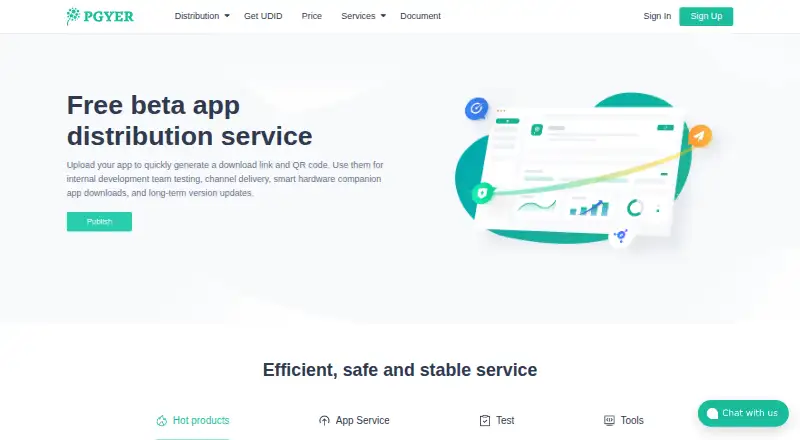
What Pgyer is
Pgyer is a mobile app beta testing and distribution platform for developers and test users. It manages multiple releases and can group iOS, Android, and HarmonyOS apps under merged QR codes. Download access can be public or controlled with passwords, verification questions, expiry settings, and custom short links. The service lists China, overseas, and global CDN delivery, long-term hosting for the latest build, and support for more than 10 languages. API 2.0 covers app upload and hosting, installation, app data, release management, feedback, and certificate management. Upload options include Fastlane and Jenkins plugins, a Mac upload tool, and a WeChat mini app. Distribution includes download analytics, user feedback, and unlimited SMS, email, and alerts. Pgyer also describes encrypted data transmission and storage, a Web firewall, high-defense servers, and anti-brute-force technology. It offers a free plan; paid services include app testing for $599, paid once, copyright registration for $600, paid once, and Android publishing for $1,999, paid once.
Good
- Manages multiple releases with merged QR codes.
- Download links support several access controls.
- API 2.0 includes release and certificate management.
- Offers Fastlane and Jenkins upload plugins.
- Includes download analytics and user feedback.
Watch out
- No free trial is listed.
- Paid testing and registration services have one-time fees.
Who it suits
Pgyer suits developers and teams distributing test builds to internal testers, customers, or international trial groups. Its listed use cases also include smart hardware companion apps and on-site deployment.
Verdict
Pgyer combines app distribution controls, release management, and testing feedback in one service. Its free plan may suit teams starting out, while specialized testing and publishing services carry listed one-time charges.
Plans and prices
From Pgyer's own pricing page, checked 15 Oct 2026.
| Plan | Price | What it gives you |
|---|---|---|
| Free | Free | app retention 5 years · 2G maximum file size · unlimited builds · 200 SMS/day · 2,000 email/day · ¥0 / month; free forever |
| API downloads after free quota | CN¥0.03, paid once | 200 shared free API/version-update downloads per day · large installers over 500 MB charged ¥0.05 per additional 100 MB rounded up · ¥0.03 per download for installers up to 500 MB after 200 free daily downloads |
| App testing | CN¥599, paid once | professional testing team divided by functional modules · ¥599 |
| Copyright registration | CN¥600, paid once | software copyright service for apps and mini apps; stated issuance in 3 days · ¥600 Up |
| Android publish | CN¥1,999, paid once | manual help with registration and uploads to 20+ Chinese Android stores · ¥1999 |
The facts
Each one read from Pgyer's own pages, with the date it was checked.
What it does
- Analytics and feedback
- The product includes download analytics, tester feedback collection, release history and alert channels.checked 15 Oct 2026
- API
- API 2.0 supports app upload and hosting, installation, app data retrieval, release management, feedback, and certificate management.checked 7 Oct 2026
- API legacy status
- Pgyer states that API 1.0 is no longer maintained and API 2.0 is the current interface.checked 15 Oct 2026
- API protocol
- Authenticated API calls generally use POST with form-encoded parameters and JSON responses, using an account API key.checked 15 Oct 2026
- API scope
- API 2.0 covers uploads, installs, app information, version control, app groups, feedback, certificates and deletion.checked 15 Oct 2026
- CI integrations
- Official materials list Fastlane and Jenkins plugins plus shell, Java, Node, PHP, Python and C# upload examples.checked 15 Oct 2026
- Compliance rules
- The review guide requires privacy-policy disclosure, consent, data minimization, HTTPS processing and least-privilege permissions for distributed apps.checked 15 Oct 2026
- Desktop clients
- Pgyer provides Mac and Windows clients; the Mac client requires macOS 10.9 or later and the Windows client supports Windows 7 and later.checked 15 Oct 2026
- Distribution access
- Install pages can be public, password protected, invitation only, quiz based or configured with expiring links.checked 15 Oct 2026
- Documentation depth
- The documentation center contains sections for upload, signing, packaging, app management, installation, integrations, CI/CD tools, API 2.0, billing, compliance and FAQs.checked 15 Oct 2026
- External organization profile
- GitHub's verified PGYER organization lists Xi'an, Shaanxi, China and links to pgyer.com.checked 15 Oct 2026
- External uptime
- SaaSHub's unofficial monitor reported PGYER up, with 100% uptime over the prior 30 days and no user reports in the prior 24 hours when crawled.checked 15 Oct 2026
- Funding news
- The company history says Pgyer received a ten-million investment in September 2015 from Infinox Angel Fund and Innovation Valley.checked 15 Oct 2026
- G2 review availability
- G2 says there are not enough Pgyer reviews to provide buying insight.checked 15 Oct 2026
- Global delivery
- The distribution product advertises China, overseas and global CDN options, multilingual pages and long-term retention.checked 15 Oct 2026
- Install API quota
- The install endpoint provides each account 200 free uses per day, with additional usage charged by installer size.checked 15 Oct 2026
- Installation controls
- Download entries can use public installation, password access, question verification, link expiry, and custom short links.checked 7 Oct 2026
Where it runs
- App distribution
- The service manages multiple releases and can merge iOS, Android, and HarmonyOS apps with merged QR codes.checked 7 Oct 2026
- App Store presence
- Apple's PGYER developer page lists Tracup and Chait apps, but no app named Pgyer itself and no ratings for the developer page.checked 15 Oct 2026
The company
- Company
- Pgyer identifies itself as a product of Xi'an Diance Company focused on app beta testing.checked 7 Oct 2026
- Company identity
- Pgyer describes itself as a product of Xi'an Diance Company focused on app beta testing.checked 15 Oct 2026
- External company description
- SaaSHub describes PGYER as a Xi'an startup founded by ShengTao Lei.checked 15 Oct 2026
- Founded
- Pgyer's history page says the company was established independently in July 2014.checked 15 Oct 2026
- Headquarters
- The published contact address is Room B2003, Venture Plaza, Science and Technology Road, Hi-Tech Zone, Xi'an, Shaanxi, China.checked 15 Oct 2026
The full review of Pgyer
Pgyer is a mobile app distribution and beta-testing service for developers. It suits teams sharing builds with testers or customers, especially across regions. Its strength is controlled release delivery and feedback; teams seeking a dedicated automated testing framework should look elsewhere.
Overview
Pgyer combines build hosting, release management, installation controls, analytics, and feedback in one service. Teams can manage multiple releases and provide a merged QR code for iOS, Android, and HarmonyOS apps. That makes it useful for internal testing, customer trials, smart-hardware companion apps, and on-site deployments. It is a distribution workflow, however, not a replacement for tools focused on executing automated device tests.
Key features
Controlled distribution
Download entries can be public or protected by a password or question verification; links can also expire, and teams can use custom short links. These controls give teams options for sharing builds with different audiences without relying on a single open download page. China, overseas, and global CDN delivery, long-term hosting for the latest build, and support for more than 10 languages make Pgyer relevant to international trials as well as local releases.
Release workflow and feedback
API 2.0 covers app upload and hosting, installation, app data retrieval, release management, feedback, and certificate management. Fastlane and Jenkins plugins, a Mac upload tool, and a WeChat mini app provide several routes into the service. Detailed download analytics and user feedback help teams follow distribution and collect responses, while unlimited SMS, email, and alerts can support communication around releases.
Security and support
Pgyer says it encrypts data in transmission and storage and cites high-defense servers, a Web firewall, and anti-brute-force technology. Its support team is described as online 7x24, with email and phone contact options. Those assurances may matter to teams distributing pre-release builds, though they do not replace a review of whether the service meets a particular organization's security requirements.
Pricing
Pgyer uses a freemium model and has no free trial. The Free plan costs no listed amount and includes five years of app storage, a maximum file size of 2G, unlimited builds, 200 SMS per day, and 2,000 emails per day. The build allowance is generous for ongoing release work, but the file-size ceiling and daily message quotas may constrain larger apps or high-volume testing.
Paid offerings are one-time services rather than monthly plans: App testing costs $599, paid once for functional-module defect finding by a professional application testing team; Copyright registration costs $600, paid once for app and mini-app software copyright registration, issued in 3 days; Android publish costs $1,999, paid once for troubleshooting registration and upload issues in more than 20 major Android app stores in China. These services fit teams needing a specific testing, registration, or China-store publishing task, but they are not recurring software tiers that expand the free distribution plan.
Platforms
Pgyer supports iOS and Android app uploads in IPA and APK formats, and also supports macOS, Windows, web, and API access. Its desktop clients require Mac OS X 10.9 or higher or Windows 7 and above. HarmonyOS appears in the merged-release workflow, extending the QR-code distribution option beyond the main iOS and Android upload formats.
Who it's for
Pgyer is a strong fit for developers and teams that need to distribute successive mobile builds, control who can install them, and gather feedback from testers or customers. Its regional delivery options and language support also suit international trials, while the Android publishing service is aimed specifically at teams navigating major app stores in China. It is a weaker fit when the core requirement is automated test execution across devices rather than build sharing.
Pros and cons
- Pros: Multiple-release management and a merged QR code bring iOS, Android, and HarmonyOS distribution into one workflow.
- Pros: Passwords, verification questions, expiring links, and custom short links give teams practical control over build access.
- Pros: API 2.0 and Fastlane and Jenkins plugins can connect uploads and release tasks to existing workflows.
- Cons: The Free plan caps individual files at 2G and daily messaging at 200 SMS and 2,000 emails, despite allowing unlimited builds.
- Cons: The paid offerings are discrete one-time services, not a broader paid distribution tier for teams that need more ongoing capacity.
- Cons: Teams primarily looking for automated device testing will need a testing-focused alternative.
Alternatives
For a directory of testing tools, browse Mobile App Testing Software. Choose Espresso instead when the need is free Android UI testing for a single target app on Android 4.0.1/API 14 or later. Katalon Studio is an option for teams seeking low-code and full-code authoring across web, mobile, and desktop, with an AI Assistant and MCP Server in its Enterprise plan.
Maestro is worth considering for teams that want to run tests on their own devices with its free Local option, or evaluate its Cloud plan. Detox offers a free, MIT-licensed framework for Android and iOS. For real-device sessions, TestMu AI Real Device Cloud has a free tier with one parallel test and five live sessions per month, each up to two minutes.
Beta Family is another option for app testing, with a free Starter plan for one app, own and unrated testers, questionnaires, online reports, and email support. Firebase Cloud Messaging is the relevant alternative when the need is no-cost messaging rather than build distribution. Tricentis Testim may suit teams looking for mobile and web testing with customized paid plans and a free tier of up to 1,000 runs per month.
Verdict
Choose Pgyer if your team needs a central place to distribute mobile releases with controlled access, regional delivery, and feedback tools, and the Free plan's storage and messaging limits fit your workload. Look elsewhere if automated device testing is the main job: Pgyer's strength is getting builds to people, not running a testing framework.
Alternatives to Pgyer
- 1

Katalon Studio
Free planAndroidiOSWebAPI8.4From $1,000 a year - 2

TestMu AI
Free planAndroidiOSWebAPI8.3From $17 a month - 3
Keysight Eggplant Test
AndroidiOSWebAPI7.9$9,999 one-time - 4
Perfecto
AndroidiOSWebAPI7.9From $83 a month - 5

TestingBot
AndroidiOSWebAPI7.9From $20 a month - 6

Maestro
Free planAndroidiOSWebLinux7.6From $250 a month