Pella Research
Pella Research builds models to assess whether audio is synthetic by examining vocoder artifacts, spectral statistics, and prosodic cues.
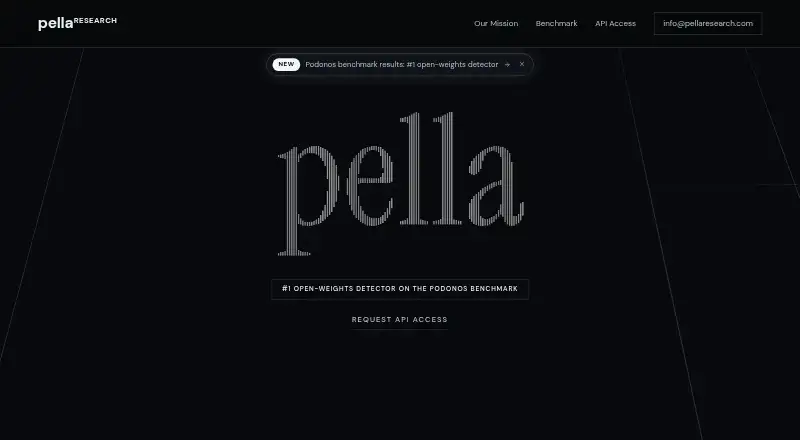
What Pella Research is
Pella Research builds models to assess whether audio is synthetic by examining vocoder artifacts, spectral statistics, and prosodic cues. Its browser demo lets users upload or record a voice clip and receive a verdict without signing up; the site says audio is not stored. A REST API returns calibrated authenticity scores and per-segment analysis, with access reviewed on request. Pella says it typically responds to requests within 24 hours, and accredited journalists and academics can receive a free API tier. The organization also publishes evaluation sets that track new voice-cloning systems, with documented provenance and no train/test leakage. Pella says its models are trained and tested on audio affected by phone-line compression, background noise, and re-encoding. The site reports that pellav2 achieved 95.82% accuracy, a 0.959 F1 score, and 57 ms latency in the August 2026 Podonos benchmark. It reports 93.6% accuracy on m4a files and says errors lean toward false positives. The maker lists pellav2 as open weights under the MIT license.
Good
- Browser demo requires no signup.
- Demo accepts uploaded or recorded clips.
- API returns per-segment analysis.
- Free API tier listed for accredited journalists and academics.
- pellav2 weights are listed under the MIT license.
Watch out
- API access requires a reviewed request.
- Demo may take up to a minute to wake.
- Reported m4a accuracy is 93.6%.
- Errors are said to lean toward false positives.
Who it suits
Pella Research is aimed at journalists, platforms, courts, researchers, and institutions investigating whether audio is synthetic. Its API is available by request, with a free tier listed for accredited journalists and academics.
Verdict
Pella combines a no-signup browser demo with a request-based API and published evaluation sets. Its reported m4a results and tendency toward false positives are important limitations when interpreting a verdict.
The facts
Each one read from Pella Research's own pages, with the date it was checked.
What it does
- Access and support
- API access is reviewed on request for journalists, platforms, researchers, and institutions, with a typical response within 24 hours.checked 7 Oct 2026
- Access response
- Pella says it reviews API requests and typically responds within 24 hours.checked 7 Oct 2026
- API
- The detection API is a REST endpoint that returns calibrated authenticity scores and per-segment analysis, with access granted on request.checked 7 Oct 2026
- API audience
- The API is offered to journalists, platforms, researchers, and institutions, and the page lists a free tier for accredited journalists and academics.checked 7 Oct 2026
- Benchmark limitation
- Pella reports 93.6% accuracy on m4a files and says its errors lean toward false positives.checked 7 Oct 2026
- Benchmark result
- Pella reports that pellav2 achieved 95.82% accuracy, a 0.959 F1 score, and 57 ms latency in the August 2026 Podonos benchmark.checked 7 Oct 2026
- Benchmarks
- Pella says its evaluation sets track new voice cloning systems and use documented provenance with no train-test leakage.checked 7 Oct 2026
- Demo limitation
- The live demo runs on free shared hardware, and its first request after a quiet period can take up to a minute to wake up.checked 7 Oct 2026
- Intended users
- Pella describes its work as serving platforms, journalists, courts, and researchers investigating whether audio is synthetic.checked 7 Oct 2026
- Known failure case
- Pella reports 93.6% accuracy on m4a files in that benchmark and says its errors lean toward false positives.checked 7 Oct 2026
- License
- The maker lists pellav2 as open weights under the MIT license.checked 7 Oct 2026
- Live demo
- The browser demo lets users upload or record a voice clip and receive a verdict without signup; the page says no audio is stored.checked 7 Oct 2026
- Location
- The site lists Amsterdam, Netherlands.checked 7 Oct 2026
- Model availability
- The site describes pellav2 as open weights under the MIT license and says the public checkpoint reproduces the submitted benchmark score.checked 7 Oct 2026
- Product
- Pella Research builds models to detect synthetic speech by analyzing vocoder artifacts, spectral statistics, and prosodic cues.checked 7 Oct 2026
- Purpose
- Pella Research studies synthetic speech and builds models to detect it in real-world audio.checked 7 Oct 2026
- Real-world conditions
- Pella says its models are trained and tested with phone-line compression, background noise, and re-encoding.checked 7 Oct 2026
- Research
- Its research examines vocoder artifacts, spectral statistics, and prosodic cues left by speech synthesis.checked 7 Oct 2026
- Research and benchmarks
- It publishes evaluation sets that track new voice cloning systems, with documented provenance and no train/test leakage.checked 7 Oct 2026
- Robustness
- Pella says its models are trained and tested on audio affected by phone-line compression, background noise, and re-encoding.checked 7 Oct 2026
Money
- Free access
- Pella states that accredited journalists and academics can receive a free API tier.checked 7 Oct 2026
The company
- Headquarters
- Amsterdam, Netherlandschecked 28 Sep 2026
Alternatives to Pella Research
- 1

FauxLens
Free planAndroidWebAPIExtension7.6$2.99 one-time - 2

Hive AI-Generated Content Detection
Free planWebAPIExtensionSelf-hosted7.4$6 one-time - 3
Resemble Detect
Free planWebAPIExtensionSelf-hosted7.4From $350 a month - 4
Netarx
Free planAndroidiOSWebExtension6.8Free plan - 5

Reality Defender
Free planWebAPISelf-hosted6.8From $399 a year - 6

Deepfake Detector
Free planWebAPIExtension6.7From $4,939 a month