
FauxLens
FauxLens analyzes images and video for signs of AI generation or manipulation, returning a verdict, confidence score, and forensic evidence.
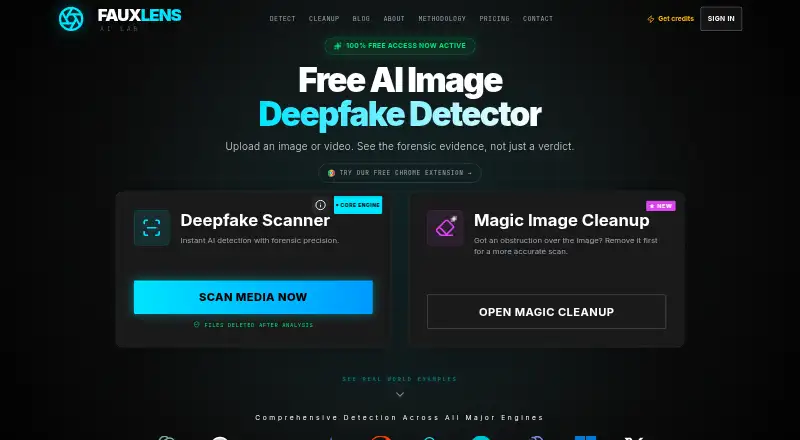
What FauxLens is
FauxLens analyzes images and video for signs of AI generation or manipulation, returning a verdict, confidence score, and forensic evidence. Its six-signal engine includes ELA, PRNU, GAN fingerprints, FFT, shadow physics, and EXIF forensics. Listed detection coverage includes OpenAI, Midjourney, Stability, Gemini, Firefly, Flux.1, Canva AI, Ideogram, Bing, and Grok. Image cleanup tools remove unwanted people, visual noise, and platform overlays. The web tool accepts JPG, PNG, and WebP; cleanup exports retain original dimensions up to 4K. A Chrome extension can scan publicly accessible images from a right-click, but not images requiring authentication or blocked by cross-origin policy. The REST API accepts image or video files or a URL and returns structured JSON with evidence by layer. FauxLens says uploaded media is deleted after analysis and scan history remains in the browser. API verdicts are informational, not proof or a sole basis for consequential decisions.
Good
- Returns a verdict, confidence score, and forensic evidence.
- Analyzes images and video.
- Cleanup tools remove people, noise, and overlays.
- API accepts files or URLs.
- Free plan includes 40 credits.
Watch out
- Free credits cover four detections.
- Chrome extension cannot scan authenticated or cross-origin-blocked images.
- API requests have rate and file-size limits.
- Verdicts should not be the sole basis for consequential decisions.
Who it suits
It suits journalists, HR teams, researchers, and others assessing whether media may be authentic. Developers can use its API for integrations, subject to request limits and the informational nature of its verdicts.
Verdict
FauxLens pairs media analysis with cleanup tools and an API, with a free credit allowance and one-time paid options. Treat its verdict as informational, especially for consequential decisions.
Plans and prices
From FauxLens's own pricing page, checked 15 Oct 2026.
| Plan | Price | What it gives you |
|---|---|---|
| Free | Free | Full forensic check · per-signal evidence · files deleted after analysis · no card · Free credits to start |
| Starter | $2.99, paid once | 500 credits · 10 credits per scan/removal · credits never expire · One-time payment |
| Pro | $9.99, paid once | 2,000 credits · 10 credits per scan/removal · credits never expire · One-time payment |
| Max | $19.99, paid once | 5,000 credits · 10 credits per scan/removal · credits never expire · One-time payment |
| API Starter | $99.99, paid once | 2,000 scans · HMAC signing · IP allowlist · 60 requests/minute · Prepaid; never expires |
| API Pro | $349.99, paid once | 10,000 scans · 120 requests/minute · priority email support · Prepaid; never expires |
| API Scale | $749.99, paid once | 25,000 scans · from 300 requests/minute · founder support · Prepaid; never expires |
The facts
Each one read from FauxLens's own pages, with the date it was checked.
What it does
- Accuracy disclosure
- FauxLens does not publish one headline accuracy percentage and describes confidence as a weight-of-evidence score rather than calibrated probability.checked 15 Oct 2026
- API
- The REST API accepts image files, video files, or a URL and returns structured JSON with a verdict, confidence score, and per-layer evidence chain.checked 28 Sep 2026
- API async support
- The developer API is synchronous and currently has no webhook callback mode.checked 15 Oct 2026
- API authentication
- Developer access uses a bearer token and requires an Idempotency-Key on every request.checked 15 Oct 2026
- API endpoint
- The public REST API uses POST /v1/analyze at api.fauxlens.com and accepts multipart files or an HTTPS URL.checked 15 Oct 2026
- API integrations
- The developer page describes integration patterns for moderation pipelines, ATS tools including Greenhouse and Lever, social platforms, WordPress, and Contentful.checked 28 Sep 2026
- API limits
- Developer keys allow 20 requests per minute per key, 30 per minute across an account, and 25 MB per uploaded request.checked 15 Oct 2026
- API response
- API responses include one of four summaries, a confidence score, per-layer evidence_chain entries, request identifiers, and remaining credits.checked 15 Oct 2026
- API SDKs
- The developer documentation provides curl and Python requests examples and says no SDKs are planned.checked 15 Oct 2026
- API URL limit
- URL-based API fetches are capped at 50 MB, while enterprise credentials can handle 200 MB.checked 15 Oct 2026
- Chrome developer
- Google lists Netanel Ossi as the extension developer and identifies the developer as an EU trader.checked 15 Oct 2026
- Chrome extension
- The Chrome extension lets users right-click publicly accessible images to run a scan, but cannot scan images requiring authentication or blocked by cross-origin policy.checked 28 Sep 2026
- Chrome extension function
- The extension adds a right-click action that sends an image for AI or deepfake analysis.checked 15 Oct 2026
- Chrome extension size
- The listed extension package size is 24.6 KiB.checked 15 Oct 2026
- Chrome extension update
- The store lists an update date of April 18, 2026.checked 15 Oct 2026
- Chrome extension users
- The Chrome Web Store listing showed 13 users when opened.checked 15 Oct 2026
- Chrome extension version
- The store lists version 1.0.0.checked 15 Oct 2026
- Chrome privacy declaration
- The store says the extension handles website content and the developer declares that data is not sold or used outside approved functionality.checked 15 Oct 2026
- Detection signals
- Its six-signal engine includes ELA, PRNU, GAN fingerprints, FFT, shadow physics, and EXIF forensics.checked 28 Sep 2026
- Detection stages
- The service checks content credentials and metadata, invisible AI watermarks, and pixel-level model signals in sequence.checked 15 Oct 2026
- Enterprise security
- Enterprise API supports optional HMAC-SHA256 signing, replay protection, per-key IP allowlists, and automatic refunds for pipeline failures.checked 15 Oct 2026
Where it runs
- API browser use
- Browser-side API calls are intentionally blocked by missing CORS headers so bearer keys remain server-side.checked 15 Oct 2026
The company
- Founded
- 2026checked 28 Sep 2026
- Headquarters
- Palm Beach Gardens, Florida, United Stateschecked 28 Sep 2026
The full review of FauxLens
FauxLens suits people who need to assess images or video and developers who want structured scan results in an API. Its mix of forensic signals, image cleanup and non-expiring credit packs is useful for occasional work, but its verdict should inform rather than determine consequential decisions.
Overview
FauxLens returns a verdict, confidence score and forensic evidence when it analyzes media for signs of AI generation or manipulation. Its six-signal engine combines ELA, PRNU, GAN fingerprints, FFT, shadow physics and EXIF forensics. It names OpenAI, Midjourney, Stability, Gemini, Firefly, Flux.1, Canva AI, Ideogram, Bing and Grok among the generators it detects; that breadth is useful, though a verdict is an indicator, not proof.
Alongside detection, FauxLens can remove unwanted people, visual noise and platform overlays from images. The site says uploads are handled in an isolated environment and deleted after analysis, while scan history remains in the user's browser. That separation may suit privacy-conscious workflows, but does not make the result a sound sole basis for a consequential decision.
Key features
Image tools
The web tool accepts JPG, PNG and WebP. Cleanup exports retain original dimensions up to 4K, a practical advantage when edits need to preserve image size. FauxLens supports video as well as images, but does not offer real-time analysis.
Extension and API
The Chrome extension lets users right-click publicly accessible images to scan them. It cannot reach images that require authentication or are blocked by cross-origin policy, so it is less useful for material inside protected services.
The REST API accepts image files, video files or a URL and returns JSON with a verdict, confidence score and per-layer evidence chain. The developer page describes integrations for moderation pipelines, ATS tools such as Greenhouse and Lever, social platforms, WordPress and Contentful. Keys are limited to 20 requests per minute, with an account-wide ceiling of 30 per minute. Requests may be up to 25MB; URL fetches are capped at 50MB. The API documentation cautions against treating its verdict as proof or as the sole basis for consequential decisions.
Pricing
The free plan costs nothing and includes 40 credits, described as 4 detections, the full six-signal forensic pipeline and no credit card requirement. It is a useful way to assess the service, but four detections make it a small allowance for recurring work. There is no free trial.
Paid plans are one-time payments, not recurring subscriptions, and their credits never expire. Starter costs $2.99, paid once for 500 credits, or about 50 image scans; Pro costs $9.99, paid once for 2,000 credits, about 200 image scans; Max costs $19.99, paid once for 5,000 credits, about 500 image scans. Starter is suited to light use, while Pro or Max gives repeat users a larger reserve without a renewal commitment. The approximate scan counts are stated for images, so they should not be read as a guaranteed video quota.
Platforms
FauxLens is available on Android, the web, as a Chrome extension and through its API. Its maximum file size is 100 MB; API requests and URL fetches have the more specific limits described above.
Who it's for
FauxLens names journalists, HR teams and researchers among its intended users. Its evidence-bearing verdict can help frame an authenticity assessment, while the cleanup tools suit people who also need to remove distractions or overlays from images. Developers can use the API to add scans to other services, subject to its rate and size limits. Anyone making hiring, moderation or other consequential decisions should seek corroboration rather than rely on a scan alone.
Pros and cons
- Pros: Six detection signals produce evidence alongside a verdict and confidence score, giving readers more context than a label alone.
- Pros: One-time credit packs never expire, which fits uneven or occasional workloads without recurring billing.
- Pros: Image cleanup and detection sit in the same service, and the web tool's cleanup exports retain dimensions up to 4K.
- Cons: The free allowance covers only four detections, limiting ongoing use without a purchase.
- Cons: The extension cannot scan authenticated or cross-origin-blocked images, and the API has request-rate and file-size ceilings.
- Cons: Verdicts are informational, not proof, and the service lacks real-time analysis.
Alternatives
For a broader comparison, see AI Deepfake Detection Tools. Choose Netarx instead if video, voice and email protection matter more than FauxLens's image cleanup and forensic signals; it has a free Individual plan and supports more platforms, including iOS, macOS and Windows.
ForgeSpy is another freemium option, with Android, iOS and web apps and five free sign-up credits; consider it if those platforms and its credit-based entry point suit your needs. For API evaluation, Tayanch offers a free Starter plan with 100 checks per month, making it a fit for a monthly integration trial rather than FauxLens's non-expiring packs.
Deepfake Detector is worth considering when a monthly quota or voice analysis is more important: its free plan includes 50 detections per month and up to two minutes of voice or video detection. Reality Defender may suit teams that want image and audio analysis with up to three seats; its RealAPI Free plan includes 50 scans per month and API keys. Resemble Detect offers a Flex plan with one team seat, pay-as-you-go credits and audio, image and video detection across platform and API access.
Unreveal is another option for readers comparing detection services. Clarity AI uses custom pricing, with a demo as the next step for prospective users.
Verdict
FauxLens is a sensible choice for journalists, researchers, occasional users and developers who want image and video analysis with forensic evidence, optional image cleanup and credits that do not expire. Its strongest case is that combination at a low one-time entry price. Look elsewhere if you need real-time analysis, a larger free allowance, or a verdict reliable enough to decide a consequential case on its own.
Getting started
- Open the FauxLens website or use its Android app.
- Choose the free plan or a one-time credit package.
- For web image analysis, upload a JPG, PNG or WebP image.
- Install the Chrome extension to scan eligible public images by right-clicking.
- For programmatic use, get an API key and send an image, video or URL to the REST API.
Limits worth knowing
The free plan provides 40 credits, described as four detections. API keys are limited to 20 requests per minute each and 30 per minute per account; requests are capped at 25MB, while URL fetches are capped at 50MB.
Questions
Does FauxLens have a free plan?
Yes. Free includes 40 credits, described as four detections, and does not require a credit card.
How much do the paid plans cost?
Starter is a $2.99 one-time payment for 500 credits, Pro is $9.99 one-time for 2,000 credits, and Max is $19.99 one-time for 5,000 credits. Credits never expire.
Which platforms does FauxLens support?
It lists Android, API, extension and web. Its Chrome extension scans publicly accessible images by right-click.
What can the API analyze?
The REST API accepts image files, video files or a URL, and returns structured JSON with a verdict, confidence score and per-layer evidence chain.
How does FauxLens handle uploads?
The site says uploaded media is processed in an isolated environment, deleted after analysis and not stored. Scan history remains in the user's browser.
Can a FauxLens verdict be treated as proof?
No. The API documentation says a verdict is informational and should not be treated as proof or used as the sole basis for consequential decisions.
Alternatives to FauxLens
- 1

Hive AI-Generated Content Detection
Free planWebAPIExtensionSelf-hosted7.4$6 one-time - 2

Resemble Detect
Free planWebAPIExtensionSelf-hosted7.4From $350 a month - 3
Netarx
Free planAndroidiOSWebExtension6.8Free plan - 4

Reality Defender
Free planWebAPISelf-hosted6.8From $399 a year - 5

Deepfake Detector
Free planWebAPIExtension6.7From $4,939 a month - 6

Tayanch
Free planWebAPI6.7From $249 a month