
Deepfake Detector
Deepfake Detector analyzes audio, video, and images and returns an Authentic, Likely Synthetic, or Inconclusive verdict with a confidence score.
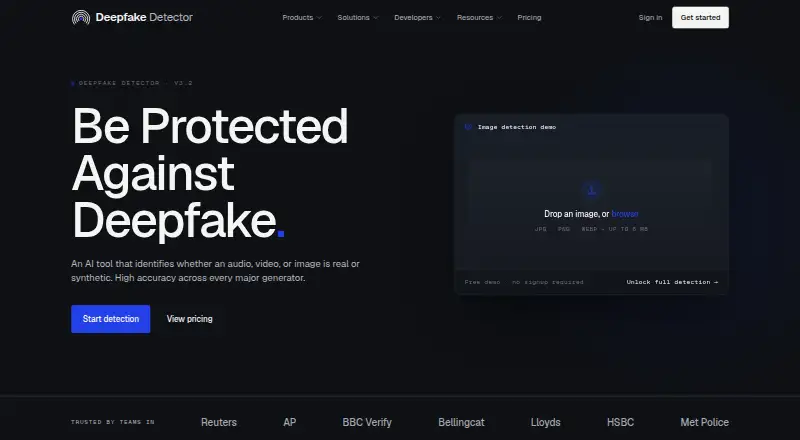
What Deepfake Detector is
Deepfake Detector analyzes audio, video, and images and returns an Authentic, Likely Synthetic, or Inconclusive verdict with a confidence score. Video checks use frame-level analysis, and applicable plans support clips up to 10 minutes. Coverage includes video generators such as Sora, Runway, Pika, and Kling; image tools such as MidJourney, DALL·E, Stable Diffusion, and Flux; and voice platforms including ElevenLabs, PlayHT, Resemble, and OpenAI. You can use the web service, a browser extension, or a public REST API that accepts a media URL or file and returns JSON results. The extension scans webpage media through a right-click menu and supports Chromium browsers including Chrome, Edge, Brave, and Arc. For files over 60 seconds, webhooks can deliver verdicts when analysis finishes. Type-safe SDKs are available for Python, Node, Go, and Ruby. Uploaded files are purged within 60 seconds of a verdict, though hashed identifiers and verdict metadata remain for billing and audit.
Good
- Checks audio, video, and images.
- Returns verdicts with confidence scores.
- Browser extension scans media from webpages.
- Uploaded files are purged after verdicts.
Watch out
- Free plan allows 50 detections monthly.
- Real-time analysis is not available.
- Hashed identifiers and verdict metadata are retained.
Who it suits
The service is presented for journalists, fact-checkers, finance teams, businesses, and personal users who need to assess media authenticity. Its API and SDKs may suit teams incorporating detection into their workflows.
Verdict
Deepfake Detector offers several ways to check media, from its web service to an API and browser extension. The free plan is limited to 50 monthly detections, and uploaded files are purged while some metadata remains.
Plans and prices
From Deepfake Detector's own pricing page, checked 1 Oct 2026.
| Plan | Price | What it gives you |
|---|---|---|
| Free | Free | 50 detections/month · up to 2 min voice/detection · up to 2 min video/detection · AI/Human verdict · TrustScore 0-100 · web access |
| Starter | $4,939 a month | 1,000 detections/month · up to 10 min voice/detection · up to 10 min video/detection · detailed confidence scores · PDF and CSV export · API · email support · $468/year |
| Business | — | 5,000 detections/month · up to 10 min voice/detection · up to 10 min video/detection · API · priority email support · $1,908/year |
| Enterprise | — | 20,000 detections/month · up to 10 min voice/detection · up to 10 min video/detection · API · priority email support · $5,748/year |
The facts
Each one read from Deepfake Detector's own pages, with the date it was checked.
What it does
- API
- A public REST API accepts a media URL or file and returns JSON detection results.checked 1 Oct 2026
- Compliance
- The company states that its SOC 2 audit is in progress and that EU data residency is available on Business plans and above.checked 1 Oct 2026
- Detection types
- The service analyzes audio, video, and images and returns an Authentic, Likely Synthetic, or Inconclusive verdict with a confidence score.checked 1 Oct 2026
- Extension privacy
- The browser extension states that it does not read other tabs, browsing history, DOM content, or cookies, and requests only contextMenus and activeTab permissions.checked 1 Oct 2026
- SDKs
- Type-safe SDKs are available for Python, Node, Go, and Ruby.checked 1 Oct 2026
- Security retention
- Uploaded files are processed in memory and purged within 60 seconds after the verdict is returned, while hashed identifiers and verdict metadata are retained for billing and audit.checked 1 Oct 2026
- Support
- Starter includes email support, while Business and Enterprise include priority email support.checked 1 Oct 2026
- Supported generators
- Coverage includes major video generators such as Sora, Runway, Pika, and Kling; image generators such as MidJourney, DALL·E, Stable Diffusion, and Flux; and voice platforms such as ElevenLabs, PlayHT, Resemble, and OpenAI.checked 1 Oct 2026
- Target users
- The product is presented for journalists, finance teams, fact-checkers, businesses, and personal users who need to verify synthetic media.checked 1 Oct 2026
- Video limits
- The detector performs frame-level video analysis and supports clips up to 10 minutes on applicable plans.checked 1 Oct 2026
- Webhooks
- For files over 60 seconds, users can register a webhook to receive the verdict when analysis completes.checked 1 Oct 2026
Where it runs
- Browser extension
- The Chrome extension scans image, video, and audio from a webpage through a right-click menu and works in Chrome, Edge, Brave, Arc, and other Chromium browsers.checked 1 Oct 2026
The company
- Founded
- 2023checked 28 Sep 2026
- Headquarters
- Montreal, Quebec, Canadachecked 28 Sep 2026
The full review of Deepfake Detector
Deepfake Detector is a media-authenticity service for images, audio, and video, with browser, web, and developer access. It is best suited to journalists, fact-checkers, finance teams, businesses, and individuals who need repeatable verification rather than a one-off novelty check. Its broad generator coverage and integrations are persuasive, but the free quota is small and there is no real-time analysis.
Overview
Each scan returns an Authentic, Likely Synthetic, or Inconclusive result alongside a confidence score. That third outcome is valuable when evidence is ambiguous, while the score gives a reviewer more context than a simple yes-or-no label. The service analyzes audio, video, and images, and includes face analysis, but it is not designed for live streams or other real-time workflows.
Founded in 2023 and based in Montreal, Deepfake Detector presents itself as a practical verification layer for professional and personal use. Uploaded files are processed in memory and purged within 60 seconds after the verdict; hashed identifiers and verdict metadata remain for billing and audit. Its SOC 2 audit is in progress, and EU data residency is offered on Business plans and above, so organizations with strict governance requirements should weigh the plan level carefully.
Key features
Video analysis works frame by frame and supports clips up to 10 minutes on applicable paid plans. The free tier limits both video and voice detections to two minutes, which is adequate for short clips but unsuitable for routinely checking interviews, recordings, or longer source material. Stated coverage includes video generators such as Sora, Runway, Pika, and Kling; image systems including MidJourney, DALL·E, Stable Diffusion, and Flux; and voice platforms such as ElevenLabs, PlayHT, Resemble, and OpenAI. That breadth makes it a sensible general-purpose detector, although a verdict should still be treated as an investigative signal rather than proof.
The Chrome extension scans image, video, and audio on a webpage from a right-click menu. It runs in Chrome, Edge, Brave, Arc, and other Chromium browsers, making in-context checks faster than downloading every file first. The extension says it does not read other tabs, browsing history, DOM content, or cookies, and requests only contextMenus and activeTab permissions.
For automation, the public REST API accepts a media URL or file and returns JSON detection results. Type-safe SDKs support Python, Node, Go, and Ruby. Files longer than 60 seconds can use a webhook so an application receives the verdict when processing finishes. These are strong building blocks for newsroom, compliance, or moderation pipelines, while the lack of real-time analysis rules it out for live screening.
Pricing
The Free plan costs nothing and includes 50 detections per month, web access, AI/Human verdicts, and a TrustScore from 0 to 100. Voice and video detections are limited to two minutes each. It fits occasional personal checks and trial evaluations, but 50 monthly scans can disappear quickly in a professional queue.
Starter costs $4,939 a month, billed $468/year, with 1,000 detections monthly, 10-minute voice and video limits, detailed confidence scores, PDF and CSV export, API access, and email support. It is the logical entry point for a small team that needs exports or integration, though the pricing is a substantial jump from free. Business costs $199,159 a month, billed $1,908/year, and raises the allowance to 5,000 detections with API access and priority email support. Enterprise costs $599,479 a month, billed $5,748/year, and provides 20,000 detections with the same 10-minute media limits, API access, and priority support. Business and Enterprise are aimed at higher-volume organizations; custom procurement should account for the stated EU residency option on those levels and above.
Platforms
Deepfake Detector is offered through its web service, API, and browser extension. The extension covers Chromium-based browsers, while SDKs make the API practical for Python, Node, Go, and Ruby development environments.
Who it's for
Choose it when a journalist, fact-checker, finance team, or business needs one detector for mixed media, quick browser checks, and programmatic processing. Personal users can use the free plan for occasional verification. Look elsewhere if you need live analysis, materially more than 50 free monthly checks, or a lower-cost paid starting point.
Pros and cons
- Pros: Handles audio, video, and images with an inconclusive option and confidence score.
- Pros: Broad stated coverage of leading video, image, and voice generators.
- Pros: Extension, REST API, webhooks, and SDKs support both quick checks and automation.
- Pros: In-memory processing and rapid file purging reduce retained media exposure.
- Cons: Free users get only 50 detections monthly and two-minute voice/video limits.
- Cons: No real-time analysis for live or continuous monitoring.
- Cons: Paid plan prices rise sharply, making regular high-volume use a significant commitment.
Alternatives
See the AI Deepfake Detection Tools list for a wider comparison. Choose Netarx instead if you want Android, iOS, macOS, Windows, web, and extension access, plus video, voice, and email protection. FauxLens suits buyers seeking a low-cost freemium option with 40 free credits, four detections, and a six-signal forensic pipeline. ForgeSpy is an alternative for Android, iOS, and web users. Tayanch is better for API evaluation with 100 free monthly checks and pay-as-you-go image checks. Hive AI-Generated Content Detection fits developers wanting API, extension, self-hosted, and web access with model-based pay-as-you-go pricing. Reality Defender offers a 50-scan monthly free API tier with up to three seats and image/audio analysis. Resemble Detect is worth considering for pay-as-you-go team access across audio, image, and video. Unreveal is an alternative with API, desktop, Linux, and web platforms.
Verdict
Deepfake Detector is a strong choice for organizations that need mixed-media detection plus an extension and API in one service. Its main reason to choose it is integration breadth and generator coverage; its main reason to look elsewhere is the limited free allowance, steep paid pricing, and absence of real-time analysis.
Alternatives to Deepfake Detector
- 1

FauxLens
Free planAndroidWebAPIExtension7.6$2.99 one-time - 2

Hive AI-Generated Content Detection
Free planWebAPIExtensionSelf-hosted7.4$6 one-time - 3

Resemble Detect
Free planWebAPIExtensionSelf-hosted7.4From $350 a month - 4
Netarx
Free planAndroidiOSWebExtension6.8Free plan - 5

Reality Defender
Free planWebAPISelf-hosted6.8From $399 a year - 6

Tayanch
Free planWebAPI6.7From $249 a month