ParticlePhaseSpace
The facts below are what the maker publishes about ParticlePhaseSpace, checked and dated. Our editors have not written about it yet.
Plans and prices
From ParticlePhaseSpace's own pricing page, checked 12 Oct 2026.
| Plan | Price | What it gives you |
|---|---|---|
| ParticlePhaseSpace | Free | No usage or volume limits stated |
The facts
Each one read from ParticlePhaseSpace's own pages, with the date it was checked.
What it does
- Analysis
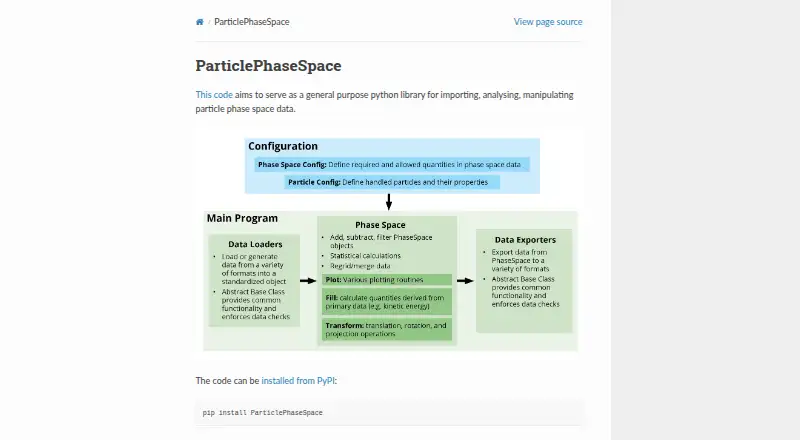
- The library documents RMS Twiss parameter calculation, energy statistics, time filtering, and particle-density assessment.checked 12 Oct 2026
- Combination limitation
- The example notes that identical particles cannot be added to an existing phase space unless particle IDs are updated first.checked 12 Oct 2026
- Data exporters
- Documented exporters write CSV and TOPAS ASCII or binary formats.checked 12 Oct 2026
- Data loaders
- Documented loaders include IAEA, pandas, Tibaray, TOPAS, and p2sat text data.checked 12 Oct 2026
- Data transformations
- The documentation covers translations, rotations, projections, and regridding of phase-space data.checked 12 Oct 2026
- Delivery mode
- webchecked 23 Sep 2026
- Experimental feature
- The documentation describes Gaussian KDE resampling as fairly experimental and advises using it with extreme caution.checked 12 Oct 2026
- Extensibility
- Users can write custom DataLoaders and DataExporters for data formats the library does not already support.checked 12 Oct 2026
- IAEA limitation
- The IAEA loader may require fine tuning and is unlikely to work out of the box with arbitrary IAEA phase-space files.checked 12 Oct 2026
- IAEA loader requirement
- The IAEA loader requires users to provide a data schema because the format does not allow the loader to infer it generally.checked 12 Oct 2026
- Installation
- The documentation says to install it with `pip install ParticlePhaseSpace`.checked 12 Oct 2026
- Intended users
- The repository describes the library as a common tool for working with particle phase spaces, and its topics include accelerator physics, TOPAS, and Twiss.checked 12 Oct 2026
- License
- The public GitHub repository identifies the project as GPL-3.0 licensed.checked 12 Oct 2026
- Plots
- Documented plots include energy and momentum histograms, particle-position plots, trace-space plots, and fluence maps.checked 12 Oct 2026
- Purpose
- ParticlePhaseSpace is a Python library for importing, analysing, and manipulating particle phase-space data.checked 12 Oct 2026
- Python requirement
- PyPI lists Python versions 3.9 and later, below 4.0, as the package requirement.checked 12 Oct 2026
- Support
- The repository asks users to report problems or request support through its Issues tab.checked 12 Oct 2026
- Supported particles
- The documented supported particles are electrons, positrons, gammas, protons, neutrons, and optical photons.checked 12 Oct 2026
- TOPAS export limit
- The TOPAS exporter does not handle time features and flags every particle as a new history.checked 12 Oct 2026
- TOPAS import limit
- The TOPAS loader does not handle time or particle-ID fields, which may or may not be present in TOPAS data.checked 12 Oct 2026
- Transformations
- The transformation documentation lists projection, regridding, rotation, and translation operations.checked 12 Oct 2026
- Units
- The library supports multiple unit sets and allows users to define new unit sets.checked 12 Oct 2026
- Visualization
- Documented plots include energy, position, momentum, transverse trace space, particle counts over time, and fluence maps.checked 12 Oct 2026
Money
- Free plan
- Yeschecked 23 Sep 2026
Alternatives to ParticlePhaseSpace
- 1

SimFlow
Free planWebLinuxmacOSWindows8.2From €8,000 a year - 2

COMSOL Multiphysics
WebAPILinuxmacOS7.7 - 3
FeenoX
Free planWebAPILinuxSelf-hosted7.5Free plan - 4
myPhysicsLab
Free planWebLinuxmacOSSelf-hosted7.5Free plan - 5

OpenFOAM
Free planLinuxmacOSSelf-hostedWindows7.3Free plan - 6
MPTRAC
Free planWebLinuxSelf-hosted7.2Free plan