PartCrafter
PartCrafter is an open-source model that generates multiple 3D parts and objects from a single RGB image.
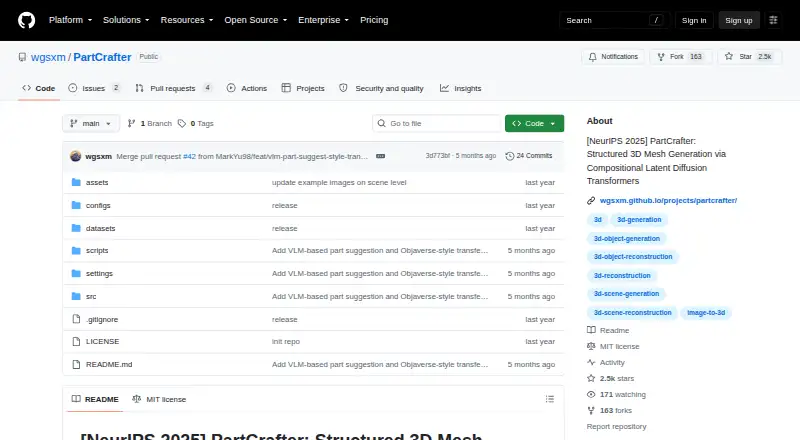
What PartCrafter is
PartCrafter is an open-source model that generates multiple 3D parts and objects from a single RGB image. It can process individual objects or complex scenes, creating distinct meshes with meaningful part structure without requiring a pre-segmented image. The project provides local inference scripts installed from its GitHub repository in a Python environment, along with pretrained object-level and scene-level weights hosted on Hugging Face. The scripts can remove backgrounds and optionally apply style transfer to adapt real-world photos toward the rendered-image domain used for training. An optional vision-language feature can suggest how many parts to generate; Gemini is the default, and the provider architecture can be extended. PartCrafter is MIT-licensed and listed as free. Local inference requires a CUDA-enabled GPU with at least 8 GB of VRAM. The linked Hugging Face demo is paused, though its page says users can ask the authors to restart it. The software is provided as-is, without warranty.
Good
- Creates distinct, semantically meaningful 3D parts
- Works with objects and complex scenes
- Does not require pre-segmented images
- Pretrained object and scene weights are available
- MIT-licensed and free
Watch out
- Inference requires a CUDA GPU with 8 GB VRAM
- The linked demo is paused
- Software is provided without warranty
Who it suits
PartCrafter suits users who want to create part-aware 3D objects or scenes from images and can run local inference on a CUDA-enabled GPU. It may also suit developers interested in an MIT-licensed project with extendable provider architecture.
Verdict
PartCrafter is a free option for image-to-3D generation when part-level structure matters. Check the local GPU requirement and paused demo status before choosing it.
Plans and prices
From PartCrafter's own pricing page, checked 9 Oct 2001.
| Plan | Price | What it gives you |
|---|---|---|
| PartCrafter (MIT-licensed open-source software) | Free | MIT license · local installation requires a CUDA-enabled GPU with at least 8GB VRAM |
The facts
Each one read from PartCrafter's own pages, with the date it was checked.
What it does
- Architecture
- Its method uses disentangled latent tokens for parts and a hierarchical attention mechanism for information flow within and across parts.checked 9 Oct 2001
- Compositional architecture
- The model represents each 3D part with disentangled latent tokens and uses hierarchical attention across parts.checked 9 Oct 2001
- Demo availability
- The linked Hugging Face demo is paused, and its page says users can ask its authors to restart it.checked 9 Oct 2001
- Deployment
- The official instructions install the project from its GitHub repository in a Python environment and run inference scripts locally.checked 9 Oct 2001
- Hardware requirement
- The README specifies a CUDA-enabled GPU with at least 8 GB of VRAM for inference.checked 9 Oct 2001
- Image preprocessing
- The inference scripts support background removal and optional style transfer to adapt real-world photos to the rendered-image domain used for training.checked 9 Oct 2001
- Image styling
- An optional Gemini-powered style-transfer step converts real-world photos toward an Objaverse-style rendering before generation.checked 9 Oct 2001
- Integrations
- The README documents Gemini for part suggestions and style transfer, and says the provider architecture can be extended with other providers.checked 9 Oct 2001
- License
- The repository lists an MIT license.checked 9 Oct 2001
- License and warranty
- The repository uses the MIT License and provides the software “AS IS,” without warranty.checked 9 Oct 2001
- Model weights
- Pretrained object-level and scene-level model weights are hosted on Hugging Face.checked 9 Oct 2001
- Object generation
- The repository provides an inference script for generating part-level 3D objects from images.checked 9 Oct 2001
- Part-aware output
- It generates semantically meaningful, geometrically distinct 3D meshes without requiring pre-segmented input images.checked 9 Oct 2001
- Part suggestions
- An optional VLM feature can suggest the number of parts, using Gemini by default.checked 9 Oct 2001
- Purpose
- PartCrafter generates multiple structured 3D parts and objects from a single RGB image in one pass.checked 9 Oct 2001
- Scene generation
- The model supports image-to-3D generation for complex scenes as well as individual objects.checked 9 Oct 2001
- Security and compliance
- The official pages opened provide no security certification or compliance claim.checked 9 Oct 2001
- Support
- The repository invites users to contact the maintainer by email or open an issue with questions or suggestions.checked 9 Oct 2001
- Tested environment
- The maintainers say they tested installation on Debian 12 with NVIDIA H20 GPUs and provide community-contributed Windows setup guidance.checked 9 Oct 2001
- Tested setup
- The project says its installation was tested on Debian 12 with NVIDIA H20 GPUs and points Windows users to a community guide and fork.checked 9 Oct 2001
- Training resources
- The project describes training scripts suited to 8 NVIDIA H20 GPUs with 96GB VRAM each.checked 9 Oct 2001
- Training scale
- The training scripts are described as suitable for eight NVIDIA H20 GPUs with 96 GB of VRAM each.checked 9 Oct 2001
Alternatives to PartCrafter
- 1

Meshy
Free planAndroidiOSWebAPI8.3From $20 a month - 2

Tripo AI
Free planAndroidiOSWebAPI8.2From $4.58 a month - 3

Polar Cloud
Free planAndroidiOSWebAPI8.1From $6.58 a month - 4
Hunyuan3D
Free planWebAPILinuxmacOS7.5CN¥100, paid once - 5

Polycam
Free planAndroidiOSWeb7.5From $12.50 a month - 6

Hyper3D Rodin
Free planWebAPI6.9From $30 a month