PARI/GP
PARI/GP is a free, open-source computer algebra system for fast number-theory computations, available across several platforms.
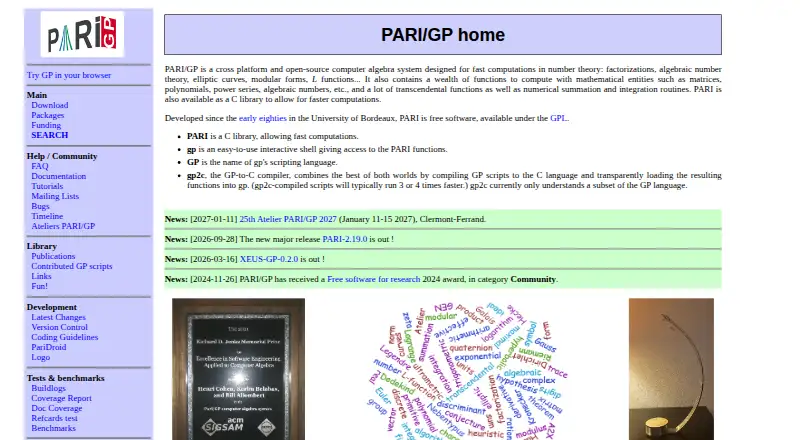
What PARI/GP is
PARI/GP is a free, open-source computer algebra system for fast number-theory computations, available across several platforms. Its mathematical functions cover factorization, algebraic number theory, elliptic curves, modular forms, L-functions, matrices, polynomials, power series, algebraic numbers, and transcendental functions. PARI is also available as a C library; gp provides an interactive shell and the GP scripting language. The gp2c compiler translates GP scripts to C and can make compiled scripts three or four times faster, though it handles only part of GP. Users can try expressions, assign variables, and define functions in a browser-based GP interface, whose speed is approximately 15% of native speed. Xeus-GP provides a Jupyter kernel based on Xeus. Optional packages are distributed separately because they take substantial disk space and are expected to be unnecessary for most users. The project provides guides, reference manuals, tutorials, quick reference cards, and downloadable manuals. Help is available through the pari-users mailing list, and a bug-tracking system accepts bug reports and feature requests.
Good
- Free software under GPL version 2 or later.
- Mathematical functions cover a wide range of number-theory work.
- Available as a C library, shell, and scripting language.
- Online manuals, tutorials, and quick reference cards are provided.
- Browser interface supports entering expressions and defining functions.
Watch out
- Browser version runs at approximately 15% of native speed.
- gp2c supports only a subset of GP.
- Optional packages are distributed separately.
- GNU MP and GNU readline are optional build dependencies.
Who it suits
PARI/GP suits users working on number theory who want a free algebra system with shell, scripting, library, or browser-based access. Its documentation and mailing list offer reference and help options.
Verdict
PARI/GP offers multiple interfaces and extensive mathematical coverage, with a browser option for trying expressions. The browser is much slower than native speed, and compiled scripts and optional packages have stated limits.
Plans and prices
From PARI/GP's own pricing page, checked 11 Oct 2026.
| Plan | Price | What it gives you |
|---|---|---|
| PARI/GP | Free | GPL v2 or later · Optional packages distributed separately |
The facts
Each one read from PARI/GP's own pages, with the date it was checked.
Where it runs
- Browser performance
- The browser version page states that its speed is approximately 15% of native speed.checked 11 Oct 2026
- Browser use
- The official site provides a browser-based GP interface where users can enter expressions, assign variables, and define functions.checked 11 Oct 2026
- Platforms
- The official download page offers binaries for Windows, macOS, and Android, and source distributions for building PARI/GP.checked 11 Oct 2026
What it does
- Build dependencies
- The source build instructions say GNU MP and GNU readline are optional but make the calculator faster and more user-friendly, respectively.checked 11 Oct 2026
- Compiler
- gp2c compiles GP scripts to C, typically making compiled scripts three or four times faster, but it supports only a subset of GP.checked 11 Oct 2026
- Documentation
- The site provides an online user's guide, reference manuals, tutorials, quick reference cards, and downloadable manuals.checked 11 Oct 2026
- Interfaces
- PARI is available as a C library, while gp is an interactive shell and GP is its scripting language.checked 11 Oct 2026
- License
- PARI/GP is free software released under the GNU General Public License, version 2 or any later version.checked 11 Oct 2026
- Maintainers
- The project says it has been developed at the University of Bordeaux since the early eighties and is maintained by volunteers.checked 11 Oct 2026
- Mathematical work
- It includes functions for factorization, algebraic number theory, elliptic curves, modular forms, L-functions, matrices, polynomials, power series, algebraic numbers, and transcendental functions.checked 11 Oct 2026
- Notebook integration
- Xeus-GP is described as a Xeus-based Jupyter kernel for PARI/GP.checked 11 Oct 2026
- Optional packages
- Optional packages are distributed separately because they use significant disk space and are expected to be unnecessary for most users.checked 11 Oct 2026
- Purpose
- PARI/GP is a cross-platform, open-source computer algebra system designed for fast number-theory computations.checked 11 Oct 2026
- Support
- The project directs users to the pari-users mailing list for help and provides a bug tracking system for bug reports and feature requests.checked 11 Oct 2026
The company
- Founded
- 1983checked 28 Sep 2026
The full review of PARI/GP
PARI/GP is a free, open-source computer algebra system aimed at serious mathematical computation, especially number theory. It suits researchers, mathematicians, students, and developers who prefer programmable tools and reusable calculations over guided, visual homework workflows. Its extensive coverage and flexible interfaces are compelling, provided you can work within the browser and compiler constraints.
Overview
Developed at the University of Bordeaux since 1983 and maintained by volunteers, PARI/GP focuses on fast computation across a substantial part of modern number theory. Its GNU General Public License version 2 or later makes the software free to use, modify, and redistribute under that license. The project is best understood as a mathematical engine rather than a polished classroom app: it rewards users who know what they want to calculate and how to express it.
PARI is provided as a C library, while gp is the interactive shell and GP is its scripting language. That division gives developers an embeddable foundation, analysts an immediate command-line environment, and researchers a way to preserve repeatable workflows in scripts.
Key features
Broad number-theory toolkit
Functions cover factorization, algebraic number theory, elliptic curves, modular forms, L-functions, matrices, polynomials, power series, algebraic numbers, and transcendental functions. This breadth makes PARI/GP a strong choice for advanced symbolic and arithmetic work, where a specialized library is more useful than a general calculator. It is less suited to readers who primarily need visual explanations or step-by-step school exercises.
Interactive, programmable, and notebook use
The GP language supports interactive exploration and scripted calculations. Xeus-GP adds a Xeus-based Jupyter kernel, giving notebook users a way to combine PARI/GP computations with a notebook workflow. The official website also supplies a browser GP interface for entering expressions, assigning variables, and defining functions, which is convenient for trying the system without a local installation.
Compilation and optional components
gp2c can compile GP scripts to C and typically makes compiled scripts three or four times faster. It supports only a subset of GP, however, so it is an optimization for compatible scripts rather than a universal replacement for the interpreter. Optional packages are distributed separately because they consume substantial disk space and are expected to be unnecessary for most users. When building from source, GNU MP can improve calculator speed and GNU readline can make interaction more user-friendly; both are optional.
Documentation and support
Online user guides, reference manuals, tutorials, quick-reference cards, and downloadable manuals provide unusually substantial documentation for a free specialist system. Help is directed through the pari-users mailing list, while a bug tracker handles bug reports and feature requests. That support model is community- and project-oriented rather than commercial help-desk support.
Pricing
| Plan | Price | What it includes |
|---|---|---|
| PARI/GP | free | Free software under GPL v2 or later; optional packages are distributed separately. |
There are no paid tiers, seat charges, quotas, trial periods, or renewal terms. The trade-off is practical rather than financial: users who need optional packages must obtain them separately, and the license governs redistribution and commercial use. For academic, personal, and development work that fits the GPL, the single free plan removes a major barrier to adopting a deep mathematical toolkit.
Platforms
PARI/GP is listed for Android, Linux, macOS, the web, and Windows. Native platforms are the better fit for sustained computation, scripting, and library integration. The browser interface is useful for short experiments, but its stated speed is approximately 15% of native speed, making it a poor choice for demanding workloads. The C library and GP shell also favor users comfortable with developer-oriented environments.
Who it's for
Choose PARI/GP for number-theory research, symbolic experimentation, teaching at an advanced level, or software projects that need a programmable arithmetic engine. Its interfaces let the same project move between library code, shell sessions, scripts, and notebooks. Look elsewhere if your priority is a guided solver, visual geometry, or a consumer-focused mobile experience with explanations rather than computation.
Pros and cons
Pros
- Deep specialist coverage: number-theory functions span factorization, elliptic curves, modular forms, L-functions, and related algebraic operations.
- Multiple integration paths: the C library, GP scripting language, interactive shell, browser interface, and Xeus-GP kernel serve different technical workflows.
- Free and open source: GPL v2-or-later licensing avoids subscription costs and permits licensed software reuse.
- Strong documentation: manuals, tutorials, quick references, and an active mailing list support self-directed users.
Cons
- Browser speed penalty: the web interface runs at about 15% of native speed, limiting it to lighter experimentation.
- Partial compilation: gp2c can accelerate compatible scripts but does not cover the full GP language.
- Optional packages require separate handling: large add-ons are distributed independently and may complicate installations that need them.
- Specialist orientation: users seeking guided, visual learning tools may find the programmable workflow demanding.
Alternatives
Math Solver Apps is a useful category starting point when you want to compare broader solver options. Pick GeoGebra instead for a freemium, cross-platform environment spanning Android, iOS, web, desktop, and API access, particularly when its visual mathematics focus matters. MathPad is the better fit if you want a freemium service with AI tutoring and credit-based plans.
Xcas is another free GPL computer algebra system, including a dual-license route for commercial inclusion. MalMath suits Android, iOS, and web users seeking a freemium solver with a one-time Premium purchase option. AI Mathbot is aimed at users who want a basic AI math solver and optional monthly or yearly Pro subscriptions. Mathway fits people who want a freemium solver and calculators with step-by-step solutions, while SnapXam focuses on algebra, trigonometry, calculus, and step-by-step API responses. AllMath AI Math Solver offers a free-forever credit plan and a paid monthly tier for users who prefer an AI-oriented solver.
Verdict
PARI/GP is an excellent choice for technically confident users who need broad, fast number-theory computation, programmable workflows, and a genuinely free license. Choose it for research, reusable scripts, or integration through C and notebooks; look elsewhere when you need full browser performance, complete GP-script compilation, or a guided visual solver.
Alternatives to PARI/GP
- 1

Mathway
Free planAndroidiOSWebExtension8.2From $39.99 a year - 2

CameraMath
Free planAndroidiOSWebAPI8.0From $59.99 a year - 3

MathPad
Free planAndroidiOSWebAPI8.0From $14.99 a month - 4
MalMath
Free planAndroidiOSWeb7.8From $24.99 a year - 5

Cymath
Free planAndroidiOSWeb7.3From $5 a month - 6
GeoGebra
Free planAndroidiOSWebAPI7.3Free plan