OWASP DevGuard
OWASP DevGuard is a vulnerability-management platform for source code, dependencies, container images, infrastructure-as-code and deployed artifacts.
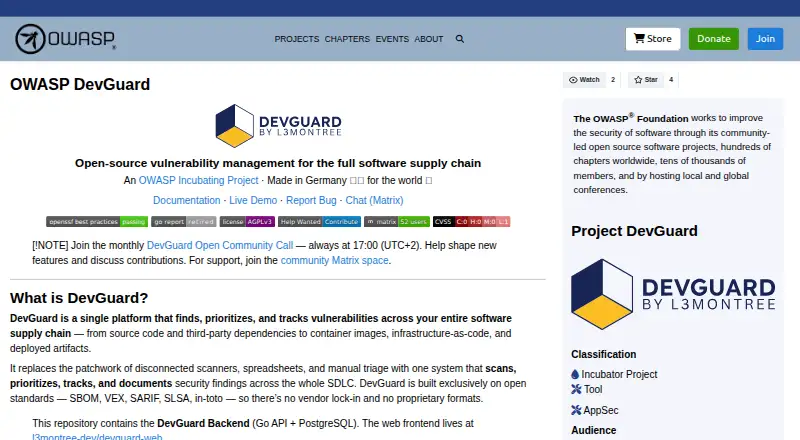
What OWASP DevGuard is
OWASP DevGuard is a vulnerability-management platform for source code, dependencies, container images, infrastructure-as-code and deployed artifacts. Its security pipeline combines secret scanning, SAST, SCA, infrastructure-as-code scanning, container scanning and license compliance. Findings are prioritized with CVSS-BE, EPSS and component-depth scoring. DevGuard supports CycloneDX software bills of materials, VEX workflows, and live SBOM and VEX endpoints. It can import CycloneDX SBOM and SARIF results from Trivy, Grype, Semgrep and other standards-compliant scanners. Bidirectional synchronization is available for GitHub Issues, GitLab Issues and Jira, including slash-command triage. A dependency proxy for npm, Go and PyPI blocks packages flagged in the OSSF malicious packages database. Security and compliance features include in-toto attestations, SLSA provenance, cosign signatures and automated evidence for ISO 27001, CRA, BSI IT-Grundschutz and SLSA. DevGuard is self-hostable with Kubernetes or Docker Compose and provides a backend API and web interface. Its source is AGPL-3.0-or-later licensed, with hybrid deployment and remediation tracking.
Good
- Covers secrets, SAST, SCA, IaC, containers and license compliance
- Prioritizes findings with CVSS-BE, EPSS and component depth
- Supports CycloneDX SBOMs, VEX workflows and live endpoints
- Synchronizes issues with GitHub Issues, GitLab Issues and Jira
- Self-hostable through Kubernetes or Docker Compose
- Dependency proxy covers npm, Go and PyPI
Watch out
- Open Source plan is limited to public projects with OSI-approved licenses
- SaaS requires a one-year contract paid yearly
- Enterprise includes a one-time initial setup
Who it suits
DevGuard suits developers, DevOps engineers and security teams managing risks across code, dependencies, infrastructure and deployed software. The project says specialized security knowledge is not required, making it approachable for teams needing integrated scanning and remediation tracking.
Verdict
Choose DevGuard if you need one platform spanning application, dependency, container and infrastructure security with prioritized remediation. Its self-hosting and standards support fit teams with control requirements. Look elsewhere if your projects are not public and OSI-licensed under the free plan, or if the SaaS contract structure does not fit.
Plans and prices
From OWASP DevGuard's own pricing page, checked 7 Oct 2026.
| Plan | Price | What it gives you |
|---|---|---|
| Open Source | Free | Free for public projects with OSI-approved license · all features · community support · self-hosted |
| SaaS | €449.10 a month | Starting at · 10 user seats included · fully managed hosting in Germany · initial 1-hour setup workshop · 8×5 email support · 1 year contract, paid yearly |
| Enterprise | Priced on request | Self-hosted · 20 to 160 support hours per year · contractual response times of 16 h, 8 h or 4 h · Annual subscription; plus one-time initial setup |
The facts
Each one read from OWASP DevGuard's own pages, with the date it was checked.
What it does
- Dependency firewall
- The dependency proxy supports npm, Go and PyPI and blocks packages flagged in the OSSF malicious packages database.checked 7 Oct 2026
- Deployment
- The platform is self-hostable using Kubernetes or Docker Compose and provides a backend API and web UI.checked 7 Oct 2026
- Integrations
- It lists GitHub Issues, GitLab Issues and Jira for bidirectional issue synchronization, including slash-command triage.checked 7 Oct 2026
- Intended users
- DevGuard identifies developers, DevOps engineers and security teams as its intended users, and says specialized security knowledge is not required.checked 7 Oct 2026
- License
- DevGuard's source code is distributed under the AGPL-3.0-or-later license.checked 7 Oct 2026
- Purpose
- DevGuard manages vulnerabilities across source code, dependencies, container images, infrastructure-as-code and deployed artifacts.checked 7 Oct 2026
- Risk prioritization
- DevGuard scores findings using CVSS-BE, EPSS and component depth to prioritize risks.checked 7 Oct 2026
- SBOM and VEX
- It supports CycloneDX SBOMs, VEX workflows and live SBOM and VEX endpoints.checked 7 Oct 2026
- Scanner imports
- DevGuard can ingest CycloneDX SBOM and SARIF data from Trivy, Grype, Semgrep and other standards-compliant tools.checked 7 Oct 2026
- Scanning
- Its security pipeline covers secret scanning, SAST, SCA, IaC scanning, container scanning and license compliance.checked 7 Oct 2026
- Security and compliance
- The project describes in-toto attestations, SLSA provenance, cosign signatures and automated evidence for ISO 27001, CRA, BSI IT-Grundschutz and SLSA.checked 7 Oct 2026
- Support
- The project directs community users to its Matrix space and monthly community call.checked 7 Oct 2026
The company
- Headquarters
- Bonn, Germanychecked 28 Sep 2026
- Maker
- The DevGuard site identifies L3montree GmbH and the DevGuard Contributors in its copyright notice.checked 7 Oct 2026
Where it runs
- Scanner platforms
- The standalone scanner supports Linux, macOS and Windows.checked 7 Oct 2026
The full review of OWASP DevGuard
OWASP DevGuard is a vulnerability-management platform covering application code, dependencies, containers, infrastructure-as-code and deployed artifacts. It is aimed at developers, DevOps engineers and security teams that want one workflow with self-hosted control or managed hosting. The strongest case is broad, standards-oriented coverage; the main qualification is that the free tier is restricted to public, OSI-licensed projects.
Overview
DevGuard combines scanning, risk ranking and remediation tracking in a single backend and web interface. Its hybrid deployment model lets organizations run it on Kubernetes or Docker Compose, while the SaaS plan provides fully managed hosting in Germany. Source code is released under AGPL-3.0-or-later, and community support is provided through a Matrix space and monthly community call.
Key features
The security pipeline includes secret scanning, SAST, software-composition analysis, infrastructure-as-code scanning, container scanning and license compliance. That range is useful for teams trying to keep findings from code and infrastructure in one queue, although operating a broad pipeline still requires appropriate process and ownership.
Risk scoring combines CVSS-BE, EPSS and component depth. In practice, those signals help distinguish urgent, exploitable or deeply embedded issues from lower-impact alerts. Remediation tracking then connects prioritized findings to work that needs an owner.
Bidirectional synchronization with GitHub Issues, GitLab Issues and Jira, including slash-command triage, fits teams whose developers already work in those systems. Existing scanner investments can be retained: DevGuard imports CycloneDX SBOM and SARIF data from Trivy, Grype, Semgrep and other standards-compliant tools.
CycloneDX SBOM support, VEX workflows and live SBOM and VEX endpoints provide a way to maintain component inventories and communicate vulnerability status. Its dependency proxy covers npm, Go and PyPI and blocks packages identified in the OSSF malicious packages database, giving teams an additional control before dependencies enter a project.
Security and compliance features include in-toto attestations, SLSA provenance, cosign signatures and automated evidence for ISO 27001, the Cyber Resilience Act, BSI IT-Grundschutz and SLSA. These capabilities are most relevant to organizations with software-supply-chain or audit obligations.
Pricing
Open Source
The Open Source plan costs free and includes all features, community support and self-hosting. It is free for public projects with an OSI-approved license. That is a comprehensive option for qualifying open-source maintainers, but it does not serve private projects under the stated terms.
SaaS
SaaS starts at €449.10 a month, billed on a one-year contract and paid yearly. Ten user seats are included, along with fully managed hosting in Germany, an initial one-hour setup workshop and 8×5 email support. This suits organizations that want DevGuard without running Kubernetes or Docker Compose, but the annual commitment and relatively high starting spend make it a deliberate choice for teams with sustained usage.
Enterprise
Enterprise uses custom pricing with an annual subscription and a one-time initial setup. It is self-hosted and includes 20 to 160 support hours per year plus contractual response times of 16, 8 or 4 hours. This is the route for organizations that need formal support commitments and their own deployment, rather than a published self-service price.
A 14-day trial is available. The published plans do not describe additional seat or scan quotas beyond the SaaS plan's ten included seats.
Platforms
DevGuard offers an API and web interface, with deployment on self-hosted infrastructure or managed hosting. The standalone scanner runs on Linux, macOS and Windows. That combination works for mixed developer environments and teams that require control over where the service operates.
Who it's for
Developers, DevOps engineers and security teams are the stated audience, and the project positions specialized security knowledge as unnecessary. DevGuard is a strong fit when one organization needs code, dependency, container and infrastructure findings tied to existing issue trackers and compliance evidence. It is less suitable for a private project seeking a no-cost tier, or for a small team that cannot justify an annual SaaS contract.
Pros and cons
- Pro: Broad scanning spans secrets, code, dependencies, IaC, containers and licenses, reducing the need to manage those categories in isolation.
- Pro: CVSS-BE, EPSS and component-depth signals give remediation queues more context than a simple severity list.
- Pro: SBOM, VEX, SARIF and CycloneDX interoperability supports standards-based workflows and imports from established scanners.
- Pro: Self-hosting, supply-chain attestations and compliance evidence suit organizations with control or audit requirements.
- Con: The free Open Source plan is limited to public projects with OSI-approved licenses.
- Con: SaaS begins at 449.10 EUR monthly on a yearly contract, which may be excessive for small or short-term projects.
- Con: Enterprise pricing is custom and adds a one-time setup, so budgeting requires a sales process.
Alternatives
Browse vulnerability management software for a wider category comparison. ManageEngine Vulnerability Manager Plus is worth considering if its free and paid editions better match an on-premises vulnerability-management budget. Intruder suits readers wanting a free tier with five infrastructure targets and weekly external scans, though its free plan excludes web apps. Nanitor is an option when asset-count pricing, including a 10-asset free plan and a 6.00 USD monthly Standard plan, is the priority. Qualys External Attack Surface Management fits a 30-day external attack-surface evaluation rather than a permanently free tier. Zscaler Private Access is a paid private-access product. OWASP DefectDojo is another open-source vulnerability platform with a free Community Edition and paid usage option. Ivanti Neurons for Zero Trust Access is a paid, named-user zero-trust access service. WPSec targets website scanning, with a free tier and a 19.00 EUR monthly Premium plan per website.
Verdict
Choose OWASP DevGuard if you need application, dependency, container and infrastructure security connected to prioritized remediation, standards-based exchange and optional self-hosting. Its main reason to look elsewhere is commercial fit: private users must move to an annual SaaS commitment or custom enterprise terms, while the free plan is reserved for qualifying public projects.
Getting started
- Open the DevGuard website
- Choose the Open Source, SaaS or Enterprise plan
- Self-host the platform with Kubernetes or Docker Compose
- Use the backend API and web UI
- Run the standalone scanner on Linux, macOS or Windows
Limits worth knowing
The free Open Source plan is for public projects with an OSI-approved license. SaaS includes 10 user seats and requires a one-year contract paid yearly; Enterprise uses annual subscription terms and includes a one-time initial setup.
Questions
Is DevGuard free?
The Open Source plan costs nothing for public projects with an OSI-approved license and includes all features with community support.
Can DevGuard be self-hosted?
Yes. Self-hosting is available with Kubernetes or Docker Compose, alongside a backend API and web UI.
Which platforms does DevGuard support?
The platform supports API, Linux, macOS, self-hosted, web and Windows environments. Its standalone scanner supports Linux, macOS and Windows.
What integrations are available?
DevGuard lists bidirectional issue synchronization for GitHub Issues, GitLab Issues and Jira, plus scanner imports from tools including Trivy, Grype and Semgrep.
Alternatives to OWASP DevGuard
- 1

UpGuard
Free planAndroidiOSWebAPI8.2From $1,750 a month - 2

OWASP DefectDojo
Free planOpen sourceWebAPILinuxSelf-hosted8.0$100 usage-based - 3

ManageEngine Vulnerability Manager Plus
Free planWebAPILinuxmacOS7.9From $695 a year - 4
Microsoft Defender for Business
AndroidiOSAPImacOS7.5 - 5

Intruder
Free planWebAPILinuxmacOS7.4Free plan - 6
Vicarius vRx
WebAPILinuxmacOS6.8From $4 a month