
Intruder
Intruder provides continuous vulnerability scanning for infrastructure, web applications, APIs and cloud environments, with issue prioritization and remediat…
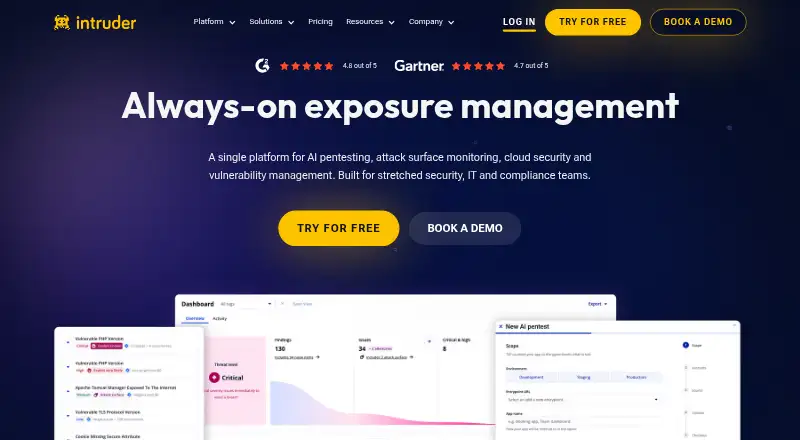
What Intruder is
Intruder provides continuous vulnerability scanning for infrastructure, web applications, APIs and cloud environments, with issue prioritization and remediation guidance. It ranks findings using exploit likelihood and real-world threat intelligence, and emerging-threat scans check systems within hours of new risks appearing. Cloud scans assess AWS, Microsoft Azure and Google Cloud environments for vulnerabilities, misconfigurations and exposures. Authenticated dynamic application testing covers customer-controlled web apps and APIs, including OWASP Top 10 checks. Supported targets include external IP addresses, domains and subdomains, internal Windows, macOS and Linux devices, and container images. Integrations include cloud platforms, code repositories, issue trackers, chat tools, Vanta and Drata. Its API can manage targets, view issues, start scans and retrieve results. Intruder offers a free plan and a 14-day trial. The free plan covers five infrastructure targets and weekly external scans, but excludes web apps. Internal target scanning is available only on Pro and Enterprise plans. All customers receive live chat support.
Good
- Continuous scanning covers infrastructure, web apps and APIs.
- Prioritizes issues using exploit likelihood and threat intelligence.
- Cloud scans cover AWS, Azure and Google Cloud.
- API can start scans and retrieve results.
- All customers receive live chat support.
Watch out
- Free plan excludes web apps.
- Free plan covers five infrastructure targets.
- Internal scanning is limited to Pro and Enterprise.
Who it suits
Intruder suits teams that need ongoing vulnerability checks across infrastructure, cloud environments, web apps or APIs. Teams requiring internal target scanning need Pro or Enterprise; Enterprise customers also have access to dedicated security professionals.
Verdict
Intruder combines continuous scanning with prioritization and remediation guidance across several target types. Its free tier is restricted to five infrastructure targets and excludes web apps, while internal scanning requires Pro or Enterprise.
Plans and prices
From Intruder's own pricing page, checked 19 Oct 2026.
| Plan | Price | What it gives you |
|---|---|---|
| Free | Free | 5 infrastructure targets · weekly external scans · 1 cloud account · 2 container images · ports 80 and 443 · 3 users · forever |
| Cloud | — | 3 cloud accounts · daily container scans · web-app and API testing · top 10 ports · 5 AI investigation credits · 15+ integrations · - / month; - annually |
| Enterprise | Priced on request | unlimited cloud accounts · all ports · 1,000+ attack-surface checks · 50 AI investigation credits · shadow-IT discovery · custom checks · custom |
| Pro | — | 10 cloud accounts · internal-server and employee-device agents · top 50 ports · 10 AI investigation credits · - / month; - annually |
The facts
Each one read from Intruder's own pages, with the date it was checked.
What it does
- API
- The REST API manages targets, views issues, starts scans and retrieves results; access is restricted to administrator users and API tokens are account-wide.checked 19 Oct 2026
- Attack-surface discovery
- The service discovers subdomains, login pages, APIs, exposed services, open ports and newly exposed cloud services.checked 19 Oct 2026
- Changelog
- Intruder publishes product updates, release dates and linked documentation in a public changelog.checked 19 Oct 2026
- Cloud security
- AWS, Microsoft Azure and Google Cloud accounts can be synchronized for asset discovery and daily posture checks; Cloudflare supports DNS-based discovery.checked 19 Oct 2026
- Compliance
- Intruder Systems Ltd says it completed an AICPA SOC 2 Type 2 audit; its datacenters have certifications including ISO 27001 and PCI DSS.checked 19 Oct 2026
- Container scanning
- Intruder scans container images and can automatically scan new versions in AWS ECR, Azure ACR and Google Cloud Artifact Registry.checked 19 Oct 2026
- Developer documentation
- A public Developer Hub provides API onboarding, access-token instructions, cloud connectors and integration guides.checked 19 Oct 2026
- Emerging threats
- Emerging threat scans check systems within hours of new risks appearing in the wild.checked 30 Sep 2026
- External scanning
- External scans cover internet-facing IP addresses, domains, subdomains, servers, container images and cloud assets.checked 19 Oct 2026
- Funding information
- Crunchbase lists Intruder as privately held, seed funded, with five funding rounds and investors including Pitch@Palace and NCSC for Startups; disclosed amounts are obfuscated.checked 19 Oct 2026
- Integrations
- Documented integrations include AWS, Google Cloud, Azure, Slack, Microsoft Teams, Jira, GitHub, GitLab, Zapier, Okta, Drata, Vanta and Microsoft Sentinel.checked 19 Oct 2026
- Internal scanning
- Internal device scanning uses agents compatible with Windows, macOS and Linux.checked 19 Oct 2026
- Limit: remediation detail
- A G2 reviewer reported that some remediation outputs lack sufficiently clear steps, paths and affected URLs.checked 19 Oct 2026
- Limit: report detail
- A TrustRadius reviewer said reports could contain more detail.checked 19 Oct 2026
- Limits
- Internal target scanning is available only on Pro and Enterprise plans.checked 30 Sep 2026
- Limit: scanning noise complaint
- A Trustpilot reviewer alleged that Intruder generated up to 48,000 hits against the same port in one night and caused blocking by server operators.checked 19 Oct 2026
- Limit: scan speed
- G2 review summaries identify scanning that can take longer than expected as a recurring complaint.checked 19 Oct 2026
Where it runs
- App scanning
- Authenticated dynamic application security testing covers web apps and APIs controlled by the customer, including OWASP Top 10 checks.checked 30 Sep 2026
The company
- Company
- Intruder says it was founded in 2015 to address information overload in vulnerability management.checked 30 Sep 2026
- Company founder and customers
- LinkedIn says Chris Wallis founded Intruder in 2015 and that the company protects more than 3,000 companies worldwide.checked 19 Oct 2026
- Company headquarters
- Intruder lists its headquarters at 1 Mark Square, London, EC2A 4EG, United Kingdom.checked 19 Oct 2026
- Company legal name
- The registered company is Intruder Systems Ltd, an active UK private limited company incorporated on 8 April 2015.checked 19 Oct 2026
- Company size
- LinkedIn lists Intruder as having 51–200 employees.checked 19 Oct 2026
Money
- Limit: licensing cost
- A Gartner reviewer criticized per-target licensing when many targets must be covered on a limited budget.checked 19 Oct 2026
The full review of Intruder
Overview
Intruder is a vulnerability-management service for teams that need recurring checks across exposed infrastructure, cloud environments, applications and APIs. It suits security teams that want findings ranked by likely exploitability, rather than a flat list to triage themselves. Its strongest case is breadth with actionable prioritization; its free tier, however, is a narrow starting point rather than a full appraisal of the product.
Key features
Continuous scanning and prioritization
Intruder continuously scans supported targets and ranks issues using exploit likelihood and real-world threat intelligence, with remediation guidance to help teams decide what to fix first. That combination is useful where vulnerability backlogs compete for limited security time. Emerging-threat scans check systems within hours of new risks appearing in the wild, adding a rapid reassessment option alongside ongoing scans.
Application, cloud and internal coverage
Authenticated dynamic testing covers customer-controlled web applications and APIs, including OWASP Top 10 checks. Cloud scans assess AWS, Microsoft Azure and Google Cloud for vulnerabilities, misconfigurations and exposures. Supported targets also include external addresses and domains, internal Windows, macOS and Linux devices, and container images, although internal scanning is reserved for Pro and Enterprise.
Operations and safeguards
Integrations include AWS, Azure, Google Cloud, GitHub, GitLab, Jira, Linear, ServiceNow, Slack, Microsoft Teams, Vanta and Drata. The API can manage targets, view issues, start scans and retrieve results. Intruder says it uses TLS in transit, logical separation between customer datasets and full-disk encryption on company devices and cloud volumes holding customer information. Intruder Systems Ltd has completed an AICPA SOC 2 Type 2 audit; the product also names SOC 2, ISO 27001, PCI DSS, HIPAA and Cyber Essentials among supported compliance frameworks. All customers get live chat support, while Enterprise adds access to dedicated security professionals.
Pricing
Intruder is freemium, with a free plan and a 14-day trial. The free plan costs nothing, billed Forever, and allows three users, five infrastructure targets, one connected cloud account and two container images. It runs weekly external scans and checks ports 80 and 443; web apps are excluded. That is enough for a small, externally focused trial, but not for application testing, broad port coverage or internal scanning.
Cloud has custom pricing, billed monthly or annually, with annual billing saving 20%. Its base fee plus per-target fee covers three cloud accounts, daily cloud checks, web app and API testing, the top 10 ports, five AI investigation credits and 15+ integrations. It fits teams centered on cloud and application coverage, but the three-account and top-10-port limits are meaningful constraints.
Pro is custom pricing, billed annually, with a base fee plus per-target fee. It raises the cloud-account allowance to 10 and adds agent-based internal scanning, the top 50 ports and 10 AI investigation credits. This is the relevant step up for organizations that need internal checks; the annual-only term and per-target charge should factor into budgeting.
Enterprise uses custom pricing, quoted separately. It includes unlimited cloud accounts, all ports, 1,000+ attack surface checks, 50 AI investigation credits and shadow IT discovery. It is aimed at larger programs that need broader coverage and dedicated security professionals, rather than teams that can work within Pro's defined allowances.
Platforms
Intruder supports API, Linux, macOS, web and Windows, with a hybrid deployment model and authenticated scanning. The range of supported target types is broader than the free plan's infrastructure-only scope, so plan choice determines how much of that coverage is usable.
Who it's for
Intruder is a good fit for teams managing a mix of internet-facing systems, cloud accounts and customer-owned applications that need risk-based triage and remediation guidance. Cloud-focused teams may find Cloud's daily checks and app testing relevant; teams requiring internal device scanning need Pro or Enterprise. It is less compelling for individuals seeking a broad free scanner or teams unwilling to commit to custom-priced plans for expanded coverage.
Pros and cons
- Pro: Prioritization combines exploit likelihood and threat intelligence, helping teams distinguish urgent issues from routine findings.
- Pro: Coverage spans infrastructure, cloud, authenticated web apps and APIs, with emerging-threat checks within hours.
- Pro: Live chat is available to all customers, and Enterprise adds dedicated security professionals.
- Con: Free scanning is limited to five infrastructure targets, weekly external checks and ports 80 and 443; it excludes web apps.
- Con: Internal scanning requires Pro or Enterprise, leaving a major target category outside the lower-cost entry point.
- Con: Paid plan costs depend on custom pricing, and Cloud and Pro also charge a base fee plus per-target fee.
Alternatives
For a broader comparison, see Vulnerability Scanning Software, Network Vulnerability Scanners, Cloud Vulnerability Scanners and Vulnerability Management Software.
Choose ManageEngine Vulnerability Manager Plus if its freemium model and support for self-hosted deployment better suit your environment. OpenVAS offers a free virtual appliance with a community feed and limited enterprise features, but no default support. Nmap is the free option for users who need a standalone network-mapping tool, subject to its restriction on redistribution within commercial software or hardware products. NSAuditor AI is another freemium alternative. Choose Nuclei for an open-source, MIT-licensed CLI intended primarily as a standalone tool. Pentest-Tools Port Scanner is a narrower alternative for open-port and service discovery, with a free tier and a NetSec plan starting from $95 a month. Ivanti Neurons for Zero Trust Access is a paid alternative with named-user licensing. NSAuditor AI is also freemium and supports Windows, macOS and Linux.
Verdict
Choose Intruder if your team needs continuous, risk-prioritized scanning across infrastructure, cloud and authenticated applications, and can budget for the plan that unlocks its required coverage. Its main advantage is the combination of broad target support with threat-aware triage; look elsewhere if you need internal scanning on a free or entry-level plan, or want transparent paid pricing before engaging.
Getting started
- Open the Intruder website.
- Choose the free plan or use the listed 14-day trial.
- Add supported targets such as infrastructure, cloud environments, web apps, APIs, or container images.
- Connect services such as AWS, GitHub, Jira, Slack, or Microsoft Teams as needed.
- Use the API to manage targets, start scans, and retrieve results.
Limits worth knowing
The free plan is billed forever at no cost and includes five infrastructure targets, weekly external scans, one connected cloud account, two container images, ports 80 and 443, and three users. Web apps are excluded. Internal target scanning is available only on Pro and Enterprise.
Questions
Does Intruder offer a free plan or trial?
Yes. It lists a free plan and a 14-day trial.
What does the free plan include?
It includes five infrastructure targets, weekly external scans, one connected cloud account, two container images, ports 80 and 443, and three users. Web apps are not included.
Which platforms does Intruder support?
Its listed platforms are API, Linux, macOS, web, and Windows.
Can Intruder scan internal targets?
Internal target scanning is available on Pro and Enterprise plans.
What does the API do?
The API can manage targets, view issues, start scans, and retrieve results.
What support is included?
All customers receive live chat support. Enterprise customers also have access to dedicated security professionals.
Alternatives to Intruder
- 1
NSAuditor AI
Free planOpen sourceAPILinuxmacOSSelf-hosted8.0From $470 a year - 2

ManageEngine Vulnerability Manager Plus
Free planWebAPILinuxmacOS7.9From $695 a year - 3
Microsoft Defender for Business
AndroidiOSAPImacOS7.5 - 4

OpenVAS
Free planWebAPILinuxmacOS7.2From €2,524 a year - 5
Nmap
Free planLinuxmacOSSelf-hostedWindows7.0From $9,980 a month - 6

NSAuditor AI
Free planLinuxmacOSSelf-hostedWindows6.9From $470 a year