
Nuclei
Nuclei is a free, open-source vulnerability scanner for applications, infrastructure, cloud platforms, and networks.
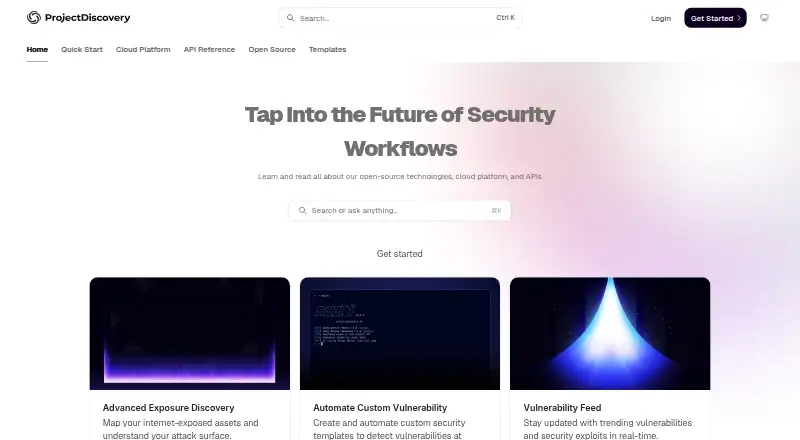
What Nuclei is
Nuclei is a free, open-source vulnerability scanner for applications, infrastructure, cloud platforms, and networks. It uses YAML templates to define checks, with more than 6,500 community-contributed templates available. Users can also create their own templates, apply authentication such as HTTP basic authentication or JWT, and run bulk or parallel scans with target and inclusion or exclusion filters. Its modules cover HTTP, DNS, TCP, headless, JavaScript, code, and file checks. Nuclei can be integrated into CI/CD workflows, including through GitHub Actions, and can export SARIF results to GitHub Code Scanning. It is distributed under the MIT License and is primarily intended as a standalone command-line tool. Installation options include Go, Homebrew, Docker, GitHub, downloadable binaries, and Helm. Nuclei is actively developed but has no LTS or stable version, so updates may introduce breaking changes. Some templates can take actions that risk denial of service; those templates are tagged and excluded from default scans.
Good
- More than 6,500 community-contributed templates are available.
- Supports bulk and parallel scans.
- Can export SARIF results to GitHub Code Scanning.
- Free and distributed under the MIT License.
Watch out
- No LTS or stable version is available.
- Updates may introduce breaking changes.
- Some templates may risk denial of service.
Who it suits
Nuclei may suit security engineers, analysts, red teams, DevOps teams, bug bounty hunters, and penetration testers who need template-based vulnerability checks. Its CI/CD options also fit teams automating security tests and regression checks.
Verdict
Nuclei offers a free, flexible scanner built around community and custom templates, with CI/CD support. Its active development and potentially disruptive templates call for care when choosing versions and checks.
Plans and prices
From Nuclei's own pricing page, checked 4 Oct 2026.
| Plan | Price | What it gives you |
|---|---|---|
| Nuclei CLI | Free | Open-source CLI · MIT licensed · primarily intended as a standalone tool |
The facts
Each one read from Nuclei's own pages, with the date it was checked.
What it does
- Authentication
- Nuclei supports authentication mechanisms including HTTP basic authentication and JWT token authentication.checked 4 Oct 2026
- CI/CD
- Nuclei can be integrated into CI/CD pipelines for automated security testing and regression checks.checked 4 Oct 2026
- Cloud connection
- The FAQ says Nuclei can connect to ProjectDiscovery Cloud Platform to view scans.checked 3 Oct 2026
- Installation
- The official installation guide lists Go, Homebrew, Docker, GitHub, binary, and Helm installation methods.checked 4 Oct 2026
- Integrations
- The project README lists Jira, Splunk, GitHub, Elastic, and GitLab integrations.checked 4 Oct 2026
- Intended users
- The documentation identifies security engineers, red teams, DevOps teams, bug bounty hunters, and penetration testers as users.checked 4 Oct 2026
- License
- Nuclei is distributed under the MIT License.checked 3 Oct 2026
- Maintenance
- The FAQ says Nuclei is actively maintained by ProjectDiscovery and generally releases every two weeks.checked 3 Oct 2026
- Protocols
- The documentation lists support for protocols including TCP, DNS, HTTP, and files.checked 4 Oct 2026
- Purpose
- Nuclei is a vulnerability scanner for probing applications, infrastructure, cloud platforms, and networks using YAML templates.checked 4 Oct 2026
- Safety limit
- The FAQ warns that some templates can fuzz or take actions that may cause denial of service, and says these templates are tagged and excluded from default scans.checked 3 Oct 2026
- Scanning features
- The overview lists bulk and parallel scanning, customizable templates, target filters, and configurable output formats.checked 4 Oct 2026
- Service deployment
- The maker says Nuclei is primarily a standalone CLI tool and warns that running it as a service may pose security risks.checked 3 Oct 2026
- Stability
- The SDK documentation says Nuclei has no LTS or stable version and that breaking changes can be expected during active development.checked 3 Oct 2026
- Support
- The open-source page says maintainers answer questions in Discord and template requests can be filed as GitHub issues.checked 4 Oct 2026
- Template library
- The overview says Nuclei has more than 6,500 community-contributed templates for detecting real-world vulnerabilities and attack vectors.checked 3 Oct 2026
- Template review
- ProjectDiscovery says public templates are reviewed and signed by its template team before distribution.checked 4 Oct 2026
- Templates
- Users can run community templates or create custom templates to define security checks.checked 4 Oct 2026
- Template safety
- The maker’s template review article says templates are checked for non-destructive, read-only requests and independently validated before merge.checked 4 Oct 2026
- Usage limitation
- The README cautions that the project is in active development and releases may introduce breaking changes.checked 4 Oct 2026
- Who it is for
- The maker names security engineers and analysts, red teams, DevOps teams, bug bounty hunters, and penetration testers as Nuclei users.checked 3 Oct 2026
The full review of Nuclei
Overview
Nuclei is a command-line vulnerability scanner for applications, infrastructure, cloud platforms, and networks. It suits security practitioners and technical teams who want to tailor checks and automate them in development workflows. Its breadth and zero-cost MIT-licensed CLI are strong reasons to consider it; teams seeking a stable, service-oriented scanner should look elsewhere.
Key features
Nuclei’s YAML templates let users run community checks or define their own security tests. The community library has more than 6,500 templates covering real-world vulnerabilities and attack vectors, giving teams a broad starting point without locking them into a fixed scan set. Public templates are reviewed and signed before distribution, and the review process checks for read-only requests and independent validation. Those safeguards help, but they do not eliminate the need to check templates and scope before running scans: some can fuzz or take actions that may cause denial of service. Such templates are tagged and excluded from default scans.
Bulk and parallel scans, multiple target formats, and inclusion and exclusion filters give experienced users control over coverage. Modules span HTTP, DNS, TCP, headless, JavaScript, code, and file checks, while authentication options include HTTP basic authentication and JWT. That range is useful for teams checking different kinds of targets, but the command-line, template-driven approach favors users comfortable choosing and managing checks.
Nuclei can run in CI/CD pipelines, including with GitHub Actions, and export SARIF results to GitHub Code Scanning. That makes it a practical option for automated security testing and regression checks. It can also connect to ProjectDiscovery Cloud Platform to view scans. The project is primarily a standalone CLI tool; the maker warns that running it as a service may pose security risks.
Pricing
The Nuclei CLI costs nothing. The plan is an open-source CLI under the MIT License, with on-premise deployment. Authenticated scans, scheduled scans, compliance reports, and API scanning are included. It is a strong fit for teams able to operate a command-line tool and manage their own scan workflows; there is no paid tier or seat-based limit to weigh against a cheaper plan.
Platforms
Nuclei supports Linux, macOS, and Windows, and can be self-hosted. Installation options include Go, Homebrew, Docker, GitHub, downloadable binaries, and Helm, giving technical teams several ways to fit it into their environments.
Who it's for
ProjectDiscovery identifies security engineers and analysts, red teams, DevOps teams, bug bounty hunters, and penetration testers as Nuclei users. Its customizable checks and CI/CD support particularly suit teams that want repeatable scans and can review templates and scope. It is less suited to users who need a stable long-term release: Nuclei is actively developed, generally releases every two weeks, and has no LTS or stable version, so breaking changes can occur.
Pros and cons
- Pros: A free, MIT-licensed CLI with more than 6,500 community templates offers substantial scope for tailored vulnerability checks.
- Pros: Multiple protocols, authenticated scans, and CI/CD integration support varied targets and automated regression checks.
- Cons: Some templates can cause denial of service, so users need to choose checks and targets carefully despite default exclusions and template review.
- Cons: Active development without an LTS or stable version means breaking changes may disrupt workflows.
- Cons: It is primarily a standalone CLI, and the maker warns against treating it as a service because of security risks.
Alternatives
For another free, open-source scanner, Wapiti supports Linux, macOS, Windows, API, and self-hosted platforms. OWASP ZAP is also free and open source, with support for Linux, macOS, Windows, API, and self-hosted use.
Readers looking for a limited free entry point rather than Nuclei’s open-source CLI can consider Beagle Security, whose free plan includes one lite test per month, monthly surface scan reports, and SSL and domain expiry monitoring. ZeroThreat offers five free scan credits on sign-up, valid for 15 days, then one scan credit per month and one target per account. For a tailored paid solution with pricing based on portfolio, consider Burp Suite DAST.
Qualys External Attack Surface Management offers a 30-day no-cost trial of CSAM with EASM. ImmuniWeb offers a €395 a month subscription for unlimited scans of any builds or versions of the same Android or iOS app. Pentest-Tools.com API Scanner has a NetSec plan from $95 a month with five assets; the price varies by asset count and billing cycle.
Browse Web Application Security Scanners, Network Vulnerability Scanners, and Vulnerability Scanning Software for more options by category.
Verdict
Choose Nuclei if you are a security or DevOps practitioner who wants a free, extensible scanner for customized checks and CI/CD. Its template ecosystem and protocol range are the main draw. Look elsewhere if your workflow depends on a stable release or a service-first deployment, and treat potentially disruptive templates with care.
Getting started
- Visit the Nuclei website.
- Choose an installation route: Go, Homebrew, Docker, GitHub, downloadable binaries, or Helm.
- Install Nuclei on Linux, macOS, or Windows, or deploy it on-premise.
- Run community templates or create custom templates to define security checks.
- Add scans to CI/CD with GitHub Actions and export SARIF results to GitHub Code Scanning if needed.
Limits worth knowing
The Nuclei CLI plan is free at no cost. No quotas or plan restrictions are stated for the listed authenticated scans, scheduled scans, compliance reports, or API scanning.
Questions
How much does Nuclei cost?
The Nuclei CLI plan is free, and the project is free and open source under the MIT License.
Which platforms does Nuclei support?
The listed platforms are Linux, macOS, Windows, and self-hosted deployment.
What kinds of checks can it run?
Its modules cover HTTP, DNS, TCP, headless, JavaScript, code, and file checks. Users can run community templates or create their own.
Can Nuclei run in CI/CD?
Yes. It can be integrated into CI/CD pipelines, including GitHub Actions, and can export SARIF results to GitHub Code Scanning.
Is Nuclei open source?
Yes. It is distributed under the MIT License.
What should I know about template safety and updates?
Some templates can fuzz or take actions that may cause denial of service; they are tagged and excluded from default scans. The project is actively developed and may release breaking changes.
Alternatives to Nuclei
- 1
OWASP ZAP
Free planOpen sourceAPIExtensionLinuxmacOS7.6Free plan - 2

Beagle Security
Free planWebAPI6.9From $99 a month - 3

ImmuniWeb
AndroidiOSWebAPI6.8From €595 a year - 4
ZeroThreat
Free planWebAPI6.7From $100 a month - 5
VAddy
WebAPILinuxmacOS6.6From ¥19,800 a month - 6

Astra Security
WebAPI6.5From $699 a year