Wapiti
Wapiti is a free Python tool for scanning deployed websites and web applications for vulnerabilities.
What Wapiti is
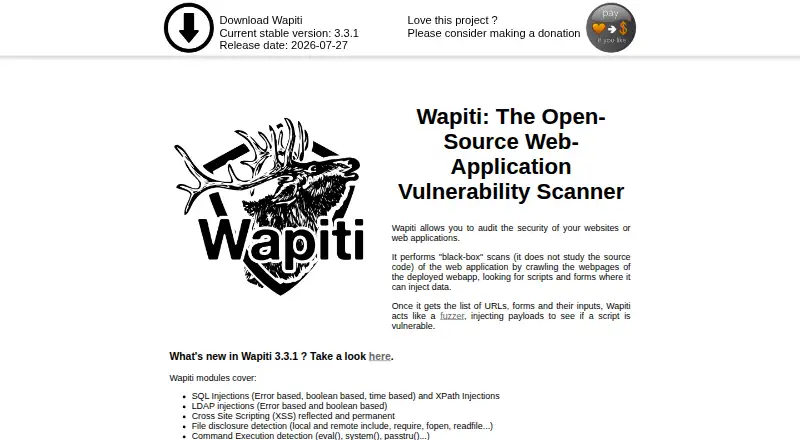
Wapiti is a free Python tool for scanning deployed websites and web applications for vulnerabilities. It crawls an application and sends payloads to links, forms and scripts rather than inspecting source code. Listed checks cover SQL and XPath injection, cross-site scripting, file disclosure, command execution, XXE, SSRF and open redirects. It can scan REST APIs using an OpenAPI (Swagger) file, and supports authenticated scans with Basic, Digest or NTLM credentials, login forms, imported browser cookies, or custom Python code. Users can configure scan scope, crawler limits, HTTP headers and HTTP, HTTPS or SOCKS5 proxies. A scan can be suspended and resumed through a session stored in SQLite. Reports can be generated as HTML, XML, JSON, TXT, CSV or Markdown. Wapiti is released under GNU GPL version 2, and installation is offered through pip. The project lists Python 3.12, 3.13 or 3.14 as requirements and says Windows use can be done through WSL. Its README warns that scans may disrupt a target, cause crashes or lose data, and requires the target owner's consent.
Good
- Free and released under GNU GPL version 2.
- Checks a range of common web vulnerabilities.
- Can scan REST APIs from OpenAPI files.
- Offers six report formats.
Watch out
- Requires Python 3.12, 3.13 or 3.14.
- Windows use is through WSL.
- Assessments may cause disruption or data loss.
- Target-owner consent is required.
Who it suits
Wapiti suits developers and security teams auditing deployed web applications or REST APIs, including authenticated areas. It is for users who can meet its Python requirements and have the target owner's consent.
Verdict
Wapiti offers configurable crawling, authenticated scans and a broad set of report formats at no cost. Its potential impact on targets makes authorization and careful scope essential.
Plans and prices
From Wapiti's own pricing page, checked 3 Oct 2026.
| Plan | Price | What it gives you |
|---|---|---|
| Free and open-source | Free | GNU GPL version 2 |
The facts
Each one read from Wapiti's own pages, with the date it was checked.
What it does
- API scanning
- It can scan REST APIs from an OpenAPI (Swagger) file.checked 3 Oct 2026
- Authentication
- It supports Basic, Digest, and NTLM authentication, login forms, browser cookie imports, and custom Python code for complicated authentication cases.checked 3 Oct 2026
- Installation
- The project homepage offers installation with pip install wapiti3.checked 3 Oct 2026
- Latest listed release
- The project's SourceForge files page lists version 3.3.2 dated 2026-08-19.checked 3 Oct 2026
- License
- The README states that Wapiti is released under the GNU General Public License version 2.checked 3 Oct 2026
- Purpose
- Wapiti is a Python web vulnerability scanner that audits websites and web applications.checked 3 Oct 2026
- Reports
- It generates reports in HTML, XML, JSON, TXT, CSV, and Markdown formats.checked 3 Oct 2026
- Requirements
- The README lists Python 3.12, 3.13, or 3.14 as requirements and says Windows use can be done through WSL.checked 3 Oct 2026
- Safety and limits
- The README warns that assessments may cause target malfunctions, crashes, or data loss, and says users need the target owner's consent.checked 3 Oct 2026
- Scan method
- It crawls deployed web applications and tests links, forms, and scripts with payloads without examining source code.checked 3 Oct 2026
- Scan sessions
- It can suspend and resume scans using sessions stored in SQLite databases.checked 3 Oct 2026
- Support
- The project README directs users to its FAQ and invites bug reports through GitHub issues.checked 3 Oct 2026
- Traffic and scan controls
- It supports HTTP, HTTPS, and SOCKS5 proxies, configurable scan scope, crawler limits, and custom HTTP headers.checked 3 Oct 2026
- Vulnerability coverage
- Its listed checks include SQL and XPath injection, XSS, file disclosure, command execution, XXE, SSRF, and open redirects.checked 3 Oct 2026
The full review of Wapiti
Overview
Wapiti is a Python scanner that crawls deployed websites and web applications, then probes what it finds for vulnerabilities. It suits technically equipped teams that need configurable, authenticated scans without a license fee. Its breadth of controls and report formats is useful, but scanning can disrupt a target, so permission and a carefully limited scope are essential.
Key features
Rather than inspect source code, Wapiti follows links, submits forms and tests scripts with payloads. Its checks cover SQL and XPath injection, cross-site scripting, file disclosure, command execution, XXE, SSRF and open redirects. That deployed-application approach is a practical fit for assessing exposed behavior, but it is not a source-code review.
Authentication options include Basic, Digest and NTLM, login forms, imported browser cookies and custom Python code for more complicated cases. This range makes it usable beyond anonymous public pages, though custom authentication can call for technical effort. For API work, it can scan REST endpoints from an OpenAPI (Swagger) file.
Users can route traffic through HTTP, HTTPS or SOCKS5 proxies, set scan scope and crawler limits, and add custom HTTP headers. Scans can be suspended and resumed through sessions stored in SQLite databases. Reports are available in HTML, XML, JSON, TXT, CSV and Markdown, giving teams several formats for review or further handling.
These controls do not remove the risk of an active assessment: scans may cause malfunctions, crashes or data loss. Obtain the target owner's consent and keep the scope deliberate.
Pricing
| Plan | Price | Best fit |
|---|---|---|
| Free and open-source | free | Teams able to operate an on-premise scanner and manage their own scanning process. |
The plan is released under GNU GPL version 2. There is no paid tier or per-seat or scan quota stated for Wapiti. That makes it a cost-free option, but not a managed service: users need to handle setup, scan configuration, authorization and interpretation themselves.
Platforms
Wapiti is available for API, Linux, macOS, self-hosted and Windows environments, with on-premise deployment. The project lists Python 3.12, 3.13 or 3.14 as requirements; Windows use can be done through WSL. Installation is offered with pip install wapiti3. JavaScript crawling is supported. The README points users to its FAQ and GitHub issues for support.
Who it's for
Wapiti is best for developers and security practitioners who can run Python software, define a safe target scope and want to assess deployed web applications or REST APIs at no license cost. Its authentication support and resumable sessions help when scans need access or take time. It is a poor fit for users seeking a turnkey service, or anyone unable to secure explicit authorization and tolerate the operational risk of active probing.
Pros and cons
- Pros: Broad checks, authenticated scanning and OpenAPI-based REST API scanning cover more than anonymous page crawling alone.
- Pros: Scope controls, crawler limits, proxy support and resumable sessions provide useful control over scan execution.
- Pros: Six report formats and a free GPL-licensed plan avoid licensing cost and accommodate different reporting workflows.
- Cons: Python requirements and on-premise operation put setup and maintenance on the user.
- Cons: Active scans can disrupt systems or lose data, so careless or unauthorized use is not an acceptable shortcut.
- Cons: Wapiti tests deployed behavior rather than source code, so it does not replace source-code analysis.
Alternatives
Web Application Security Scanners is the broader category for comparing tools in this field. Choose Nuclei instead if a free, MIT-licensed standalone CLI is the priority. OWASP ZAP is another free, open-source choice for users who want a project that invites community contributions.
Qualys External Attack Surface Management may suit readers who want to evaluate a freemium product through its 30-day no-cost trial rather than adopt a free plan. Beagle Security offers a free plan with one lite test per month and monthly surface scan reports, while its Essential plan is $99 a month, billed Billed $1188 annual.
ZeroThreat may appeal to those who want to begin with five free scan credits valid for 15 days, then one scan credit per month for one target per account. ImmuniWeb is an alternative for Android and iOS app scanning, with its Neuron Mobile monthly subscription priced at €395 a month per app.
Burp Suite DAST is a paid alternative for buyers seeking a tailored solution with pricing based on portfolio. Pentest-Tools.com API Scanner is another option for API scanning; its NetSec plan starts at $95 a month with five assets, with price varying by asset count and billing cycle.
Verdict
Choose Wapiti if you need a no-cost, configurable scanner for authorized assessments of deployed websites or REST APIs and can manage its Python-based, on-premise operation. Its strongest case is the combination of authentication support, scope controls and broad reports without a license fee. Look elsewhere if you need a managed workflow or source-code analysis, or if the risk of disruption cannot be responsibly controlled.
Getting started
- Open the Wapiti project website.
- Install the tool with `pip install wapiti3`.
- Use Python 3.12, 3.13, or 3.14; Windows use can be done through WSL.
- Configure the target scope, crawler limits, headers, and any needed proxy.
- For authenticated areas, configure a supported authentication method or custom Python code.
- For REST API scanning, provide an OpenAPI (Swagger) file.
- Obtain the target owner's consent before scanning.
Limits worth knowing
The free plan costs nothing and is released under GNU GPL version 2. The listed Python requirements are versions 3.12, 3.13, and 3.14; Windows use can be done through WSL. Scans can cause target malfunctions, crashes, or data loss.
Questions
How much does Wapiti cost?
The listed Free and open-source plan costs nothing.
Is Wapiti open source?
Yes. It is released under GNU GPL version 2.
Which platforms does it support?
Listed platforms are API, Linux, macOS, self-hosted, and Windows. The README says Windows use can be done through WSL.
Can Wapiti scan authenticated applications and REST APIs?
Yes. It supports several authentication methods, including login forms and imported browser cookies, and it can scan REST APIs from an OpenAPI (Swagger) file.
How do I install Wapiti?
The project homepage offers installation with `pip install wapiti3`. Its README lists Python 3.12, 3.13, or 3.14 as requirements.
What should I know before scanning a target?
Assessments may cause malfunctions, crashes, or data loss. The project says users need the target owner's consent.
Alternatives to Wapiti
- 1
OWASP ZAP
Free planOpen sourceAPIExtensionLinuxmacOS7.6Free plan - 2

Beagle Security
Free planWebAPI6.9From $99 a month - 3

ImmuniWeb
AndroidiOSWebAPI6.8From €595 a year - 4

Nuclei
Free planLinuxmacOSSelf-hostedWindows6.8Free plan - 5
ZeroThreat
Free planWebAPI6.7From $100 a month - 6
VAddy
WebAPILinuxmacOS6.6From ¥19,800 a month