OpenWrt
OpenWrt is a Linux operating system for embedded devices, most often wireless routers.
What OpenWrt is
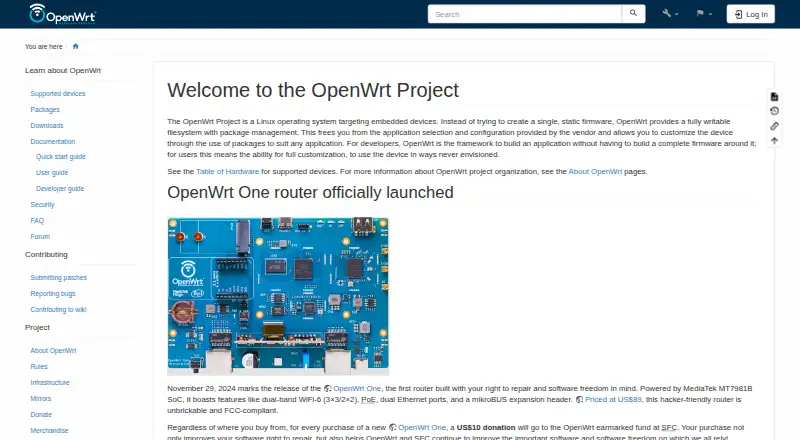
OpenWrt is a Linux operating system for embedded devices, most often wireless routers. Its writable filesystem and optional package management let users customize a device by adding packages. OpenWrt lists more than 27,000 packages and services, and supports configuration through either an SSH command-line interface or a web interface. Before installing, users can consult its Table of Hardware to check device support. Hardware capacity matters: the project identifies 8 MB of flash and 64 MB of RAM as bare minimums, and warns against devices at those limits for current, secure use. The downloads page lists OpenWrt 25.12.5 as the current stable release; development snapshots are generally untested. The older 24.10 release is set to receive limited security and bug fixes for some time. OpenWrt is free, open-source software, with no subscription or licensing fees. The project recommends familiarity with GNU/Linux and basic networking concepts, and notes that voluntary support from developers and users is not guaranteed.
Good
- Writable filesystem supports device customization.
- More than 27,000 packages and services are listed.
- Configuration is available through SSH or a web interface.
- Table of Hardware helps check device support.
Watch out
- GNU/Linux and networking knowledge are recommended.
- 8 MB flash and 64 MB RAM are bare minimums.
- Development snapshots are generally untested.
- Project support is voluntary and not guaranteed.
Who it suits
OpenWrt suits users customizing embedded devices who are comfortable with GNU/Linux and basic networking. Check the hardware support list and device resources before installing.
Verdict
OpenWrt offers broad package-based customization and two configuration interfaces for supported embedded devices. Its hardware requirements and expected Linux and networking knowledge make checking compatibility important before installation.
Plans and prices
From OpenWrt's own pricing page, checked 11 Oct 2026.
| Plan | Price | What it gives you |
|---|---|---|
| OpenWrt | Free | No subscription or licensing fees |
| OpenWrt free software | Free | GPL-licensed · supported hardware required · voluntary community support |
The facts
Each one read from OpenWrt's own pages, with the date it was checked.
What it does
- API and IPC
- The uBus IPC/RPC system lets services publish callable methods for other services or clients.checked 15 Oct 2026
- Build framework
- Its build system cross-compiles the Linux kernel, root filesystem, toolchain and packages for a selected device target.checked 15 Oct 2026
- Build requirements
- The build system needs a case-sensitive GNU/Linux environment, roughly 10–15 GB free disk space and at least 2 GB RAM for typical compilation.checked 15 Oct 2026
- Command line
- Routers can also be administered through SSH and Linux command-line tools.checked 15 Oct 2026
- Configuration interfaces
- Users can configure OpenWrt through a command-line interface over SSH or a web-based user interface.checked 11 Oct 2026
- Current release
- OpenWrt 25.12.5 is the latest stable release listed for the 25.12 series, released in July 2026.checked 15 Oct 2026
- Customizable filesystem
- It provides a fully writable filesystem with optional package management so users can customize devices with packages.checked 11 Oct 2026
- Documentation
- Official documentation is organized into quick-start, user and developer guides plus hardware and technical references.checked 15 Oct 2026
- Extensibility
- Developer feeds can load package recipes from Git, version-control repositories, local filesystems or other supported URLs.checked 15 Oct 2026
- Firmware releases
- The downloads page lists OpenWrt 25.12.5 as the current stable release and describes development snapshots as generally untested.checked 11 Oct 2026
- Google Play availability
- The Akasha Router listing showed 500+ downloads and was updated August 16, 2026; the page did not display a user-rating total.checked 15 Oct 2026
- Google Play companion
- The third-party Akasha Router app supports OpenWrt through JSON-RPC over ubus and advertises telemetry, Wi-Fi control, parental schedules, ad blocking, WireGuard, SQM, port forwarding and Wake-on-LAN.checked 15 Oct 2026
- Hardware limits
- The supported-devices page warns against 8 MB flash and 64 MB RAM devices for up-to-date, secure OpenWrt use, and lists 8 MB flash and 64 MB RAM as bare minimums.checked 11 Oct 2026
- Image customization
- The Image Generator can create device images with chosen packages and preset configuration.checked 15 Oct 2026
- Installation requirement
- Users must verify exact router model and hardware revision in the Table of Hardware before flashing firmware.checked 15 Oct 2026
- Intended users
- OpenWrt says users should know GNU/Linux and basic networking concepts before installing it.checked 11 Oct 2026
- License
- The build environment is generally GPLv2, while bundled third-party components may use their own open-source or public-domain licenses.checked 15 Oct 2026
- Limit: administration burden
- An independent 2026 review found custom-image testing does not prove firmware safety and recommends verifying the exact device revision before flashing.checked 15 Oct 2026
- Limit: hardware compatibility
- ComputerBase warns that support can differ between hardware revisions sharing the same router model name.checked 15 Oct 2026
- Limit: warranty
- ComputerBase says installing OpenWrt generally voids the router manufacturer's warranty.checked 15 Oct 2026
The company
- Company database profile
- Crunchbase lists OpenWrt as an active private organization with 11–50 employees and identifies OpenWrt and its build framework as products.checked 15 Oct 2026
- Company profile
- LinkedIn classifies OpenWrt as a nonprofit software-development organization founded in 2003 with 11–50 employees.checked 15 Oct 2026
- Founded
- 2004checked 28 Sep 2026
Where it runs
- Device support
- OpenWrt provides a Table of Hardware to check whether a device is supported.checked 11 Oct 2026
The full review of OpenWrt
OpenWrt is a Linux operating system for embedded hardware, most commonly wireless routers, built for owners who want control beyond a vendor firmware. It is best suited to technically confident users comfortable with Linux and networking, while anyone installing it should verify hardware support first. The trade-off is substantial flexibility at no software cost, balanced by device constraints and volunteer-only support.
Overview
OpenWrt replaces a fixed embedded-device environment with a configurable Linux system. Its fully writable filesystem lets users alter the system rather than being limited to the manufacturer’s predefined options, and optional package management extends that system as requirements change. This is a strong fit for custom router and embedded deployments, but it is a poor match for people who want a sealed appliance with guaranteed assistance.
The project dates to 2004 and describes itself as free software. Its build environment is generally released under GPL version 2 unless an exception applies. That licensing keeps the software cost at zero and supports modification, while putting the burden of selecting, installing and maintaining a suitable build on the device owner.
Key features
Writable system and package catalog
OpenWrt’s writable filesystem and optional package management provide practical room to tailor a supported device. The project says its catalog contains more than 27,000 packages and services, giving experienced administrators a broad base for adding functions without replacing the operating system. The same openness can make setup and upkeep demanding for users without command-line and networking experience.
Two configuration paths
Administration is available through a command-line interface over SSH or a web-based user interface. SSH favors precise, scriptable control for Linux users; the web interface offers a more visual route for routine configuration. Having both is useful when a deployment needs automation as well as browser-based administration, but neither removes the need to understand networking fundamentals.
Compatibility and release guidance
The project’s Table of Hardware is the essential first stop for checking whether a particular device is supported. OpenWrt lists 8 MB of flash and 64 MB of RAM as bare minimums, yet warns against using devices with those specifications for an up-to-date, secure installation. The current stable download is OpenWrt 25.12.5; development snapshots are generally untested. The older 24.10 line continues to receive limited security and bug fixes for some time, so choosing a current stable build is the sensible path for a new deployment.
Pricing
| Plan | Price | What it includes |
|---|---|---|
| OpenWrt | free | No subscription or licensing fees |
OpenWrt is free and open source, with no trial or paid tier to outgrow. That makes it practical for personal routers, labs and embedded projects where software licensing must remain at zero. The cost is instead operational: hardware must be compatible, and project support may be offered voluntarily by developers and users but is not guaranteed.
Platforms
OpenWrt targets Linux and self-hosted deployments. It is designed for embedded devices rather than as a general desktop operating system, and it supports site-to-site VPN use. Deployment is classified as hybrid, so the surrounding hardware and network design still determine how it fits into an installation.
Who it's for
Choose OpenWrt if you manage a supported router or embedded device and want package-based customization, SSH access and a web interface in the same system. It is particularly appropriate for Linux users who understand basic networking and are willing to check hardware tables and memory limits before installation. It is less suitable for newcomers seeking guaranteed support, or for owners of devices at the project’s minimum specifications who need current security updates.
Pros and cons
Pros
- Deep customization: A writable filesystem and more than 27,000 packages allow supported hardware to be shaped around specialized requirements.
- Flexible administration: SSH and a web interface cover both command-line workflows and browser-based management.
- No software fees: The OpenWrt plan costs nothing with no subscription or licensing charges.
- Compatibility reference: The Table of Hardware gives prospective installers a concrete way to check device support.
Cons
- Technical entry bar: The project expects GNU/Linux and basic networking knowledge, so installation and package choices are not beginner-focused.
- Hardware sensitivity: Devices with 8 MB flash and 64 MB RAM are bare minimums and are discouraged for current, secure use.
- Support is not guaranteed: Help may come from volunteers rather than a committed support service.
- Development builds carry risk: Snapshots are generally untested, making them unsuitable when predictable behavior matters.
Alternatives
For a broader survey, see IoT Operating Systems, Network Firewall Software, Operating Systems and Business VPN Software.
- Apache Mynewt is a free, Apache License 2.0 embedded OS and development-tools stack for Linux, macOS, Windows and self-hosting; choose it when those development targets matter more than router-focused OpenWrt deployment.
- Contiki-NG is a free, 3-clause BSD-licensed open-source operating system for Linux, macOS, Windows and self-hosting, suited to a different embedded-OS workflow.
- FreeRTOS is a free MIT-licensed kernel and libraries for Linux and Windows, with commercial licenses and safety certification available through a strategic partner.
- Particle Device OS offers a forever-free tier for 100 devices and 100K Data Operations per month, with a Basic plan at $299 a month per 100-device block and 720K Data Operations; choose it when managed device operations and quotas are preferable.
- Apache NuttX is free and open-source, self-hosted, and includes source artifacts for the OS and integrated apps.
- PX5 RTOS offers paid licensing from 5000.00 USD once for perpetual source-code licensing with no royalties and professional support, plus a free trial.
- Micrium OS is a free option for Linux, macOS and Windows.
- QNX Neutrino RTOS is a paid, self-hosted commercial platform with a free trial and runtime licensing options priced through QNX sales.
Verdict
OpenWrt is the right choice for technically capable owners of supported embedded hardware who want an unusually customizable, package-rich Linux environment without licensing fees. Its main reason to choose it is control through a writable system, extensive packages and dual administration interfaces.
Alternatives to OpenWrt
- 1

OPNsense
Free planOpen sourceAndroidiOSWebAPI8.6Free plan - 2
Kali Linux
Free planOpen sourceAndroidLinuxmacOSSelf-hosted7.6Free plan - 3
Apache NuttX
Free planOpen sourceAPILinuxmacOSSelf-hosted7.3Free plan - 4
AlmaLinux OS
Free planOpen sourceAPILinuxSelf-hostedWindows7.1Free plan - 5
pfSense
Free planWebLinuxSelf-hosted7.0Free plan - 6
Manjaro Linux
Free planOpen sourceLinuxSelf-hosted6.9Free plan