Apache Mynewt
Apache Mynewt is a real-time operating system and development toolkit for embedded systems, aimed at embedded and higher-level application developers.
What Apache Mynewt is
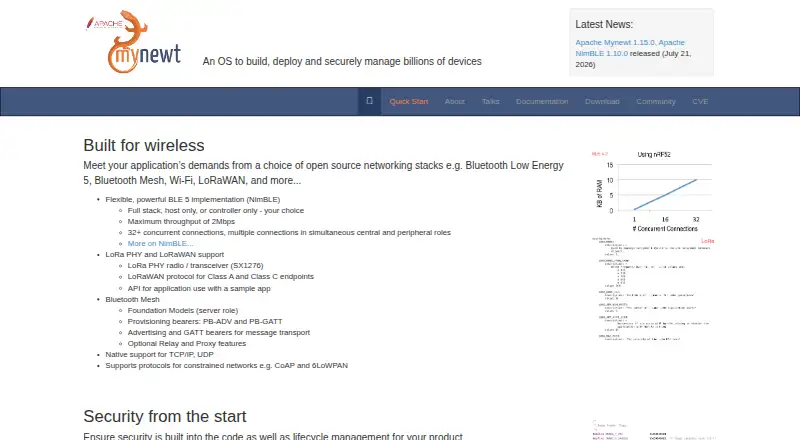
Apache Mynewt is a real-time operating system and development toolkit for embedded systems, aimed at embedded and higher-level application developers. It is designed for Cortex-M0–M4, MIPS, and RISC-V microcontrollers, with a hardware abstraction layer and board support packages. Wireless and networking options include BLE 5, Bluetooth Mesh, LoRaWAN, TCP/IP, UDP, CoAP, and 6LoWPAN. NimBLE can be configured as a full stack, host only, or controller only; the project lists throughput up to 2 Mbps and more than 32 concurrent connections. Mynewt also provides remote firmware image management, logging, component and network statistics, and a sensor framework. It describes automatic device discovery and management using OIC 1.1. The Newt tool combines source package management with building, debugging, and installing applications. Security features include device identity, secure boot, authenticated and encrypted communications, and secure over-the-air updates. The software is free under Apache License 2.0. Newt installation instructions cover macOS, Linux, and Windows, although simulator support is limited on Windows and newer macOS versions.
Good
- Free under Apache License 2.0.
- Supports multiple wireless and network stacks.
- Newt provides build, debug, and install tooling.
- Includes secure over-the-air updates.
- Targets Cortex-M0–M4, MIPS, and RISC-V.
Watch out
- Simulator has documented limits on Windows.
- Simulator limits also apply to newer macOS versions.
Who it suits
Mynewt suits embedded developers building applications for supported microcontrollers and needing an operating system with networking, device management, and security features. It is intended for constrained embedded uses ranging from doorbells to medical devices and power grids.
Verdict
Apache Mynewt combines an embedded OS, networking options, and development tools for constrained devices. Check simulator limitations for your platform before choosing a development workflow.
Plans and prices
From Apache Mynewt's own pricing page, checked 4 Oct 2026.
| Plan | Price | What it gives you |
|---|---|---|
| Apache Mynewt | Free | Open source embedded OS and development tools · Apache License 2.0 |
The facts
Each one read from Apache Mynewt's own pages, with the date it was checked.
What it does
- Build tooling
- Newt combines source package management with building, debugging, and installing embedded applications.checked 4 Oct 2026
- Downloads
- The download page lists Apache Mynewt Core 1.15.0 and Apache NimBLE 1.10.0, both released July 21, 2026.checked 4 Oct 2026
- Hardware support
- Mynewt is designed for Cortex-M0–M4, MIPS, and RISC-V microcontrollers, with a hardware abstraction layer and board support packages.checked 4 Oct 2026
- Intended use
- The project describes Mynewt as suitable for constrained embedded applications ranging from doorbells to medical devices and power grids.checked 4 Oct 2026
- License
- Apache Mynewt is available under the Apache License, version 2.0.checked 4 Oct 2026
- NimBLE
- The NimBLE implementation supports full-stack, host-only, or controller-only configurations, up to 2 Mbps throughput, and 32+ concurrent connections.checked 4 Oct 2026
- Purpose
- Mynewt OS is a real-time operating system for embedded systems, aimed at embedded and higher-level application developers.checked 4 Oct 2026
- Security
- Security features described by the project include device identity, secure boot, authenticated and encrypted communications, and secure over-the-air updates.checked 4 Oct 2026
- Support
- The project directs users and contributors to the dev mailing list for questions, discussion, and help.checked 4 Oct 2026
- Wireless stacks
- The project offers BLE 5, Bluetooth Mesh, LoRaWAN, TCP/IP, UDP, CoAP, and 6LoWPAN support.checked 4 Oct 2026
Where it runs
- Developer platforms
- Newt installation instructions are provided for macOS, Linux, and Windows; the simulator runs natively on Linux, FreeBSD, and older macOS versions, with documented simulator limits on Windows and newer macOS.checked 4 Oct 2026
- Device discovery
- The project describes auto-discovery and management using OIC 1.1, the IoT platform standard from the Open Connectivity Foundation.checked 4 Oct 2026
- Device operations
- Mynewt includes image management for remote firmware updates, logging, component and network statistics, and a sensor framework.checked 4 Oct 2026
The full review of Apache Mynewt
Apache Mynewt is an embedded real-time operating system with networking stacks and firmware development tools for microcontroller-based devices. It is best suited to developers targeting its supported processor families who need connected-device features in an open-source package. The combination is broad; board fit and simulator support deserve early attention.
Overview
Mynewt combines its operating system with Newt, a tool for managing source packages and building, debugging, and installing embedded applications. That gives firmware teams a single project for core development tasks as well as device operations. The project is licensed under Apache License 2.0.
Its intended applications span small connected products through infrastructure and medical devices. Mynewt is designed for Cortex-M0–M4, MIPS, and RISC-V microcontrollers, with a hardware abstraction layer and board support packages. Developers outside those target families should check hardware compatibility before committing to it.
Key features
Networking and Bluetooth
Mynewt supports BLE 5, Bluetooth Mesh, LoRaWAN, TCP/IP, UDP, CoAP, and 6LoWPAN. That protocol range gives teams room to choose connectivity suited to different device designs. NimBLE can be configured as a full stack, host only, or controller only, with throughput up to 2 Mbps and support for more than 32 concurrent connections. Those options are useful when a project needs flexibility in how Bluetooth is integrated.
Device operations and discovery
Image management supports remote firmware updates, while logging, component and network statistics, and a sensor framework address ongoing device operation. Mynewt also describes automatic discovery and management through OIC 1.1, the Open Connectivity Foundation's IoT platform standard. Together, these functions make the project relevant beyond the initial firmware build, particularly for connected devices that need updating and monitoring.
Security and development tools
Security features include device identity, secure boot, authenticated and encrypted communications, and secure over-the-air updates. Newt brings package management together with building, debugging, and installation. This is a substantial toolkit for embedded application developers, though the value depends on a project's hardware and workflow fitting the platform.
Pricing
Apache Mynewt is free: the Apache Mynewt plan costs nothing and includes the open-source embedded OS and development tools under Apache License 2.0. There is no free trial because the project is free to use. No paid plan is described.
Platforms
Newt installation instructions cover Linux, macOS, and Windows. The simulator runs natively on Linux, FreeBSD, and older macOS versions; Windows and newer macOS have documented simulator limits. That distinction matters: developers can install the tools on those desktop platforms, but simulator-based workflows may be constrained on Windows or current macOS. Mynewt's device deployment focus is edge computing, and its supported device OS is Apache Mynewt.
Who it's for
Mynewt suits embedded and higher-level application developers building resource-constrained connected devices, especially when they need several networking choices, firmware update support, and device-operation tools in one project. Its listed processor families make it a more natural fit for teams working with Cortex-M0–M4, MIPS, or RISC-V microcontrollers. The development tools are aimed at both application and embedded work, while questions and contributor discussion go through the dev mailing list.
It is a weaker fit when a project depends on a target outside those processor families or on an unconstrained native simulator workflow on Windows or newer macOS. In those cases, hardware and development setup can outweigh the breadth of included protocols.
Pros and cons
- Pros: Broad wireless and network protocol support, including BLE 5, LoRaWAN, and 6LoWPAN, helps accommodate different connected-device designs.
- Pros: NimBLE's full-stack, host-only, and controller-only configurations give teams control over how Bluetooth is integrated.
- Pros: Firmware image management, logging, statistics, and security features cover important device lifecycle needs alongside development tools.
- Cons: Hardware focus on Cortex-M0–M4, MIPS, and RISC-V narrows the fit; board compatibility should be established up front.
- Cons: Simulator support is limited on Windows and newer macOS, which can restrict development workflows on those systems.
Alternatives
Compare IoT operating systems if you want to survey the category. Contiki-NG is another free, open-source operating system, with a 3-clause BSD license. FreeRTOS is a free option for Linux and Windows; its kernel and libraries use the MIT license, with commercial licenses and safety certification available through a strategic partner.
Particle Device OS may suit teams seeking a hosted-device plan: its free tier is capped at 100 devices and 100K Data Operations per month, while Basic starts at $299 a month and scales in blocks of 100 devices. OpenWrt is a free option for Linux and self-hosted environments with no subscription or licensing fees. Apache NuttX is another free and open-source OS with source artifacts for the OS and integrated apps.
PX5 RTOS is a paid alternative with one-time device or product licensing starting at 5000.00 USD, including perpetual licensing, full source code, and no royalties. Micrium OS is another free option for Linux, macOS, and Windows. QNX Neutrino RTOS is a paid option with runtime licensing through QNX sales.
Verdict
Choose Apache Mynewt if you are building a connected, resource-constrained device on a supported microcontroller family and want networking, firmware operations, security features, and development tools in a free Apache-licensed project. Its breadth is the main reason to choose it. Look elsewhere if your processor or desktop simulator workflow falls outside its practical support.
Getting started
- Visit the Apache Mynewt website.
- Install Newt using the instructions for Linux, macOS, or Windows.
- Use Newt to manage source packages and build, debug, and install embedded applications.
- Check the simulator platform notes if planning to use its simulator.
Questions
How much does Apache Mynewt cost?
The listed plan is free at no cost. The project describes it as open source.
What license does Mynewt use?
Apache Mynewt is available under the Apache License, version 2.0.
Which platforms have Newt installation instructions?
The project provides installation instructions for Linux, macOS, and Windows.
Where does the simulator run natively?
The simulator runs natively on Linux, FreeBSD, and older macOS versions. The project documents limits on Windows and newer macOS.
What hardware is Mynewt designed for?
It is designed for Cortex-M0–M4, MIPS, and RISC-V microcontrollers, with a hardware abstraction layer and board support packages.
Alternatives to Apache Mynewt
- 1
OpenWrt
Free planOpen sourceAndroidWebAPILinux7.8Free plan - 2
Apache NuttX
Free planOpen sourceAPILinuxmacOSSelf-hosted7.3Free plan - 3
Contiki-NG
Free planLinuxmacOSSelf-hostedWindows6.1Free plan - 4
Particle Device OS
Free planWeb6.1From $299 a month - 5
FreeRTOS
Free planLinuxWindows6.0Free plan - 65.9From $5,000 a year