OpenVox SMS Gateway
- Android app
- Not listed
- Free plan
- Yes
- Runs on
- api, Linux, self-hosted, Web
Summary
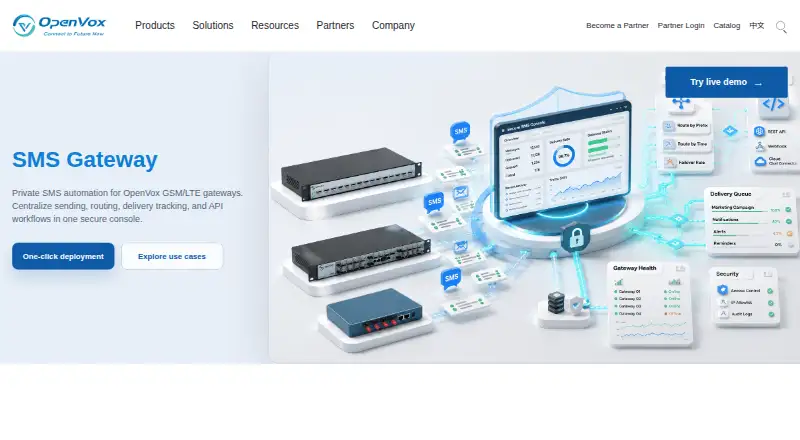
OpenVox SMS Gateway is a private SMS automation product for OpenVox GSM/LTE gateways. Its console brings together gateway management, sending, routing, delivery tracking and API workflows, with views of device status, ports and SIM resources. Incoming texts can be routed by sender, keyword, gateway, SIM port, priority or business workflow. The service can also send SMS from email and forward received messages to email. Automation rules match message details such as content, sender, device and port, then pass messages to email, SMS, webhooks or API consumers. REST API, OpenAPI documentation and webhooks support connections to CRM, ERP, monitoring and custom systems. Deployment can be private and Docker-based; Docker Compose runs the frontend and backend services, while SQLite is created and migrated automatically. The default external web port is 4674. Listed Linux support includes Debian, Ubuntu, several RHEL-family systems, CentOS Stream, Fedora and Alpine. Controls include role-based access, group visibility, LDAP or SAML authentication, encrypted saved credentials and audit logs. The free version is listed at 0.00 USD per free. Capacity depends on connected gateways, active SIM ports, carrier policies and message mix.
Who it is for
OpenVox SMS Gateway suits teams using OpenVox GSM/LTE gateways for NOC or IoT alerts, OTP notifications, shared support inboxes, field operations or SMS governance. It is designed for private deployment and integration with business systems.
What is good
- Manages gateway status, ports and SIM resources.
- Routes inbound SMS using multiple conditions.
- Supports email, REST API and webhooks.
- Includes roles, authentication options and audit logs.
What to know first
- Capacity depends on gateways, active SIM ports and carriers.
- Private Docker deployment requires supported Linux systems.
- The listed free version is described as essential features.
Everything Xiaomi review
OpenVox SMS Gateway: the full review
OpenVox SMS Gateway centralizes SMS routing and automation for OpenVox gateways, with API connections and private Docker deployment. Capacity varies with gateway, SIM, carrier and message conditions.
OpenVox SMS Gateway is a private SMS automation console for OpenVox GSM/LTE gateways. It suits teams routing alerts, OTPs or customer messages through their own gateway hardware. Its combination of SIM-aware routing, API workflows and Docker deployment is compelling for OpenVox operators, but it is not a hardware-independent SMS service.
Overview
The product brings gateway status, ports and SIM resources into one console, then connects them to rules for sending, routing and delivery tracking. In practice, that makes it a fit for organizations that already operate OpenVox gateways and want a centrally governed messaging workflow rather than a separate inbox for each device.
Inbound messages can be directed by sender, keyword, gateway, SIM port, priority or business workflow. The email bridge also sends SMS from email and forwards received SMS to email, useful for teams that need messaging in existing operational routines. Capacity depends on connected gateways, active SIM ports, carrier policies and message mix, so the software alone does not determine throughput.
Key features
Routing and automation
Rules can match sender, message content, regular expressions, device, port and priority, then forward messages to email, SMS, webhooks or API consumers. Balanced SIM routing applies monthly usage limits, removes saturated SIMs from selection and respects each user's allowed-port permissions. Those controls help distribute traffic and enforce access boundaries, though the actual capacity remains tied to the gateway and carrier environment.
Integration and governance
REST API access, OpenAPI documentation and webhooks connect the gateway to CRM, ERP, monitoring and custom systems. Role-based access, group visibility, LDAP or SAML authentication, encrypted saved credentials and audit logs make it better suited to shared operational use than an unmanaged device setup. Two-way messaging, inbound SMS, delivery reports, contact management and API access are included in the free version.
Private deployment
OpenVox supports private Docker deployment through a one-command installer. Docker Compose runs the frontend and backend, SQLite is created and migrated automatically, and the default external web port is 4674. This keeps deployment within an organization's environment, but it also means the organization needs to run and maintain that environment.
Pricing
OpenVox offers a free plan, the Free SMS Gateway version, at 0.00 USD per free. It includes essential starting features alongside two-way messaging, delivery reports, inbound SMS, contact management and API access. That makes it suitable for evaluating the workflow or running modest deployments; no paid tier or expanded quota is given.
There is no published paid-plan structure to compare. The free plan's value therefore depends on whether its essential feature set and the capacity of the connected gateway, SIMs and carrier meet the workload. It is not a per-message cloud service with a stated universal sending allowance.
Platforms
OpenVox supports API, Linux, self-hosted and web use. Validated Linux systems include Debian 11–13, Ubuntu 22.04+, RHEL/Rocky/AlmaLinux/Oracle Linux 8–10, CentOS Stream 9–10, Fedora 43–44 and Alpine Linux 3.21+. The broad Linux coverage is useful for teams with existing infrastructure, while private Docker deployment makes this less suited to users seeking an app-only, hosted setup.
Who it's for
The product is aimed at NOC and IoT alerting, fintech and SaaS OTP notifications, support shared inboxes, field operations and enterprise SMS governance. It is strongest where a team already has OpenVox GSM/LTE gateways and needs controlled routing, integrations and shared access. Readers without that gateway setup, or who want messaging capacity detached from local hardware and SIMs, should consider other SMS platforms.
Pros and cons
Pros
- Detailed SIM-aware routing: Monthly usage limits, saturation avoidance and allowed-port permissions make it possible to govern how traffic is distributed across SIM resources.
- Useful integration paths: REST API, OpenAPI documentation and webhooks support connections to business and monitoring systems.
- Private deployment with access controls: Docker deployment, role-based access, directory authentication options and audit logs suit teams with governance requirements.
- Free core capabilities: Inbound SMS, delivery reports, two-way messaging and API access are available in the free version.
Cons
- OpenVox gateway dependency: Its purpose is specifically to automate OpenVox GSM/LTE gateways, limiting its appeal to teams without that hardware.
- Capacity is environment-dependent: Gateway count, active SIM ports, carrier policies and message mix all affect throughput, so buyers cannot judge capacity from the software plan alone.
- Self-hosting carries operational work: Private Docker deployment offers control, but teams must provide and maintain the Linux environment.
Alternatives
Browse the SMS Gateway Software category to compare more options. Telerivet is worth considering for Android, API and web deployments; its free plan caps usage at 50 messages per day, 50 stored contacts and two automated services. Ozeki SMS Gateway suits buyers who want a paid, cross-platform gateway with a free trial; its listed 5 MPM plan costs 1490.00 EUR per once and supports one service-provider connection and 10 users.
SMSBOX is an alternative for API, web and Windows use, with eight one-off test credits for sending to a verified number and no free plan. NowSMS is another paid option, with web, Windows, macOS, Linux and Android platforms. Clickatell SMS API is a better fit for API-based enterprise messaging when pay-as-you-go outgoing SMS is preferred; message prices vary by destination and type.
Diafaan SMS Server is worth a look for a self-hosted Windows-oriented setup with Android and API support; its Light edition is a 195.00 USD per once permanent licence for one gateway, one connector and a single-user web application. Android SMS Gateway fits Android-based deployments, with a free plan capped at one device, 300 lifetime SMS and 300 contacts. Jasmin SMS Gateway is another free option for Linux users.
Verdict
Choose OpenVox SMS Gateway if your team already runs OpenVox GSM/LTE hardware and needs private, governed SMS routing with API and webhook connections. Its free core features and SIM-aware automation make it a practical control layer for operational messaging. Look elsewhere if you need a gateway-independent service or predictable capacity without managing hardware, SIMs and a self-hosted deployment.
OpenVox SMS Gateway plans and pricing
All plansCompared on SMS gateway software
- Free plan
- Yesopenvox.cn
- Two-way messaging
- Yesopenvox.cn
- Delivery reports
- Yesopenvox.cn
- Inbound SMS
- Yesopenvox.cn
- Contact management
- Yesopenvox.cn
- API access
- Yesopenvox.cn
Facts
- Purpose
- SMS Gateway provides private SMS automation for OpenVox GSM/LTE gateways, centralizing sending, routing, delivery tracking, and API workflows.openvox.cn · 30 Sept 2026
- Gateway management
- The console manages OpenVox gateways, device status, ports, and SIM resources.openvox.cn · 30 Sept 2026
- Routing
- Inbound SMS can be routed by sender, keyword, gateway, SIM port, priority, and business workflow.openvox.cn · 30 Sept 2026
- Email bridge
- The product sends SMS from email and forwards received SMS to email.openvox.cn · 30 Sept 2026
- Integrations
- REST API, OpenAPI documentation, and webhooks integrate CRM, ERP, monitoring, and custom systems.openvox.cn · 30 Sept 2026
- Access security
- Security controls include role-based access, group visibility, LDAP or SAML authentication, encrypted saved credentials, and audit logs.openvox.cn · 30 Sept 2026
- Deployment
- The product supports private Docker deployment with a one-command installer.openvox.cn · 30 Sept 2026
- Linux support
- Validated systems include Debian 11–13, Ubuntu 22.04+, RHEL/Rocky/AlmaLinux/Oracle Linux 8–10, CentOS Stream 9–10, Fedora 43–44, and Alpine Linux 3.21+.openvox.cn · 30 Sept 2026
- Runtime
- Docker Compose runs frontend and backend services, SQLite is created and migrated automatically, and the default external web port is 4674.openvox.cn · 30 Sept 2026
- SIM limits
- Balanced SIM auto-routing uses monthly usage limits, excludes saturated SIMs, and respects each user’s allowed-port permissions.openvox.cn · 30 Sept 2026
- Automation
- Rules can match sender, content, regular expressions, device, port, and priority, then forward messages to email, SMS, webhooks, or API consumers.openvox.cn · 30 Sept 2026
- Target users
- Use cases include NOC and IoT alerting, fintech and SaaS OTP notifications, customer support shared inboxes, field operations, and enterprise SMS governance.openvox.cn · 30 Sept 2026
- Support
- OpenVox’s Service Hub provides firmware, datasheets, FAQs, tutorial videos, and application notes.openvox.cn · 30 Sept 2026
- Compliance
- OpenVox states that its manufacturing includes EU RoHS compliance, CE certification, FCC certification, and additional country-specific certifications.openvox.cn · 30 Sept 2026
- Capacity limitation
- Capacity depends on connected OpenVox gateways, active SIM ports, carrier policies, and message mix.openvox.cn · 30 Sept 2026
Company
- Founded
- 2002openvox.cn · 28 Sept 2026
- Headquarters
- Shenzhen, Chinaopenvox.cn · 28 Sept 2026
Best OpenVox SMS Gateway alternatives
See all 20



Where it ranks on Everything Xiaomi
Is OpenVox SMS Gateway yours?
Claim it for free: prove the domain, then correct facts, plans and screenshots. An editor reviews every change.
Sources
- openvox.cn/solutions/sms-gateway/· checked 30 Sept 2026
- openvox.cn/company/about/· checked 30 Sept 2026